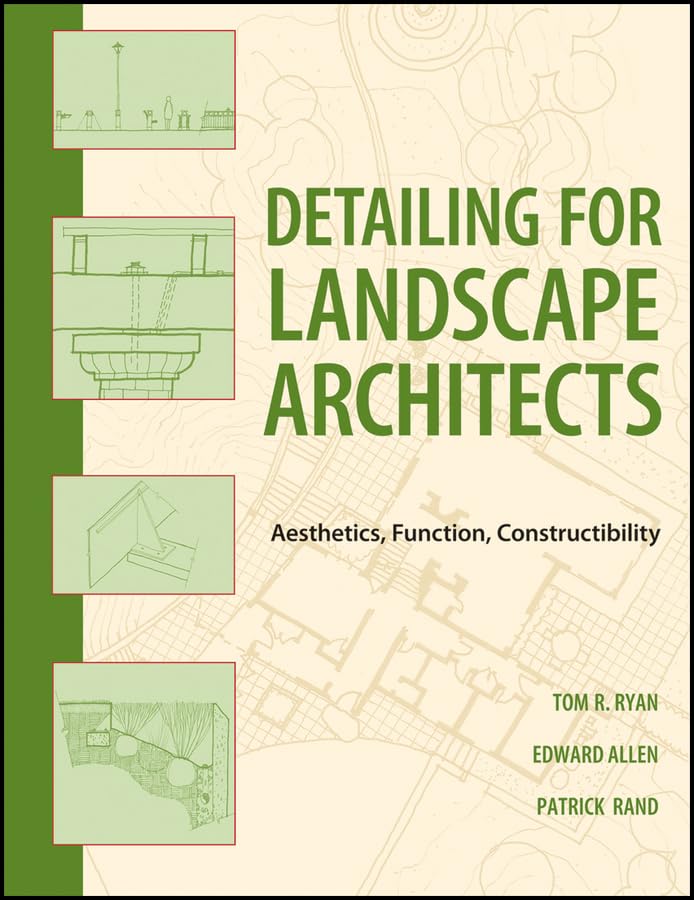

Detailing for landscape architects aesthetics, function, constructibility Tom Ryan, Edward Allen, and Patrick Rand ; drawings by Edward Allen ... [et al.].
Idioma: Español Detalles de publicación: Hoboken, N.J. Wiley c2011.Descripción: xiii, 258 p. ill. 28 cmISBN:- 9780470548783 (pbk.)
- 712/.3 22
- SB472 .R93 2011
| Imagen de cubierta | Tipo de ítem | Biblioteca actual | Biblioteca de origen | Colección | Ubicación en estantería | Signatura topográfica | Materiales especificados | Info Vol | URL | Copia número | Estado | Notas | Fecha de vencimiento | Código de barras | Reserva de ítems | Prioridad de la cola de reserva de ejemplar | Reservas para cursos | |
|---|---|---|---|---|---|---|---|---|---|---|---|---|---|---|---|---|---|---|
| Libro | CARIBET Biblioteca Arquitectura Colección General CARIBET | SB472 .R93 2011 (Navegar estantería(Abre debajo)) | Disponible | 91000000028811 |
Descripciones mejoradas de Syndetics:
Based upon the best-selling book Architectural Detailing by Edward Allen and Patrick Rand, Landscape Architectural Detailing applies the same organization to the three major concerns of the landscape architecture detailer--function, constructability, and aesthetics. Richly illustrated, this book approaches landscape architecture detailing in a systematic manner and provides a framework for analyzing existing details and devising new ones. Landscape Architectural Detailing includes material on details related to aesthetics, water drainage and movement, structures, construction assemblies, sustainable resources, and more.
Includes index.
Tabla de contenidos provista por Syndetics
- Introduction
- Part I Detail Pattern
- Section 1 Aesthetics
- Chapter 1 Aesthetics
- Contributive Details
- Timeless Features
- Hierarchy of Refinement
- Intensification and Ornamentation
- Active and Recessive Details
- Continuous and Discontinuous Details
- Formal Transitions
- Composing the Detail
- Section 2 Function
- Chapter 2 Controlling Water Movement
- Drainage Diversions
- Redundant Drainage Systems
- Foundation Drainage
- Wash
- Overlap
- Overhang and Drip
- Drain and Weep
- Roof Drainage
- Capillary Break
- Joints and Gaskets
- Chapter 3 Controlling Subsurface Water Movement and Sedimentation
- Control Velocity
- Sumps
- Progressive Filtering
- Separation
- Reinforcement
- Level Drainage Surfaces
- Water Level Reduction
- Overflow
- Structural Tree Planting Soils
- Chapter 4 Accommodating Movement
- Seasoning and Curing
- Vertical-Grain Lumber
- Relieved Back
- Foundation Below Frost Line
- Edge Restraint
- Staggered Joints
- Structural Joints
- Abutment Joint
- Expansion Joint
- Control Joint
- Sliding Joint
- Hinge Joint
- Building Separation Joint
- Chapter 5 Accommodating Growth
- Root Zone Growth
- Trunk Growth
- Branch Growth
- Succession
- Maintenance Practices
- Chapter 6 Providing Structural Support
- Small Structures
- Chapter 7 Providing Passages for Pipes and Wires
- Vertical Chase
- Horizontal Connections
- Chapter 8 Health and Safety
- Safe Footing
- Fall Protection
- Safe Edges
- Safe Glazing
- Appropriate for Users
- Nontoxic Materials
- Site Specific Hazards
- Barrier-Free Design
- Chapter 9 Providing for the Life Cycles of the Landscape
- Seasonal Cycle
- Planting Life Cycle
- Material Life Cycle
- Expected Life
- Surfaces That Age Gracefully
- Repairable Surfaces
- Cleanable Surfaces
- Maintenance Access
- Dry Wood
- Similar Metals
- Less Absorbent Materials
- Robust Assemblies
- Building and Landscape Armor
- Section 3 Constructability
- Chapter 10 Ease of Assembly
- Uncut Units
- Minimum Number of Parts
- Parts That Are Easy to Handle
- Repetitious Assembly
- Simulated Assemblies
- Observable Assemblies
- Accessible Connections
- Installation Clearance
- Nonconflicting Systems
- Chapter 11 Forgiving Details
- Dimensional Tolerance
- Sliding Fit
- Adjustable Fit
- Reveal
- Butt Joint
- Clean Edge
- Progressive Finish
- Forgiving Surface
- Chapter 12 Efficient Use of Construction Resources
- Factory and Site
- Rehearsing the Construction Sequence
- Off-the-Shelf Parts
- Local Skills and Customs
- Refining the Detail
- All-Weather Construction
- Pride of Craftsmanship
- Accepted Standards
- Chapter 13 Sustainability
- Minimize Site Impacts
- Maximize Site Benefits
- Moderate Peaks
- Efficiency
- Part II Detail Development
- Section 1 Applying The Detail Patterns
- Chapter 14 Detailing a Traditional Plaza
- Chapter 15 Detailing a Rooftop Garden
- Section 2 Getting Started
- Appendix A The Detailer's Reference Shelf
- Appendix B Formulating Exercises for Self-Study or Classroom Use
- Index
Notas de autor provistas por Syndetics
Tom R. Ryan, FASLA , is Principal of Ryan Associates, Landscape Architecture and Planning. He has more than thirty years of experience as a practicing landscape architect, and has taught in the landscape architecture departments at the University of Pennsylvania, SUNY College of Environmental Science and Forestry, and Harvard University Graduate School of Design.Edward Allen, FAIA , has been a member of the faculties at Yale University and the Massachusetts Institute of Technology, and has frequently taught as a guest at other institutions across the United States over the past thirty years. He is also the best-selling coauthor of Fundamentals of Building Construction and The Architect's Studio Companion (both with Joseph Iano), Form and Forces (with Waclaw Zalewski), and Architectural Detailing (with Patrick Rand), all published by Wiley.
Patrick Rand, FAIA , is a Professor in the School of Architecture at North Carolina State University, where he teaches design studios, construction systems courses, and detailing seminars. He is coauthor of Architectural Detailing along with Edward Allen.