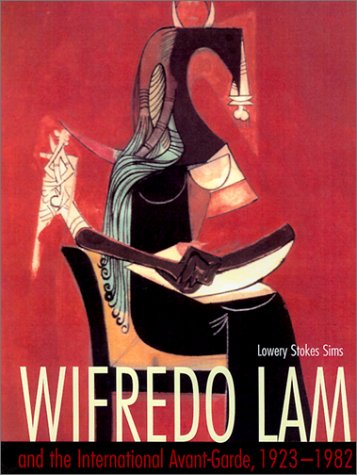

Wifredo Lam and the international avant-garde, 1923-1982 Lowery Stokes Sims.
Detalles de publicación: Austin, Tex. University of Texas Press 2002.Edición: 1st edDescripción: xiii, 281 p. ill. 28 cmISBN:- 0292777507 (cloth : alk. paper)
- 759.97291 L213s 21
- ND305.L3 S56 2002
| Imagen de cubierta | Tipo de ítem | Biblioteca actual | Biblioteca de origen | Colección | Ubicación en estantería | Signatura topográfica | Materiales especificados | Info Vol | URL | Copia número | Estado | Notas | Fecha de vencimiento | Código de barras | Reserva de ítems | Prioridad de la cola de reserva de ejemplar | Reservas para cursos | |
|---|---|---|---|---|---|---|---|---|---|---|---|---|---|---|---|---|---|---|
| Libro | Biblioteca Encarnación Valdés Colección General bev | 759.97291 L213s (Navegar estantería(Abre debajo)) | Disponible | 80000002461963 |
Descripciones mejoradas de Syndetics:
With its signature style that marries Cubism and Surrealism with Afro-Cuban and Caribbean motifs, the art of Wifredo Lam occupies a unique position in the history of modern art. Like many modern artists, specifically Pablo Picasso, Lam participated in the primitivist movement, drawing inspiration and imagery from non-western, pre-technological cultures. Yet, unlike European and Euroamerican primitivists, Lam, who was a Cuban of Spanish, African, and Chinese descent, was engaging with his own cultural heritage in his works. His authenticity as both "primitive" and "primitivist" challenges the fundamental tenets of primitivism and makes Lam an ambiguous, fascinating figure in twentieth-century art. This wide-ranging study explores Lam's enduring contribution to world art history--the reclamation and projection of an African identity within mainstream art. Lowery Stokes Sims surveys Lam's work, focusing on the period from 1947 onwards, in which he demonstrated the viability of nationalist pursuits within modernism to a new generation of artists. She traces his career and life and the critical reception of his work in Cuba and Latin America, the United States, and Europe as each locale predominated in his career. This masterly assessment of Lam's later work demonstrates the evolution of primitivist concepts in modern art from the specifically ethnographic to the more psychic and existential. What emerges from Lam's story is the fate of Surrealism in the postwar era as it permutated into international artistic movements such as the CoBrA, the Group Phases, and the International Situationists.
Includes bibliographical references (p. 243-267) and index.
Tabla de contenidos provista por Syndetics
- Acknowledgments
- Introduction
- 1 The "Primitive" within "Primitivism": Lam's Encounter with the School of Paris
- 2 Mediating the Sacred and the Profane: Lam's Cuban Work in the 1940s
- 3 Myth and Totemism: Lam and the New York School, 1942-1952
- 4 Surrealism after World War II: Lam in Europe, 1947-1960
- 5 "Lo Maravilloso" and the Antillean Ethos: Lam in Cuba and Latin America, 1946-1960
- 6 The Demise of Surrealism: Lam and the U.S. Art Scene, 1950-1980
- 7 The Artist in the Revolution: Lam in Cuba, 1960-1982
- 8 A Shaman for Modern Times: Lam in Europe, 1960-1982
- 9 New Means and New Media: Lam's Late Work, 1970-1982
- 10 The "Deft Juggler of Cultural Modes": Lam in the Postmodern Context
- 11 Toward a New Art History: Lam Scholarship in the Twenty-first Century
- Notes
- Selected Bibliography
- Index