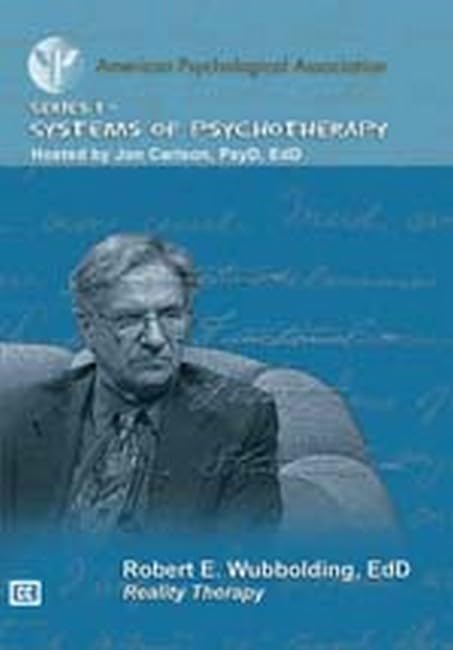

Reality therapy Robert E. Wubbolding.
Series Theories of psychotherapy seriesDetalles de publicación: Washington, DC : American Psychological Association, c2011.Edición: 1st edDescripción: xiii, 162 p. ill. 23 cmISBN:- 9781433808531
- 1433808536
- 616.89165 W9598r 22
- RC489.R37 W826 2011
| Imagen de cubierta | Tipo de ítem | Biblioteca actual | Biblioteca de origen | Colección | Ubicación en estantería | Signatura topográfica | Materiales especificados | Info Vol | URL | Copia número | Estado | Notas | Fecha de vencimiento | Código de barras | Reserva de ítems | Prioridad de la cola de reserva de ejemplar | Reservas para cursos | |
|---|---|---|---|---|---|---|---|---|---|---|---|---|---|---|---|---|---|---|
| Libro | Biblioteca Encarnación Valdés Colección General bev | 616.89165 W9598r (Navegar estantería(Abre debajo)) | Disponible | 80000002657156 | ||||||||||||||
| Libro | Biblioteca Encarnación Valdés Colección General bev | 616.89165 W9598r (Navegar estantería(Abre debajo)) | Lost and Paid For | 80000002461732 |
Descripciones mejoradas de Syndetics:
In Reality Therapy , Robert E. Wubbolding explores the history, theory, research, and practice of this choice-focused approach to psychotherapy.
William Glasser first developed the ideas behind reality therapy in the 1950s and 1960s when he formulated the basis of choice theory, which concerns the way human beings choose their own behavior and how these choices can either satisfy or not satisfy basic drives and goals. Using this theoretical basis, reality therapy helps clients to learn to be more aware of their choices and how these choices may be inefficient in achieving their goals. Framing behavior as a choice, a choice made by client's internal control, leads clients to feel more responsible and in command of their lives. Reality therapy is structured around the WDEP system (wants, doing, evaluation, and planning): The reality therapist works with clients to explore their wants and what they are doing to achieve those wants, evaluating whether what they are doing is helpful or harmful to their goals, and finally helping the client plan ways to change their behavior.
In this book, Wubbolding presents and explores this approach, its theory, history, therapy process, primary change mechanisms, the empirical basis for its effectiveness, and contemporary and future developments. This essential primer, amply illustrated with case examples featuring diverse clients, is perfect for graduate students studying theories of therapy and counseling, as well as for seasoned practitioners interested in understanding how this approach has evolved and how it might be used in their practice.
Includes bibliographical references (p. 141-149) and index.
Introduction -- History -- Choice theory -- The therapy process -- Evaluation -- Future developments.