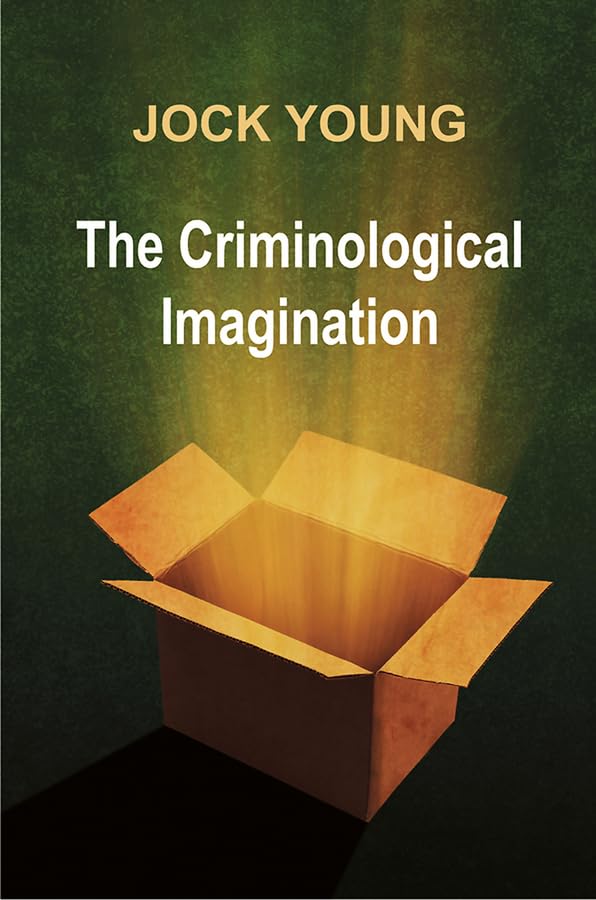

The criminological imagination Jock Young.
Detalles de publicación: Cambridge Malden, MA Polity 2011.Descripción: xi, 252 p. 23 cmISBN:- 9780745641065 (hbk.)
- 0745641067 (hbk.)
- 9780745641072 (pbk.)
- 0745641075 (pbk.)
- 364 22
- HV6025 .Y693 2011
| Imagen de cubierta | Tipo de ítem | Biblioteca actual | Biblioteca de origen | Colección | Ubicación en estantería | Signatura topográfica | Materiales especificados | Info Vol | URL | Copia número | Estado | Notas | Fecha de vencimiento | Código de barras | Reserva de ítems | Prioridad de la cola de reserva de ejemplar | Reservas para cursos | |
|---|---|---|---|---|---|---|---|---|---|---|---|---|---|---|---|---|---|---|
| Libro | Biblioteca de Mayagüez Colección General mb | HV6025 .Y693 2011 (Navegar estantería(Abre debajo)) | Disponible | 50000003230330 |
Descripciones mejoradas de Syndetics:
For the last three decades Jock Young's work has had a profound impact on criminology. In this provocative new book, Young rejects much of what criminology has become, criticizing the rigid determinism and rampant positivism that dominate the discipline today. His erudite and entertaining examination of what's gone wrong with criminology draws on a range of research - from urban ethnography to sexology and criminal victimization studies - to illustrate its failings.
Young makes a passionate case for a return to criminology's creative and critical potential, partly informed by the new developments in cultural criminology. A late-modern counterpart to C. Wright Mills' classic The Sociological Imagination , this inspirational piece of writing from one of the most brilliant voices in contemporary criminology will command widespread attention. The concluding part of the author's trilogy of influential texts including The Vertigo of Late Modernity and The Exclusive Society , it will be essential reading for anyone who cares about the future of criminology, and the social sciences more generally.
Includes bibliographical references (p. [226]-246) and index.
Closing down the imagination -- Measurement and the sexologists -- Amnesia and the art of skating on thin ice -- The bogus of positivism -- Loosening the Moorings: the emergence of cultural criminology -- Giuliani and the New York miracle -- Mayhem, Magic and Magaret Mead: towards a critical ethnography -- Subcultures as Magic: problems of urban ethnography -- Dangerous knowledge and the politics of imagination -- Rescuing the imagination.
Tabla de contenidos provista por Syndetics
- Preface(p. vii)
- Acknowledgements(p. x)
- Introduction: The Legacy of C. Wright Mills(p. 1)
- 1 Closing Down the Imagination(p. 10)
- 2 Measurement and the Sexologists(p. 24)
- 3 Amnesia and the Art of Skating on Thin Ice(p. 39)
- 4 The Bogus of Positivism(p. 62)
- 5 Loosening the Moorings: The Emergence of Cultural Criminology(p. 83)
- 6 Giuliani and the New York Miracle(p. 111)
- 7 Mayhem, Magic and Margaret Mead: Towards a Critical Ethnography(p. 131)
- 8 Subcultures as Magic: Problems of Urban Ethnography(p. 151)
- 9 Dangerous Knowledge and the Politics of the Imagination(p. 174)
- 10 Rescuing the Imagination(p. 219)
- References(p. 226)
- Index(p. 247)