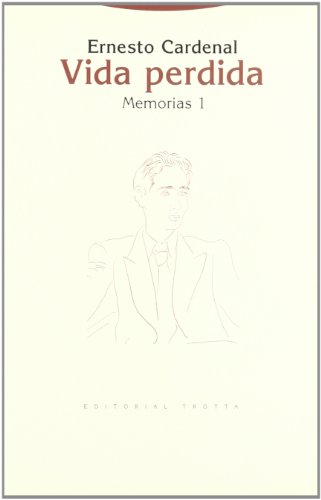

Vida perdida Ernesto Cardenal.
Series La Dicha de enmudecer | Memorias ; 1Detalles de publicación: Madrid Editorial Trotta c2005.Descripción: 446 p. ill. 23 cmISBN:- 8481647489
- 861/.64 B 22
- PQ7519.C34 Z46 2005 vol. 1
| Imagen de cubierta | Tipo de ítem | Biblioteca actual | Biblioteca de origen | Colección | Ubicación en estantería | Signatura topográfica | Materiales especificados | Info Vol | URL | Copia número | Estado | Notas | Fecha de vencimiento | Código de barras | Reserva de ítems | Prioridad de la cola de reserva de ejemplar | Reservas para cursos | |
|---|---|---|---|---|---|---|---|---|---|---|---|---|---|---|---|---|---|---|
| Libro | Biblioteca Encarnación Valdés Colección General bev | N861C266yca 2005 (Navegar estantería(Abre debajo)) | Disponible | 80000002447152 |
Includes index.
Notas de autor provistas por Syndetics
An ordained priest who lives in Solentiname, a community that he founded, and a member of the Nicaraguan cabinet, Ernesto Cardenal is Latin America's best known exponent of what might be called the literature of the theology of liberation. His poetry is the expression of tension between his faith and a strongly rooted sense of reality and the need for drastic change.Influenced heavily by Thomas Merton, by his residence in the Trappist community of Gethsemane, Kentucky, by English and American poetry, Christianity, and the fact of social injustice, Cardenal consciously writes antirhetorical and often didactic poetry. Frequently, he uses other sources: newspapers, Native American texts, and so on, just as the masses at Solentiname use nontraditional sources as subjects for discussion. Zero Hour (1980) details the existence of tyranny in America; the Psalms (1981) are a rewriting of the biblical Psalms of David for a modern world. The Gospel in Solentiname (1982) is a collection of dialogues or commentaries on the Gospels.
Cardenal served as minister of culture in the government organized after the 1979 ouster of Anastasio Somoza in Nicaragua.
Ernesto Cardenal died on March 1, 2020 at the age of 95.
(Bowker Author Biography)