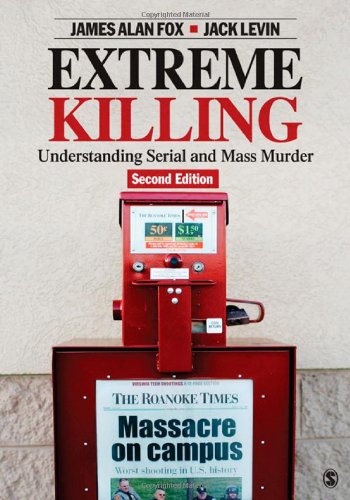

Extreme killing understanding serial and mass murder James Alan Fox and Jack Levin.
Detalles de publicación: Thousand Oaks Sage Publications c2011.Edición: 2 nd edDescripción: xiv,262 p. ill. 24 cmISBN:- 9781412980319
- 364.152/3/0973 22
- HV6529 .F685 2011
| Imagen de cubierta | Tipo de ítem | Biblioteca actual | Biblioteca de origen | Colección | Ubicación en estantería | Signatura topográfica | Materiales especificados | Info Vol | URL | Copia número | Estado | Notas | Fecha de vencimiento | Código de barras | Reserva de ítems | Prioridad de la cola de reserva de ejemplar | Reservas para cursos | |
|---|---|---|---|---|---|---|---|---|---|---|---|---|---|---|---|---|---|---|
| Libro | Biblioteca de Mayagüez Colección General mb | HV6529 .F685 2011 (Navegar estantería(Abre debajo)) | Disponible | 50000003210571 |
Descripciones mejoradas de Syndetics:
This comprehensive overview of serial and multiple murders looks at the theories for the criminal behavior and applies them to a multitude of well-known and little-known cases worldwide, examining similarities and differences. Jamie Fox and Jack Levin are renowned experts and authors in the field and they bring their years of research to bear in this fascinating analysis of serial, multiple and mass murder. The second edition is updated with more recent theory and cases.
Features of the 2nd edition:
1. Updated throughout with new cases like the BTK Killer, Virginia Tech shootings, Ft. Hood mass murder.
2. Expanded coverage of theory
3. Stronger research focus
4. Expanded illustration program with better use of photos, charts and graphs
eigm 01/2012
Includes bibliographical references and index.
Tabla de contenidos provista por Syndetics
- Preface(p. xi)
- Acknowledgments(p. xiv)
- Part I Multiple Murder(p. 1)
- 1 America's Fascination With Multiple Homicide(p. 2)
- The Gein Legacy(p. 3)
- Multiple Murder in Popular Culture(p. 4)
- The Selling of Multiple Murder(p. 6)
- Craving Attention(p. 7)
- Killer Communication(p. 8)
- Killer Groupies(p. 14)
- The Impact of Celebrating Murderers(p. 15)
- Sensitize, Not Sanitize(p. 16)
- 2 Defining Multiple Murder(p. 17)
- Mass, Serial, and Spree(p. 19)
- A Typology of Multiple Murder(p. 21)
- Power(p. 23)
- Revenge(p. 24)
- Loyalty(p. 25)
- Profit(p. 26)
- Terror(p. 26)
- Part II Serial Murder(p. 27)
- 3 An Anatomy of Serial Murder(p. 28)
- Prevalence of Serial Murder(p. 30)
- Extraordinarily Ordinary(p. 33)
- A Profile of the Typical Serial Killer(p. 34)
- 4 With Deliberation and Purpose(p. 40)
- When Killing Is Thrilling(p. 41)
- On a Deadly Mission of Terror or Revenge(p. 45)
- Killing for Expediency(p. 47)
- For Love and Loyalty(p. 49)
- 5 Murder Without Guilt(p. 51)
- Self-Control and Social Control(p. 52)
- The Sociopathic Personality(p. 53)
- The Culture of Sociopathy(p. 55)
- Empathy and Serial Killers(p. 57)
- Borderline Personality Disorder(p. 59)
- Normalcy in Serial Murder(p. 59)
- Rehumanizing the Victims(p. 63)
- 6 Partners in Murder(p. 66)
- Insanity in the Relationship(p. 67)
- Partners for Profit(p. 68)
- Partnerships of Men and Women(p. 70)
- 7 Killing for Company(p. 75)
- Placing the Blame(p. 76)
- Killing for Companionship(p. 78)
- The Functions of Cannibalism(p. 78)
- Desire for Total Control and Ownership(p. 79)
- 8 Fantasyland(p. 81)
- Keeping Souvenirs(p. 82)
- Normal and Abnormal Fantasies(p. 83)
- The Impact of Pornography(p. 84)
- 9 The Making of a Serial Killer(p. 88)
- Childhood Suffering(p. 89)
- Testimony Under Hypnosis(p. 91)
- Child Abuse and Murder(p. 92)
- Inordinate Need for Power(p. 94)
- Animal Cruelty and Violence Against Humans(p. 95)
- Challenges of Predicting Serial Murder(p. 97)
- Biological Predisposition(p. 98)
- Blaming the Family(p. 101)
- 10 Nonsexual Control(p. 103)
- Power Over Patients(p. 104)
- Female Serial Killers(p. 106)
- Munchausen Syndrome by Proxy(p. 107)
- 11 Killing Cults(p. 111)
- Killing for a Cause(p. 112)
- The Appeal of Dangerous Cults(p. 114)
- Suicide or Homicide?(p. 114)
- Satanism and Serial Murder(p. 117)
- 12 So Many Victims(p. 121)
- Vulnerable Victims Preferred(p. 122)
- Catching the Serial Killer(p. 126)
- Behavioral Profiling(p. 128)
- Reducing Linkage Blindness(p. 130)
- Lucky Breaks(p. 131)
- Part III Massacres(p. 133)
- 13 For Love, Money, or Revenge(p. 134)
- Relative Obscurity(p. 134)
- A Profile of Mass Killers(p. 136)
- Selective and Methodical(p. 142)
- When Love Kills(p. 142)
- Sweet Revenge(p. 145)
- Profiting From Mass Murder(p. 146)
- Explaining Mass Murder(p. 147)
- The Great Equalizer(p. 152)
- Contributing Factors(p. 156)
- 14 Family Annihilation(p. 157)
- A Profile of the Family Annihilator(p. 161)
- Impact of Unemployment(p. 163)
- Murdering Moms(p. 164)
- The Defiant Son(p. 166)
- 15 Firing Back(p. 169)
- Profile of the Workplace Avenger(p. 170)
- The Impact of Frustration(p. 172)
- Mixed Motives(p. 175)
- Workplace Murder by Proxy(p. 176)
- Romantic Obsession(p. 177)
- Externalizing Responsibility(p. 178)
- Social Isolation(p. 180)
- Screening Out Problem Workers(p. 181)
- Going Postal(p. 182)
- 16 Schooled in Mass Murder(p. 186)
- Student Massacres(p. 189)
- On to College(p. 193)
- Shooting for Infamy(p. 196)
- Overstating the Copycat Effect(p. 198)
- 17 Fighting City Hall(p. 199)
- Attacking the System(p. 200)
- Legal Battles(p. 200)
- Filing a Grievance(p. 201)
- Increasing Alienation(p. 204)
- 18 Hate-Motivated Mass Murder(p. 206)
- Choice of Victims(p. 207)
- A Life of Frustration(p. 208)
- Blaming Women(p. 209)
- The Killer as Victim(p. 212)
- Settling a Grudge With a Gun(p. 214)
- Minority Against Majority(p. 216)
- 19 Going Berserk(p. 219)
- Paranoid Thinking(p. 220)
- Confused State of Mind(p. 222)
- Long-Standing Mental Illness(p. 223)
- Civilian Battlefields(p. 225)
- Brain Abnormalities(p. 228)
- Deadly Weapons(p. 229)
- Part IV Epilogue(p. 232)
- 20 Remembering the Victims(p. 233)
- References(p. 240)
- Credits and Sources(p. 248)
- Index(p. 250)
- About the Authors(p. 262)
Notas de autor provistas por Syndetics
James Alan Fox is the Lipman Family Professor of Criminology, Law, and Public Policy at Northeastern University. He has published 18 books, dozens of journal and magazine articles, as well as hundreds of freelance columns in newspapers around the country, primarily in the areas of multiple murder, youth crime, school and campus violence, workplace violence, and capital punishment. As a member of its Board of Contributors, his opinion column appears frequently in USAToday . Fox led the investigation of Seattle's Capitol Hill mass shooting and was part of the task force investigating the serial murder of college students in Gainesville, Florida. He also served on President Clinton's advisory committee on school shootings, and a Department of Education Expert Panel on Safe, Disciplined and Drug-Free Schools. In addition, he has been retained as an expert witness/consultant in several mass shooting cases, including the recent massacres at the First Baptist Church of Sutherland Springs, Texas, and the Marjory Stoneman Douglas High School in Parkland, Florida. Fox is one of the principals in maintaining the Associated Press/USA Today/Northeastern University Mass Killing Database. Finally, he has received several awards and honors for his work, including the Hugo Adam Bedau Award for excellence in capital punishment scholarship.
Jack Levin is the Brudnick Professor Emeritus in the Department of Sociology at Northeastern University, where he codirects its Center on Violence and Conflict. He has authored or coauthored more than 30 books, most recently The Violence of Hate: Understanding Harmful Forms of Bias and Bigotry and The Allure of Premeditated Murder: Why Some People Plan to Kill . Levin has also published more than 250 articles and columns in professional journals, books, magazines, and newspapers, such as The New York Times, The Boston Globe, The Dallas Morning News, The Philadelphia Inquirer, The Christian Science Monitor, The Chicago Tribune, The Washington Post, and USA Today. Levin was honored by the Massachusetts Council for Advancement and Support of Education as its "Professor of the Year" and by the American Sociological Association for his contributions to the public understanding of sociology. He has also received awards from the Eastern Sociological Society, New England Sociological Association, Association of Clinical and Applied Sociology, and Society for the Study of Social Problems. Moreover, he has spoken to a wide variety of community, academic, and professional groups, including the White House Conference on Hate Crimes, the Department of Justice, OSCE's Office for Democratic Institutions and Human Rights (a membership of 59 countries), and the International Association of Chiefs of Police.