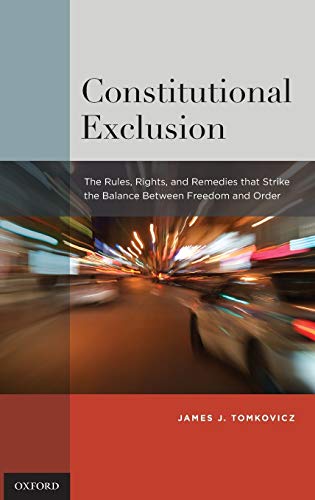

Constitutional exclusion the rules, rights, and remedies that strike the balance between freedom and order James J. Tomkovicz.
Detalles de publicación: Oxford New York Oxford University Press c2011.Descripción: xviii, 430 p. 25 cmISBN:- 9780195369243 (hbk. : alk. paper)
- 0195369246 (hbk. : alk. paper)
- 347.73/5 22
- KF 4765 .T66 2011
| Imagen de cubierta | Tipo de ítem | Biblioteca actual | Biblioteca de origen | Colección | Ubicación en estantería | Signatura topográfica | Materiales especificados | Info Vol | URL | Copia número | Estado | Notas | Fecha de vencimiento | Código de barras | Reserva de ítems | Prioridad de la cola de reserva de ejemplar | Reservas para cursos | |
|---|---|---|---|---|---|---|---|---|---|---|---|---|---|---|---|---|---|---|
| Libro | Biblioteca de Derecho Mons. Fremiot Torres Oliver Colección General biblioteca derecho | KF 4765 .T66 2011 (Navegar estantería(Abre debajo)) | Disponible | 70000000892355 |
Descripciones mejoradas de Syndetics:
Supreme Court interpretations of the Bill of Rights have produced seven constitutional "exclusionary rules." These rules prevent prosecutors from introducing evidence of guilt in criminal trials, making it harder to convict offenders and enabling some criminals to avoid conviction and punishment. The importance of these evidentiary bars cannot be understated. They reflect inevitable tensions between liberty and security.Constitutional Exclusion, by James J. Tomkovicz contains in-depth analyses of each constitutional doctrine that dictates the suppression of evidence. The text begins with an extensive treatment of the Fourth Amendment exclusionary rule which bars evidence acquired by means of unreasonable searches or seizures. It then addresses three distinct doctrines that suppress confessions - the due process and privilege against compelled self-incrimination bar to coerced confessions, Miranda v. Arizona's Fifth Amendment prophylactic presumption that certain confessions are inadmissible, and the Massiah doctrine's Sixth Amendment right to counsel bar to incriminating admissions. Next, the book explains two prohibitions on eyewitness identification evidence, one rooted in the Sixth Amendment right to counsel and another grounded in the due process guarantee. Finally, the text explores the exclusion of hearsay commanded by the Sixth Amendment Confrontation Clause.Constitutional Exclusion analyzes the histories of, justifications for, and the legitimacy of these exclusion doctrines. By juxtaposing the rules and highlighting their distinctive characters, the book sheds new light on topics of vital importance to the administration of criminal justice.
Includes bibliographical references and index.
The fourth amendment exclusionary rule -- Fifth and fourteenth amendment exclusion of confessions -- The Miranda exclusionary rule -- The Massiah doctrine : sixth amendment exclusion of confessions -- Sixth amendment exclusion of eyewitness identifications -- Due process exclusion of eyewitness identifications -- Confrontation clause exclusion of hearsay.
Tabla de contenidos provista por Syndetics
- Preface
- Introduction
- 1 The Fourth Amendment Exclusionary Rule
- 2 Fifth and Fourteenth Amendment Exclusion of Confessions
- 3 The Miranda Exclusionary Rule
- 4 The Massiah Doctrine: Sixth Amendment Exclusion of Confessions
- 5 Sixth Amendment Exclusion of Eyewitness Identifications
- 6 Due Process Exclusion of Eyewitness Identifications
- 7 Confrontation Clause Exclusion of Hearsay
- Conclusion
- Index