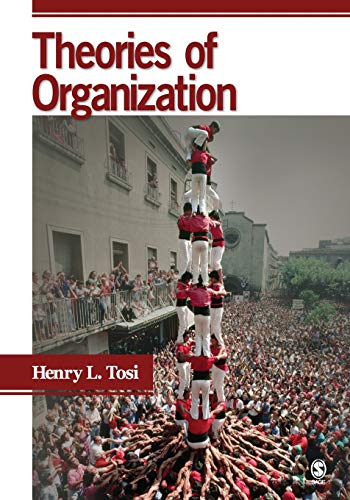

Theories of organization [compiled by] Henry L. Tosi.
Detalles de publicación: Los Angeles SAGE c2009.Descripción: 329 p. ill. 25 cmISBN:- 9781412924993 (pbk. : acid-free paper)
- 302.35 T3964 2009 22
- HD31 .T486 2009
| Imagen de cubierta | Tipo de ítem | Biblioteca actual | Biblioteca de origen | Colección | Ubicación en estantería | Signatura topográfica | Materiales especificados | Info Vol | URL | Copia número | Estado | Notas | Fecha de vencimiento | Código de barras | Reserva de ítems | Prioridad de la cola de reserva de ejemplar | Reservas para cursos | |
|---|---|---|---|---|---|---|---|---|---|---|---|---|---|---|---|---|---|---|
| Libro | Biblioteca Encarnación Valdés Colección General bev | 302.35 T3964 2009 (Navegar estantería(Abre debajo)) | Disponible | 80000002441429 |
Descripciones mejoradas de Syndetics:
Henry L. Tosi′s Theories of Organization offers a unique treatment of a broad range of important theoretical approaches to the study of organizations, including a thorough overview of classical theory, institutional theory, population ecology, critical organization theory, and postmodern approaches. Tosi also provides a helpful summary of the work of Chester Barnard, the contributions of James March and Herbert Simon, and economic approaches to organization. Rather than focusing on specific topics, such as authority, goals, and organizational structure, this unique treatment of organizational theory provides comprehensive coverage of the important variables and relationships in each of a broad range of theories, thus providing the reader with a thorough understanding of each of the theoretical models included. Key Features:
Includes excerpts from seminal works and summaries of key theoretical models that form the basis of the field of organization theory Features a logical organization, with each of the main sections serving as a summary or abstract of a theoretical framework--including variables and propositions--thus allowing the reader to see the entire theoretical framework and all of its attendant interrelationships Provides concepts and methodology that have been class-tested successfully over many years Helps readers understand each of the theoretical models included by explaining the variables constituting each theoretical network in a clear, straightforward writing styleIntended Audience: This book is useful as a supplemental text in advanced undergraduate or graduate courses in Organizational Theory.
Includes bibliographical references (p. 283-304) and index.
Tabla de contenidos provista por Syndetics
- Part I Overture
- Chapter 1 -About Theories of Organization
- Chapter 2 - Assumptions About the Nature of Social Science and Society
- Part II Closed System Rational Models
- Chapter 3 - The Classical Approach: The Fundamentals of Top Management
- Part III Closed System Natural Models
- Chapter 4 The Functions of the Executive
- Part IV Integrative Approaches to Organization
- Chapter 5 - Organizations Power and Compliance: Amatai Etzioni's A Comparative Analysis of Complex Organizations
- Chapter 6 James D. Thompson's Organizations in Action
- Part V Open System Rational Models
- Bounded Rationality
- Chapter 7 - James March and Herbert Simon, Organizations
- Contingency Theories
- Chapter 8 Burns and Stalker, The Management of Innovation
- Chapter 9 Woodward's Industrial Organization
- Chapter 10 Organization Analysis: A Sociological Point of View
- Chapter 11 Henry Mintzberg, The Structuring of Organizations
- Economic Approaches
- Chapter 12 Agency Theory: an Assessment and Overview
- Chapter 13 Theory of Managerial Capitalism
- Chapter 14 The Markets and Hierarchies Program of Research: Origins, Implications, Prospects
- Part VI Open System Natural Models
- Chapter 15 Selznick's TVA and the Grass Roots
- Chapter 16 The Population Ecology of Organizations
- Chapter 17 The Adolescence of Institutional Theory
- Part VII Critical Theory and Post Modernism
- Chapter 18 Critical Organizational Theory
- Chapter 19 -Past Postmodernism? Reflections and Tentative Directions
Notas de autor provistas por Syndetics
Henry Tosi is currently the McGriff Professor of Management Emeritus at the University of Florida. He received his Ph.D. from the Ohio State University in 1964. Before coming to Gainesville, he was on the faculty at Michigan State University and the University of Maryland. He has been a visiting faculty member at the University of California-Irvine, Emory University, Cornell University in the United States. He also has held visiting appointments at Luigi Bocconi University (Milan, Italy), LUISS (Rome, Italy), the University of Catania in Sicily, and the University of Modena (Modena, Italy). He has been the President of the Midwest Division of the Academy of Management, a founding member of the Organizational Behavior Division and the Research Methods Division of the Academy of Management, as well as serving on the Board of Governors. In addition, he has served on the editorial review boards of Administrative Science Quarterly , Journal of Business Research, and The Academy of Management Review . Along with Bernard Bass and Robert House, he is a founding editor of The Leadership Quarterly . His research has covered a range of diverse topics. His work on Management by Objectives was among the first serious research studies on the role of goals and goal setting in organizations. His most recent work has been on CEO compensation issues and organizational control. His scholarly papers have appeared in The Academy of Management Journal , The Academy of Management Review , Administrative Science Quarterly , Personnel Psychology , The Journal of Applied Psychology , The Journal of Business , Human Relations , Business Horizons , and The California Management Review .