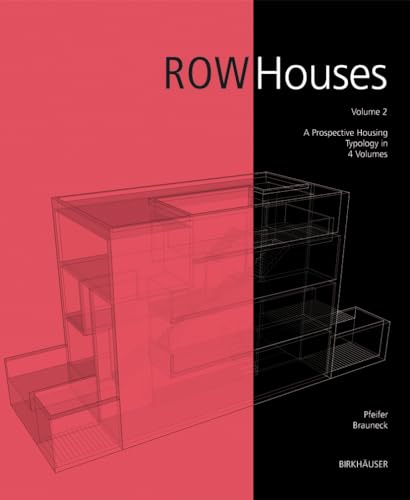

Row houses : a housing typology. / Günter Pfeifer and Per Brauneck ; [translation from German into English, Usch Engelmann]. txt
Idioma: Inglés Lenguaje original: Alemán Basel : Birkhäuser , 2008Descripción: 112 p. ill.; plans.; 28 cmTipo de contenido:- text
- unmediaded
- volume
- 9783764378387
- 3764378387
- 23 728.312
- NA7520 P49 2008
| Imagen de cubierta | Tipo de ítem | Biblioteca actual | Biblioteca de origen | Colección | Ubicación en estantería | Signatura topográfica | Materiales especificados | Info Vol | URL | Copia número | Estado | Notas | Fecha de vencimiento | Código de barras | Reserva de ítems | Prioridad de la cola de reserva de ejemplar | Reservas para cursos | |
|---|---|---|---|---|---|---|---|---|---|---|---|---|---|---|---|---|---|---|
| Libro | CARIBET Biblioteca Arquitectura Colección General CARIBET | General NA7520 P49 2008 (Navegar estantería(Abre debajo)) | 1 | Disponible | 91000000023085 |
Descripciones mejoradas de Syndetics:
To continue developing existing building types in an intelligent way is a crucial task in the field of residential building. A deeper understanding of the underlying types is indispensable for the success of the individual design, as well as for ensuring that tried and tested structures can be utilized, repeated, and varied in a wide variety of situations.
For this typology of residential buildings, the authors have developed systematic new presentations of the most innovative types. Each individual volume lays out the possibilities for using and transforming a particular form of residential structure.
The first volume deals with the various types of the courtyard house, which utilizes the courtyard as an intimate outdoor living space. A presentation of the courtyard as a building block of the city is followed by coverage of the complete spectrum of types - cluster, network, carpet, terraces, etc.
The second volume is devoted to the various types of row house, a particularly widespread form of residential structure. A general discussion of the row as organizing principle - the row as urban building block, linear space, ways of handling corners - is followed by the systematic presentation of the different types.
Within each type, variants are distinguished according to how they organize space, their number of floors, etc. The range of possible solutions is presented in uniform ground plans newly drawn to scale.
Include Bibliography
Cybernetics: Integration of type and topos --
The principle of repetition --
Floor plan types --
Without staircase --
Group of houses / Roland Schweitzer --
Student project / Katja Fischer --
Longitudinal staircase : Group of houses "Falkenweg" / Johannes Kaufmann --
Solar houses / Harry Ludszuweit --
Group of houses "Sackpfeife" / Walter Stamm-Teske --
Thomas de Beer houses / Neutelings Riedijk --
Ecumenical residential house / Günter Pfeifer --
Group of houses "Serrewoningen " / Bedaux de Brouwer --
Residential area " Pilotengasse" / Herzog & de Meuron --
Student project / Leon Schmidt --
Student project / Simon Gallner --
Student project / Markus Guennigmann --
Group of houses "Voltstraat" / Rijnvos Voorwinde --
Group of houses "Jagdgasse" / Holzbox ZT --
Group of houses / Bedaux de Brouwer --
Group of houses "Quartier Mc Nair" / d-company --
Project "Wachsendes Haus" / schneider+schumacher --
Group of houses / baumschlager & eberle --
Group of houses "De Landtong" / Frits van Dongen --
28 apartments / Bosch Haslett --
"Scheepstimmermanstraat" house / MVRDV --
Transversal staircase --
Project "Karower Damm" / Rolf Mühlethaler --
Residential park at Betzenberg / AV 1 --
Drive-in row houses / Geurst & Schulze --
Longitudinal split-level --
Residential park at Kirchhölzle / Günter Pfeifer --
Group of houses "Nofels" / baumschlager & eberle --
LBS "System houses" project / Günter Pfeifer --
Student project / Sebastian Schaal --
Student project / Martin Trefon --
Student project / Catrin Kuchta Schrader --
Transversal split-level --
"Diagoon Houses" / Herman Hertzberger --
Student project / Per Brauneck --
Student project / Felix Mantel --
Student project / Martin Trefon --
Student project / Jörn Rabach --
Back-to-back --
Residential complex / Oscar Gil Delgado --
Ringstraße development / Fink + Jocher --
Student project / Kai Dibutch --
Student project / Sabine Svrcina --
Student project / Kai Dreker --
Student project / Roland Pier --
Student project / Duc Tuan Tong Tran --
Patio houses / Van Sambeek + Van Veen Architecten --
Group of houses "02 + 14" / KOther & Salman --
Group of houses / Claus en Kaan Architecten --
99 patio houses / Atelier Zeinstra van der Pol --
44 patio houses / Kees Christiaanse architects and planners --
Front-to-back --
Student project / Eva Zimmermann --
Student project / Claudia Wall --
Student project / Christoph Winterling --
Back-to-back, "vis-à-vis" --
Student project / Gabriele Pinter --
Two-zone house --
Group of houses / Herzog + Partner --
Group of houses "Kranichstein" / Herzog + Partner. --
To continue developing existing building types in an intelligent way is a crucial task in the field of residential building. A deeper understanding of the underlying types is indispensable for the success of the individual design, as well as for ensuring that tried and tested structures can be utilized, repeated, and varied in a wide variety of situations. For this typology of residential buildings, the authors have developed systematic new presentations of the most innovative types. Each individual volume lays out the possibilities for using and transforming a particular form of residential s.
Notas de autor provistas por Syndetics
Günter Pfeifer ist Professor für Entwerfen und Wohnungsbau an der Technischen Universität Darmstadt.