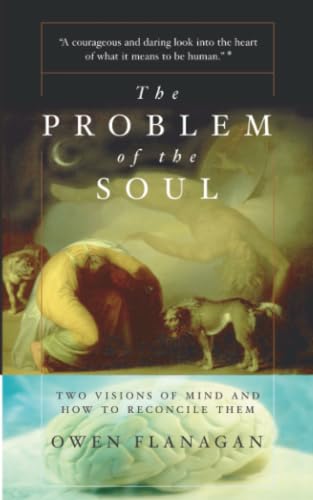

The problem of the soul two visions of mind and how to reconcile them Owen Flanagan.
Detalles de publicación: New York Basic Books 2002.Descripción: xvi, 364 p. ill. 24 cmISBN:- 0465024610 (pbk)
| Imagen de cubierta | Tipo de ítem | Biblioteca actual | Biblioteca de origen | Colección | Ubicación en estantería | Signatura topográfica | Materiales especificados | Info Vol | URL | Copia número | Estado | Notas | Fecha de vencimiento | Código de barras | Reserva de ítems | Prioridad de la cola de reserva de ejemplar | Reservas para cursos | |
|---|---|---|---|---|---|---|---|---|---|---|---|---|---|---|---|---|---|---|
| Libro | Biblioteca Encarnación Valdés Colección General bev | 128 F583p (Navegar estantería(Abre debajo)) | Disponible | 80000002440124 |
Descripciones mejoradas de Syndetics:
Science has always created problems for traditional ways of seeing things, but now the very attributes that make us human -- free will, the permanence of personal identity, the existence of the soul -- are threatened by the science of the mind. If the mind is the brain, and therefore a physical object subject to deterministic laws, how can we have free will? If most of our thoughts and impulses are unconscious, how can we be morally responsible for what we do? If brains and bodies undergo relentless change, how can our identities be constant? The Problem of the Soul shows the way out of these paradoxes. Framing the conflict in terms of two dominant visions of the mind -- the "manifest image" of humanistic philosophy and theology, and the scientific image -- Owen Flanagan demonstrates that there is common ground, and that we need not give up our ideas of moral responsibility and personal freedom in order to have an empirically sound view of the human mind. This is a profoundly relevant work of philosophy for the common reader.
Includes bibliographical references (p. 335-348) and index.
1. Human being -- 2. The human image -- 3. Mind -- 4. Free will -- 5. Permanent persons -- 6. Natural selves -- 7. Ethics as human ecology.
"Science has always created problems for traditional ways of seeing things, but now the problem has become acute. Traditional humanistic ideas about the basic nature of humanity are under attack as never before. The very attributes that make us human - free will, the permanence of personal identity, the existence of the soul - are undermined and threatened by the current revolution in the science of the mind. If the mind is the brain, and therefore a physical object subject to deterministic laws, how can we have free will? If most of our thoughts and impulses are unconscious, how can we be morally responsible for what we do? If brains and bodies are constantly undergoing change, how can our identities be constant?" "The Problem of the Soul shows the way out of these seemingly intractable paradoxes. Framing the conflict in terms of two dominant visions of the mind - the "manifest image" of humanistic philosophy and theology, and the scientific image - renowned philosopher Owen Flanagan demonstrates that there is, in fact, common ground, and that we need not give up our ideas of moral responsibility and personal freedom in order to have an empirically sound view of the human mind. With implications ranging from the stem-cell debate and the teaching of evolution to everyday life, this is a profoundly relevant work of philosophy for the common reader."--BOOK JACKET.