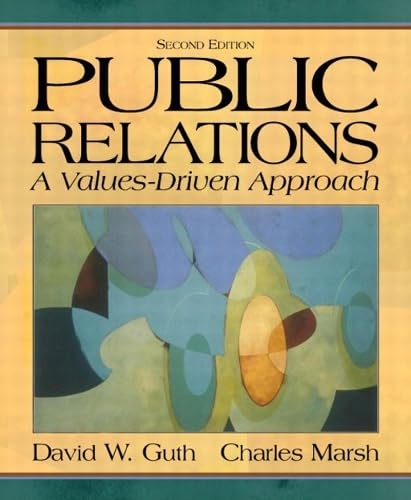
Imagen de Amazon.com

Portada de Syndetics
Imagen de OpenLibrary
Public relations a values-driven approach David Guth, Charles Marsh.
Detalles de publicación: Boston Pearson/Allyn & Bacon c2003.Edición: 2. edDescripción: xxi, 600 p. ill. 24 cmISBN:- 0205359698
- 659.2 G9841p2 22
- HM1221 .G87 2003
| Imagen de cubierta | Tipo de ítem | Biblioteca actual | Biblioteca de origen | Colección | Ubicación en estantería | Signatura topográfica | Materiales especificados | Info Vol | URL | Copia número | Estado | Notas | Fecha de vencimiento | Código de barras | Reserva de ítems | Prioridad de la cola de reserva de ejemplar | Reservas para cursos | |
|---|---|---|---|---|---|---|---|---|---|---|---|---|---|---|---|---|---|---|
| Libro | Biblioteca Encarnación Valdés Colección General bev | 659.2 G9841p2 (Navegar estantería(Abre debajo)) | Disponible | 80000002439704 |
Total de reservas: 0
Descripciones mejoradas de Syndetics:
This text examines how public relations activities reflect and affect an organization's core values, covering new communication technologies, integrated marketing, crisis communication, and cross-cultural communication, as well as more traditional subjects of research, communication, writing and pre
Includes bibliographical references and index.
Tabla de contenidos provista por Syndetics
- Preface(p. xv)
- About the Authors(p. xix)
- Section 1 Foundations of Public Relations
- Chapter 1 What Is Public Relations?(p. 1)
- Public Relations: Everywhere You Look(p. 2)
- A Profession Gaining in Respect(p. 8)
- Why a Public Relations Career?(p. 11)
- The Public Relations Process(p. 14)
- The Role of Values in Public Relations(p. 15)
- Values-Driven Public Relations(p. 17)
- Summary(p. 21)
- Discussion Questions(p. 22)
- Key Terms(p. 28)
- Notes(p. 29)
- Chapter 2 Jobs in Public Relations(p. 32)
- Where the Jobs Are(p. 33)
- Public Relations Activities and Duties(p. 43)
- Working Conditions and Salaries(p. 46)
- What's Important in a Job?(p. 48)
- Summary(p. 48)
- Discussion Questions(p. 49)
- Key Terms(p. 55)
- Notes(p. 55)
- Chapter 3 A Brief History of Public Relations(p. 57)
- Why History Is Important to You(p. 58)
- Premodern Public Relations(p. 58)
- The Seedbed Years(p. 65)
- War and Propaganda(p. 69)
- The Postwar Boom(p. 75)
- The Downsizing of the United States(p. 78)
- The New Millennium(p. 79)
- Summary(p. 80)
- Discussion Questions(p. 81)
- Key Terms(p. 88)
- Notes(p. 88)
- Chapter 4 The Publics in Public Relations(p. 92)
- What Is Public?(p. 93)
- The Publics in Public Relations(p. 95)
- What Do We Need to Know about Each Public?(p. 100)
- The Traditional Publics in Public Relations(p. 104)
- Summary(p. 124)
- Discussion Questions(p. 125)
- Key Terms(p. 131)
- Notes(p. 131)
- Chapter 5 Communication Theory and Public Opinion(p. 137)
- The Power of Public Opinion(p. 138)
- A Communication Model(p. 139)
- Mass Communication Theories(p. 143)
- Motivation(p. 149)
- Persuasion and Public Opinion(p. 153)
- Summary(p. 158)
- Discussion Questions(p. 159)
- Key Terms(p. 166)
- Notes(p. 166)
- Chapter 6 Ethics and Social Responsibility in Public Relations(p. 169)
- What Are Ethics?(p. 170)
- Objectivity versus Advocacy: A Misleading Ethics Debate(p. 173)
- Challenges to Ethical Behavior(p. 175)
- The Rewards of Ethical Behavior(p. 178)
- Trust and Corporate(p. 179)
- Beyond CSR: Strengthening Ethical Behavior(p. 181)
- Summary(p. 189)
- Discussion Questions(p. 190)
- Key Terms(p. 197)
- Notes(p. 197)
- Section 2 The Public Relations Process
- Chapter 7 Research and Evaluation(p. 200)
- Did the Needle Move?(p. 201)
- The Value of Research and Evaluation(p. 203)
- Developing a Research Strategy: What Do I Want to Know?(p. 205)
- Developing a Research Strategy: How Will I Gather Information?(p. 209)
- Survey Research(p. 216)
- Analyzing Survey Results(p. 225)
- Summary(p. 227)
- Discussion Questions(p. 227)
- Key Terms(p. 234)
- Notes(p. 235)
- Chapter 8 Planning: The Strategies of Public Relations(p. 238)
- The Basics of Values-Driven Planning(p. 240)
- Different Kinds of Public Relations Plans(p. 242)
- Why Do We Plan?(p. 244)
- How Do We Plan?(p. 247)
- Expanding a Plan into a Proposal(p. 256)
- Qualities of a Good Plan(p. 257)
- Summary(p. 258)
- Discussion Questions(p. 258)
- Key Terms(p. 265)
- Notes(p. 266)
- Chapter 9 Communication: The Tactics of Public Relations(p. 268)
- Communicating with Specific Publics(p. 269)
- Tactics as Messages and Channels(p. 270)
- Tactics and Traditional Publics(p. 276)
- Summary(p. 299)
- Discussion Questions(p. 300)
- Key Terms(p. 306)
- Notes(p. 306)
- Chapter 10 Writing and Presentation Skills(p. 309)
- The Importance of Writing and Presentation Skills(p. 310)
- A Context for Public Relations Writing(p. 311)
- The Writing Process(p. 311)
- Writing for the Ear(p. 330)
- The Process of Successful Presentations(p. 333)
- Summary(p. 340)
- Discussion Questions(p. 340)
- Key Terms(p. 346)
- Notes(p. 347)
- Chapter 11 Public Relations in the Digital Age(p. 349)
- Welcome to the Revolution(p. 350)
- The Digital Revolution(p. 353)
- Computers and the Internet(p. 357)
- Wireless Communications Technology(p. 369)
- Why New Isn't Always Better(p. 374)
- Summary(p. 375)
- Discussion Questions(p. 375)
- Key Terms(p. 384)
- Notes(p. 385)
- Section 3 Public Relations Today and Tomorrow
- Chapter 12 Crisis Communications(p. 389)
- A New "Day of Infamy"(p. 390)
- The Anatomy of a Crisis(p. 393)
- Crisis Communications Planning(p. 402)
- Crisis Planning Ethics(p. 415)
- Summary(p. 417)
- Discussion Questions(p. 417)
- Key Terms(p. 424)
- Notes(p. 425)
- Chapter 13 Public Relations and Marketing(p. 428)
- Public Relations and Marketing(p. 429)
- The Impact of Consumer-Focused Marketing on Public Relations(p. 433)
- A Closer Look at Marketing(p. 435)
- A Closer Look at IMC(p. 437)
- How IMC Works(p. 441)
- Problems with 21st-Century Marketing(p. 446)
- Summary(p. 448)
- Discussion Questions(p. 448)
- Key Terms(p. 454)
- Notes(p. 454)
- Chapter 14 Cross-Cultural Communication(p. 457)
- Cultures: Realities and Definitions(p. 458)
- Cultural Attributes(p. 460)
- Cross-Cultural Communication: Definitions and Dangers(p. 466)
- Achieving Successful Cross-Cultural Public Relations: A Process(p. 469)
- Summary(p. 477)
- Discussion Questions(p. 477)
- Key Terms(p. 483)
- Notes(p. 483)
- Chapter 15 Public Relations and the Law(p. 487)
- A Parade of Corporate Horrors(p. 488)
- Public Relations and the First Amendment(p. 490)
- Federal Agencies That Regulate Speech(p. 494)
- Libel(p. 503)
- Privacy(p. 506)
- Copyright(p. 509)
- Litigation Public Relations(p. 513)
- Summary(p. 517)
- Discussion Questions(p. 517)
- Key Terms(p. 524)
- Notes(p. 524)
- Chapter 16 Your Future in Public Relations(p. 529)
- What's Next?(p. 530)
- Social Forces and Public Relations(p. 532)
- Where Public Relations Is Headed(p. 543)
- Your Future in Public Relations(p. 546)
- Summary(p. 551)
- Discussion Questions(p. 552)
- Key Terms(p. 559)
- Notes(p. 560)
- Appendix Public Relations Society of America Member Code of Ethics 2000(p. 564)
- Glossary(p. 571)