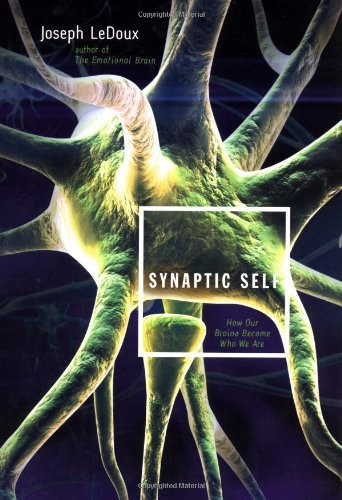
Imagen de portada de Amazon
Imagen de Amazon.com
Imagen de cubierta Syndetics
Portada de Syndetics
Imagen de OpenLibrary

Synaptic self how our brains become who we are Joseph LeDoux.

Por: Detalles de publicación: New York Viking 2002.Descripción: x, 406 p. ill. 25 cmISBN:
  • 0670030287 (alk. paper)
Tema(s): Clasificación CDD:
  • 612.82 L474s 21
Clasificación LoC:
  • QP402 .L43 2002
Valoración
    Valoración media: 0.0 (0 votos)
Existencias
Imagen de cubierta Tipo de ítem Biblioteca actual Biblioteca de origen Colección Ubicación en estantería Signatura topográfica Materiales especificados Info Vol URL Copia número Estado Notas Fecha de vencimiento Código de barras Reserva de ítems Prioridad de la cola de reserva de ejemplar Reservas para cursos
Libro Biblioteca Encarnación Valdés Colección General bev 612.82 L474s (Navegar estantería(Abre debajo)) Disponible 80000002439407
Total de reservas: 0

Descripciones mejoradas de Syndetics:

Ranging widely through philosophy, literature, and the history of science, LeDoux examines how we have conceptualized the relationship between brain and self through the centuries. His own contribution, based on two decades of research, begins with the startlingly simple premise that the self-the essence of who a person is-intricately reflects patterns of interconnectivity between neurons in the brain. Synapses, the spaces between neurons, are not only the channels through which we think, act, imagine, feel, and remember, but also the means by which we encode our most fundamental traits, preferences, and beliefs, allowing us to function as a single, integrated individual-a synaptic self. As LeDoux brilliantly argues, a synaptic self does not exclude other ways of understanding existence-spiritual, aesthetic, moral-but rather it enriches and broadens these avenues by providing a neurological/psychological construct grounded in the latest research in biology. Rather than join the age-old debate on whether nature or nurture is more determinative, LeDoux posits that both genes and experience contribute to synaptic connectivity. Mind expanding in every sense of the word, Synaptic Selfrepresents an important breakthrough in one of the last frontiers of medical research.

Includes bibliographical references (p. 359-392) and index.

Tabla de contenidos provista por Syndetics

  • Acknowledgments(p. ix)
  • 1. The Big One(p. 1)
  • 2. Seeking the Self(p. 13)
  • 3. The Most Unaccountable of Machinery(p. 33)
  • 4. Building the Brain(p. 65)
  • 5. Adventures in Time(p. 97)
  • 6. Small Change(p. 134)
  • 7. The Mental Trilogy(p. 174)
  • 8. The Emotional Brain Revisited(p. 200)
  • 9. The Lost World(p. 235)
  • 10. Synaptic Sickness(p. 260)
  • 11. Who are You?(p. 301)
  • Notes(p. 325)
  • Works Cited(p. 359)
  • Index(p. 393)

Reseñas proporcionadas por Syndetics

Library Journal Review

Brain/mind theorists tread upon sensitive territory when they address the issue of personality. Many will readily concede that the activities of the mind result from physical process in the brain, but they find a purely material explanation of selfhood troubling. LeDoux (Ctr. for Neural Sciences, New York Univ.; The Emotional Brain) puts forth a new, unified theory in which neurology shapes experience and vice versa. The critical locus is the synapses, which convey information and stimulate functions within the brain. The interconnections of the synapses are plastic, shaped by a person's experiences, and thus give rise to unique thoughts and feelings. Memory arises from these, creating a sense of self and personality. LeDoux is not the first to discuss the role of memory in selfhood (see, for instance, Daniel Schacter's Searching for Memory); nor is he the first to stress the importance of synaptic firing in brain/mind interactions (see Gerald Edelman's Bright Air, Brilliant Fire). He does, however, bring together these pieces to render a convincingly integrated theory. It will be of vital interest to those in the field and to informed lay readers who have followed the debates. Gregg Sapp, Science Lib., SUNY at Albany (c) Copyright 2010. Library Journals LLC, a wholly owned subsidiary of Media Source, Inc. No redistribution permitted.

Publishers Weekly Review

Despite ongoing debate about the root cause of psychological disorders, most agree that the development of the self is central to the distinction between normality and psychopathology. Yet neuroscientists have been slow to probe the biological basis for our sense of self, focusing instead on states of consciousness. LeDoux (The Emotional Brain), professor at New York University's Center for Neural Sciences, has come up with a theory: it's the neural pathways the synaptic relationships in our brains that make us who we are. Starting with a description of basic neural anatomy (including how neurons communicate, the brain's embryological development and some of the key neural pathways), LeDoux reviews experiments and research, arguing that the brain's synaptic connections provide the biological base for memory, which makes possible the sense of continuity and permanence fundamental to a "normal" conception of self. Writing for a general audience, he succeeds in making his subject accessible to the dedicated nonspecialist. He offers absorbing descriptions of some of the most fascinating case studies in his field, provides insight into the shortcomings of psychopharmacology and suggests new directions for research on the biology of mental illness. While some may disagree with LeDoux's conclusion that "the brain makes the self" through its synapses, he makes an important contribution to the literature on the relationship between these two entities. Agents, Katinka Matson and John Brockman. (On-sale: Jan. 14) (c) Copyright PWxyz, LLC. All rights reserved

Booklist Review

Neuroscientist LeDoux's second popular work, following The Emotional Brain (1996), is a forceful argument that our brains, particularly the synapses, create our personalities. Modestly admitting that this theory is far from completion, LeDoux still believes he's on the right track. Reaching back five decades to the research of psychologist Donald Hebb, who investigated "plasticity" of the brain--the way its neurons form interconnections--LeDoux delves deeply into the exact biochemicals and neurotransmitters central to plasticity. Aided by dozens of diagrams, the author explains how a neuron's axon basically "fires"; how the molecules then drift across the synapse to the receiving neuron's dendrite; and what will promote or inhibit that neuron's firing. LeDoux's work, covering an avalanche of neuroscientific research, is surely the most accessible contemporary work for those interested in the brain's effect on personality. --Gilbert Taylor

Notas de autor provistas por Syndetics

Joseph LeDoux, Henry and Lucy Moses Professor of Science at New York University's Center for Neural Sciences
Compartir
logopucpr-y-vive

Contáctanos

¡Queremos saber de ti!

Tel. 787.841.2000 Ext. 1801

bibliotecavaldes@pucpr.edu

⁣Búscanos en las redes

© 2026 Desarrollado por Ignite Online • All Rights Reserved • Powered by Koha.