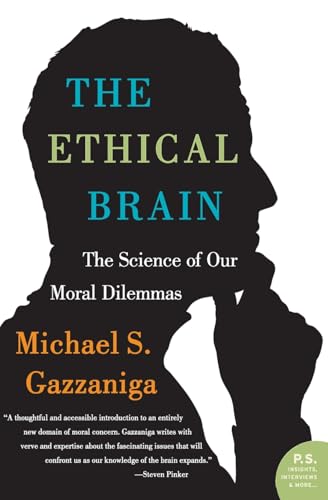
Imagen de portada de Amazon
Imagen de Amazon.com
Imagen de cubierta Syndetics
Portada de Syndetics
Imagen de OpenLibrary

The ethical brain : the science of our moral dilemmas / Michael S. Gazzaniga.

Por: Descripción: xix, 202, 16 pages ; 21 cmTipo de contenido:
  • text
Tipo de medio:
  • unmediated
Tipo de soporte:
  • volume
ISBN:
  • 9780060884734 (pbk. : alk. paper)
  • 0060884738 (pbk. : alk. paper)
Tema(s): Clasificación CDD:
  • 174.2928233 G291e 22
Clasificación LoC:
  • QP 360.5 .G393 2005
Recursos en línea:
Contenidos:
Part I Life-Span Neuroethics--Conferring Moral Status on an Embryo--The Aging Brain--Part II Brain Enchancement--Better Brains Through Genes--Training the Brain--Shaping the Smart Brain with Drugs--Part III Free Will, Personal Responsability, and the Law--My Brain Made Me Do It--Antisocial Thoughts and the Right to Privacy--The Brain Produces a Poor Autobiography--Part IV The Nature of Moral Beliefs and the Concept of Universal Ethics--The Beliving Brain--Toward a Universal Ethics.
Resumen: The rapid advance of scientific knowledge has raised ethical dilemmas that humankind has never before had to address. Questions about the moment when life technically begins and ends or about the morality of genetically desining babies are now relevant and timely. Our ever-incresing knowledge of the workings of the human brain can guide us in the formation of new moral principles in the twenty-first century. In the Ethical Brain, preeminent neuroscientist Michael S. Gazzaniga presents the emerging social and ethical issues arising out of modern-day brain science and challenges the way we look at them. Courageous and thought-provoking–a work of enormous intelligence, insight, amd importance– this book explores the hitherto uncharted landscape where science and society interesect.
Valoración
    Valoración media: 0.0 (0 votos)
Existencias
Imagen de cubierta Tipo de ítem Biblioteca actual Biblioteca de origen Colección Ubicación en estantería Signatura topográfica Materiales especificados Info Vol URL Copia número Estado Notas Fecha de vencimiento Código de barras Reserva de ítems Prioridad de la cola de reserva de ejemplar Reservas para cursos
Libro Biblioteca Encarnación Valdés Colección General bev 174.2928233 G291e (Navegar estantería(Abre debajo)) Disponible 80000002439399
Libro BET Biblioteca Escuela de Teología Colección General BET QP 360.5 .G393 2005 (Navegar estantería(Abre debajo)) Disponible 41000000004128
Total de reservas: 0

Descripciones mejoradas de Syndetics:

A provocative and fascinating look at new discoveries about the brain that challenge our ethics

The rapid advance of scientific knowledge has raised ethical dilemmas that humankind has never before had to address. Questions about the moment when life technically begins and ends or about the morality of genetically designing babies are now relevant and timely. Our ever-increasing knowledge of the workings of the human brain can guide us in the formation of new moral principles in the twenty-first century. In The Ethical Brain, preeminent neuroscientist Michael S. Gazzaniga presents the emerging social and ethical issues arising out of modern-day brain science and challenges the way we look at them. Courageous and thought-provoking -- a work of enormous intelligence, insight, and importance -- this book explores the hitherto uncharted landscape where science and society intersect.

Previously published: New York : Dana Press, c2005.

"An Ecco book."

Includes bibliographical references and index.

Part I Life-Span Neuroethics--Conferring Moral Status on an Embryo--The Aging Brain--Part II Brain Enchancement--Better Brains Through Genes--Training the Brain--Shaping the Smart Brain with Drugs--Part III Free Will, Personal Responsability, and the Law--My Brain Made Me Do It--Antisocial Thoughts and the Right to Privacy--The Brain Produces a Poor Autobiography--Part IV The Nature of Moral Beliefs and the Concept of Universal Ethics--The Beliving Brain--Toward a Universal Ethics.

The rapid advance of scientific knowledge has raised ethical dilemmas that humankind has never before had to address. Questions about the moment when life technically begins and ends or about the morality of genetically desining babies are now relevant and timely. Our ever-incresing knowledge of the workings of the human brain can guide us in the formation of new moral principles in the twenty-first century. In the Ethical Brain, preeminent neuroscientist Michael S. Gazzaniga presents the emerging social and ethical issues arising out of modern-day brain science and challenges the way we look at them. Courageous and thought-provoking–a work of enormous intelligence, insight, amd importance– this book explores the hitherto uncharted landscape where science and society interesect.

Tabla de contenidos provista por Syndetics

  • Acknowledgments(p. ix)
  • Preface(p. xiii)
  • Part I Life-Span Neuroethics
  • 1 Conferring Moral Status on an Embryo(p. 3)
  • 2 The Aging Brain(p. 19)
  • Part II Brain Enhancement
  • 3 Better Brains Through Genes(p. 37)
  • 4 Training the Brain(p. 55)
  • 5 Shaping the Smart Brain with Drugs(p. 71)
  • Part III Free Will, Personal Responsibility, and the Law
  • 6 My Brain Made Me Do It(p. 87)
  • 7 Antisocial Thoughts and the Right to Privacy(p. 103)
  • 8 The Brain Produces a Poor Autobiography(p. 120)
  • Part IV The Nature of Moral Beliefs and the Concept of Universal Ethics
  • 9 The Believing Brain(p. 145)
  • 10 Toward a Universal Ethics(p. 163)
  • Endnotes(p. 179)
  • Index(p. 195)

Extracto provisto por Syndetics

The Ethical Brain The Science of Our Moral Dilemmas Chapter One Conferring Moral Status on an Embryo Central to many of the bioethical issues of our time is the question, When should society confer moralstatus on an embryo? When should we call an embryo or a fetus one of us? The fertilized egg represents the starting point for the soon-to-be dividing entity that will grow into a fetus and finally into a baby. It is a given that a fertilized egg is the beginning of the life of an individual. It is also a given that it is not the beginning of life, since both the egg and the sperm, prior to uniting, represent life just as any living plant or creature represents life. Yet is it right to attribute the same moral status to that human embryo that one attributes to a newborn baby or, for that matter, to any living human? Bioethicists continue to wrestle with the question. The implications of determining the beginning of moral status are far-reaching, affecting abortion, in vitro fertilization, biomedical cloning, and stem cell research. The rational world is waiting for resolution of this debate. This issue shows us how the field of neuroethics goes beyond that of classic bioethics. When ethical dilemmas involve the nervous system, either directly or indirectly, those trained in the field of neuroscience have something to say. They can peek under the lid, as it were, and help all of us to understand what the actual biological state is and is not. Is a brain present? Is it functioning in any meaningful way? Neuroscientists study the organ that makes us uniquely human -- the brain, that which enables a conscious life. They are constantly seeking knowledge about what areas of the brain sustain mental thought, parts of mental thought, or no thought. So at first glance, it might seem that neuroethicists could determine the moral status of an embryo or fetus based on the presence of the sort of biological material that can support mental life and the sort that cannot -- in other words, whether the embryo has a brain that functions at a level that supports mental activity. Modern brain science is prepared to answer this question, but while the neurobiology may be clear, neuroethics runs into problems when it tries to impose rational, scientific facts on moral and ethical issues. The Path to Conscious Life As soon as sperm meets egg, the embryo begins its mission: divide and differentiate, divide and differentiate, divide and differentiate. The embryo starts out as the melding of these two cells and must eventually become the approximately 50 trillion cells that make up the human organism. 1 There is no time to lose -- after only a few hours, three distinct areas of the embryo are apparent. These areas become the endoderm, mesoderm, and ectoderm, the initial three layers of cells that will differentiate to become all the organs and components of the human body. The layer of the ectoderm gives rise to the nervous system. As the embryo continues to grow in the coming weeks, the base of the portion of the embryo called the neural tube eventually gives rise to neurons and other cells of the central nervous system, while an adjacent portion of the embryo called the neural crest eventually becomes cells of the peripheral nervous system (the nerves outside the brain and spinal cord). The cavity of the neural tube gives rise to the ventricles of the brain and the central canal of the spinal cord, and in week 4 the neural tube develops three distinct bulges that correspond to the areas that will become the three major divisions of the brain: forebrain, midbrain, and hindbrain. The early signs of a brain have begun to form. Even though the fetus is now developing areas that will become specific sections of the brain, not until the end of week 5 and into week 6 (usually around forty to forty-three days) does the first electrical brain activity begin to occur. This activity, however, is not coherent activity of the kind that underlies human consciousness, or even the coherent activity seen in a shrimp's nervous system. Just as neural activity is present in clinically brain-dead patients, early neural activity consists of unorganized neuron firing of a primitive kind. Neuronal activity by itself does not represent integrated behavior. During weeks 8 to 10, the cerebrum begins its development in earnest. Neurons proliferate and begin their migration throughout the brain. The anterior commissure, which is the first interhemispheric connection (a small one), also develops. Reflexes appear for the first time during this period. The frontal and temporal poles of the brain are apparent during weeks 12 to 16, and the frontal pole (which becomes the neocortex) grows disproportionately fast when compared with the rest of the cortex. The surface of the cortex appears flat through the third month, but by the end of the fourth month indentations, or sulci, appear. (These develop into the familiar folds of the cerebrum.) The different lobes of the brain also become apparent, and neurons continue to proliferate and migrate throughout the cortex. By week 13 the fetus has begun to move. Around this time the corpus callosum, the massive collection of fibers (the axons of neurons) that allow for communication between the hemispheres, begins to develop, forming the infrastructure for the major part of the cross talk between the two sides of the brain. Yet the fetus is not a sentient, self-aware organism at this point; it is more like a sea slug, a writhing, reflex-bound hunk of sensory-motor processes that does not respond to anything in a directed, purposeful way. Laying down the infrastructure for a mature brain and possessing a mature brain are two very different states of being. Synapses -- the points where two neurons, the basic building blocks of the nervous system, come together to interact -- form in large numbers during the seventeenth and following weeks, allowing for communication between individual neurons. Synaptic activity underlies all brain functions. Synaptic growth does not skyrocket until around postconception day 200 (week 28). . . . The Ethical Brain The Science of Our Moral Dilemmas . Copyright © by Michael S. Gazzaniga. Reprinted by permission of HarperCollins Publishers, Inc. All rights reserved. Available now wherever books are sold. Excerpted from The Ethical Brain: The Science of Our Moral Dilemmas by Michael S. Gazzaniga All rights reserved by the original copyright owners. Excerpts are provided for display purposes only and may not be reproduced, reprinted or distributed without the written permission of the publisher.

Notas de autor provistas por Syndetics

Michael S. Gazzaniga, one of the premiere doctors of neuroscience, was born on December 12, 1939 in Los Angeles. Educated at Dartmouth College and California Institute of Technology, he has been on the faculty of the Center for Neuroscience, University of California, Davis.

His early research examined the subject of epileptics who had undergone surgery to control seizures. He has also studied Alzheimer's and Parkinson's patients and reveals important findings in books such as Cognitive Neuroscience: The Biology of the Mind.

While many of his writings are technical, he also educates and stimulates readers with discussions about the fascinating and mysterious workings of the brain. Books such as The Social Brain and The Mind's Past bring forth new information and theories regarding how the brain functions, interacts, and responds with the body and the environment.

(Bowker Author Biography)

Compartir
logopucpr-y-vive

Contáctanos

¡Queremos saber de ti!

Tel. 787.841.2000 Ext. 1801

bibliotecavaldes@pucpr.edu

⁣Búscanos en las redes

© 2026 Desarrollado por Ignite Online • All Rights Reserved • Powered by Koha.