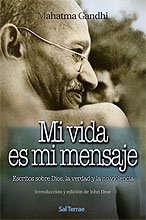

Mi vida es mi mensaje escritos sobre Dios, la verdad y la no violencia Mahatma Gandhi.
Detalles de publicación: Santander Editorial Sal Terrae 2003Edición: 2a edDescripción: 231 p. 20 cmISBN:- 8429315217
| Imagen de cubierta | Tipo de ítem | Biblioteca actual | Biblioteca de origen | Colección | Ubicación en estantería | Signatura topográfica | Materiales especificados | Info Vol | URL | Copia número | Estado | Notas | Fecha de vencimiento | Código de barras | Reserva de ítems | Prioridad de la cola de reserva de ejemplar | Reservas para cursos | |
|---|---|---|---|---|---|---|---|---|---|---|---|---|---|---|---|---|---|---|
| Libro | Biblioteca Mons. Iñaki Mallona (Arecibo) Colección General ab | 954.03 G195ma (Navegar estantería(Abre debajo)) | c.2 | Disponible | 60000010125737 | |||||||||||||
| Libro | Biblioteca Mons. Iñaki Mallona (Arecibo) Colección General ab | 954.03 G195ma (Navegar estantería(Abre debajo)) | Disponible | 60000010125729 |
Descripciones mejoradas de Syndetics:
Author William A. Kappele shows you the grandeur of Utah's exposed formations, its canyon walls etched with fossils, and the spires and arches of the Needles District in Canyonlands National Park. Each description includes concise information on the material to be found there, the tools to bring, the best season to visit, the vehicle to drive, or when a remote find suggests it's time to lace up the hiking boots. Readers will glean new insights into the obsidian of the Black Rock sites, jasper at Hell's Backbone, petrified wood at Bullfrog Turnoff, and fossils of sea lillies along the Wasatch Range. May your journeys be fruitful and your bag be heavy on the way home. Somewhere in that bag among your rocks, we hope you haven't forgotten your copy of Rockhounding Utah.
Notas de autor provistas por Syndetics
Mohandas Gandhi is well known as a political activist and pacifist who played a key role in achieving India's independence from Great Britain. Although born in Porbandar, India, to parents of the Vaisya (merchant) caste, he was given a modern education and eventually studied law in London. After returning briefly to India, Gandhi went to South Africa in 1893, where he spent the next 20 years working to secure Indian rights. It was during this time that he experimented with and developed his basic philosophy of life.Philosophically, Gandhi is best known for his ideas of satyagraha (truth-force) and ahimsa (nonharming). Intrinsic to the idea of truth-force is the correlation between truth and being; truth is not merely a mental correspondence with reality but a mode of existence. Hence, the power of the truth is not what one argues for but what one is. He developed this idea in conjunction with the principle of nonviolence, showing in his nationalist activities that the force of truth, expressed nonviolently, can be an irresistible political weapon against intolerance, racism, and social violence. Although his basic terminology and conceptual context were Hindu, Gandhi was impressed by the universal religious emphasis on the self-transformative power of love, drawing his inspiration from Christianity, Western philosophy, and Islam as well.
(Bowker Author Biography)