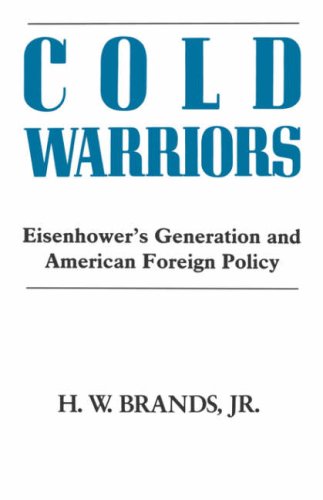
Imagen de portada de Amazon
Imagen de Amazon.com
Imagen de cubierta Syndetics
Portada de Syndetics
Imagen de OpenLibrary

Cold warriors Eisenhower's generation and American foreign policy H.W. Brands, Jr.

Por: Series Contemporary American history seriesDetalles de publicación: New York Columbia University Press 1988.Descripción: xii, 252 p. 24 cmISBN:
  • 0231065264
Tema(s): Clasificación CDD:
  • 327.73 19
Clasificación LoC:
  • E835 .B684 1988
Valoración
    Valoración media: 0.0 (0 votos)
Existencias
Imagen de cubierta Tipo de ítem Biblioteca actual Biblioteca de origen Colección Ubicación en estantería Signatura topográfica Materiales especificados Info Vol URL Copia número Estado Notas Fecha de vencimiento Código de barras Reserva de ítems Prioridad de la cola de reserva de ejemplar Reservas para cursos
Libro Biblioteca de Mayagüez Colección General mb E835 .B684 1988 (Navegar estantería(Abre debajo)) Disponible 50000001804409
Total de reservas: 0

Bibliography: p. [241]-247.

Includes index.

Reseñas proporcionadas por Syndetics

CHOICE Review

Brands examines the formulation of foreign policy during the administration of President Dwight D. Eisenhower. He does so by focusing on Eisenhower and eight other men who did more than any other advisors to put together that policy. Brands divides the nine into three groups: 1) the inner circle--John Foster Dulles, chief architect and Secretary of State; Milton Eisenhower, his brother's closest advisor; and Allen Dulles, head of the CIA; 2) the lieutenants who did not so much devise policy as they did execute and refine policy--Walter Bedell Smith and Robert Murphy; 3) the agitators and agents who were influential in certain specific areas--C. D. Jackson, Harold Stassen, and Henry Cabot Lodge. Brands uses his study of the views and influence of each of these men to assess both specific policy areas and overall operating assumptions. Their shared experience of WW II resulted in an administration's "legacy at once of excess and of deficiency." Brands notes that their experience with the horrors and difficulties of modern war made these men properly cautious behind their bellicose rhetoric. Their successors, the Kennedy advisers, inherited the arrogance and slogans but not the experience, and mistakenly believed their "best and brightest" men would win their war. College and university libraries. -J. P. Hobbs, North Carolina State University
Compartir
logopucpr-y-vive

Contáctanos

¡Queremos saber de ti!

Tel. 787.841.2000 Ext. 1801

bibliotecavaldes@pucpr.edu

⁣Búscanos en las redes

© 2026 Desarrollado por Ignite Online • All Rights Reserved • Powered by Koha.