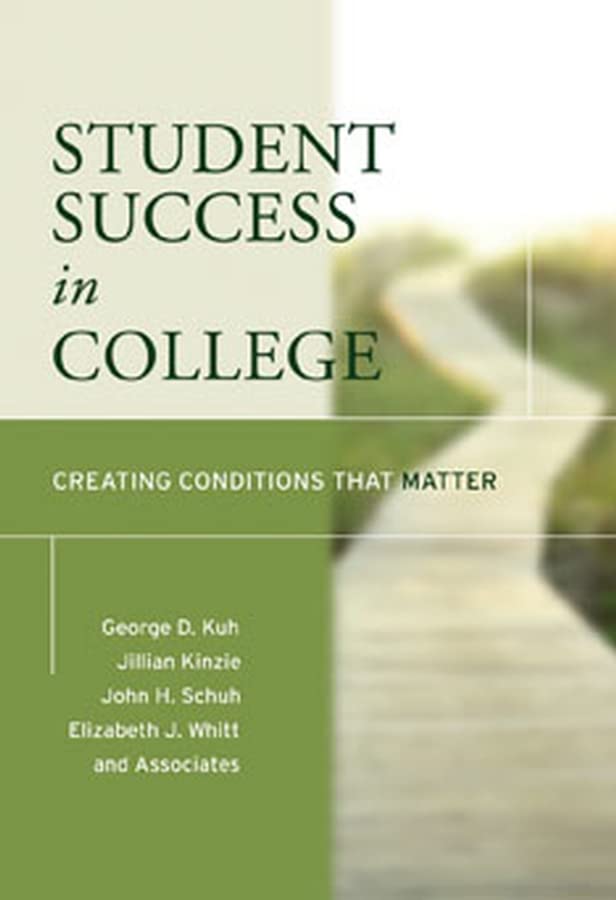

Student success in college creating conditions that matter George D. Kuh ... [et al.].
Detalles de publicación: San Francisco Jossey-Bass c2005.Edición: 1st edDescripción: xx, 370 p. 24 cmISBN:- 0787979147 (alk. paper)
- 378.198 S9331 22
- LB2343.32 .S79 2005
| Imagen de cubierta | Tipo de ítem | Biblioteca actual | Biblioteca de origen | Colección | Ubicación en estantería | Signatura topográfica | Materiales especificados | Info Vol | URL | Copia número | Estado | Notas | Fecha de vencimiento | Código de barras | Reserva de ítems | Prioridad de la cola de reserva de ejemplar | Reservas para cursos | |
|---|---|---|---|---|---|---|---|---|---|---|---|---|---|---|---|---|---|---|
| Libro | Biblioteca Encarnación Valdés Colección General bev | 378.198 S9331 (Navegar estantería(Abre debajo)) | Disponible | 80000002438573 |
Descripciones mejoradas de Syndetics:
Student Success in College describes policies, programs, and practices that a diverse set of institutions have used to enhance student achievement. This book clearly shows the benefits of student learning and educational effectiveness that can be realized when these conditions are present. Based on the Documenting Effective Educational Practice (DEEP) project from the Center for Postsecondary Research at Indiana University, this book provides concrete examples from twenty institutions that other colleges and universities can learn from and adapt to help create a success-oriented campus culture and learning environment.
Includes bibliographical references and index.
Tabla de contenidos provista por Syndetics
- Preface
- Part 1 Introduction
- 1 Student Engagement: A Key to Student Success
- Part 2 Properties and Conditions Common to Educationally Effective Colleges
- 2 "Living" Mission and "Lived" Educational Philosophy
- 3 An Unshakeable Focus on Student Learning
- 4 Environments Adapted for Educational Enrichment
- 5 Clear Pathways to Student Success
- 6 An Improvement-Oriented Ethos
- 7 Shared Responsibility for Educational Quality and Student Success
- Part 3 Effective Practices Used at Deep Colleges and Universities
- 8ttAcademic Challenge
- 9ttActive and Collaborative Learning
- 10 Student-Faculty Interaction
- 11 Enriching Educational Experiences
- 12 Supportive Campus Environment
- Part 4 Summary and Recommendations
- 13 Principles for Promoting Student Success
- References
- Appendices
- Appendix A Research Methods
- Appendix B Project DEEP Research Team
- Appendix C National Survey of Student Engagement
- Index
Reseñas proporcionadas por Syndetics
CHOICE Review
Student success has always been a core objective of US higher education. Today that objective is to deliver "a high-quality postsecondary education to more than three quarters of the adult population" (p. xiii). Accrediting agencies now require evidence of institutional accomplishment of stated objectives. Institutions everywhere are referencing concepts and policies of student engagement, active learning, learning communities, and first-year experience. Documenting effective educational practice (DEEP) and reporting such practice was the now-accomplished goal of the team of specialists who undertook the project, which featured 20 universities and colleges, all with records of effective practice. DEEP institutions represent a diverse array of institutional types. These institutions have been successful in implementing 1) tried-and-true policies and practices, 2) "sleepers"--practices referenced in the literature, but without much prior documentation of effectiveness, and 3) fresh ideas. Also featured are challenges such as faculty overload and striking a suitable balance between teaching and research. The book concludes with eight recommendations. Some may mistakenly discount the importance of these recommendations as giving voice to what is already self-evident. But in addition to empirical validation of practices assumed to be good, this work can spark new ideas and encourage cultivation of "an ethic of positive restlessness." ^BSumming Up: Recommended. Primarily higher education professionals. J. D. Gillespie Presbyterian CollegeNotas de autor provistas por Syndetics
George D. Kuh is Chancellor's Professor of Higher Education at Indiana University Bloomington. He directs the Center for Postsecondary Research which is home to the National Survey of Student Engagement (NSSE), the NSSE Institute for Effective Educational Practice, and the College Student Experiences Questionnaire research program.Jillian Kinzie is associate director of the NSSE Institute for Effective Educational Practice and project manager of the Documenting Effective Educational Practice (DEEP) initiative.
John H. Schuh is distinguished professor of educational leadership at Iowa State University in Ames, Iowa, where he is also department chair.
Elizabeth J. Whitt is professor in the College of Education at the University of Iowa and coordinator of Graduate Programs in Student Affairs Administration.