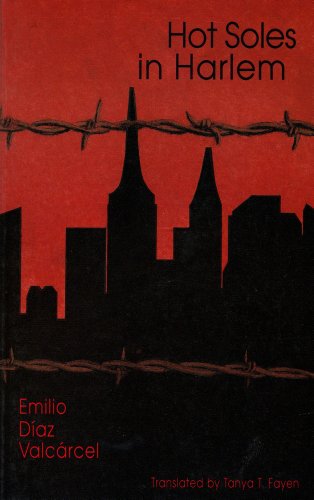

Hot soles in Harlem by Emilio Díaz Valcárcel ; translated by Tanya T. Fayen.
Series DiscoveriesDetalles de publicación: Pittsburgh, Pa. Latin American Literary Review Press 1993.Descripción: 203 p. 22 cmISBN:- 0935480617 (alk. paper)
- 863 20
- PQ7439.D498 H3713 1993
| Imagen de cubierta | Tipo de ítem | Biblioteca actual | Biblioteca de origen | Colección | Ubicación en estantería | Signatura topográfica | Materiales especificados | Info Vol | URL | Copia número | Estado | Notas | Fecha de vencimiento | Código de barras | Reserva de ítems | Prioridad de la cola de reserva de ejemplar | Reservas para cursos | |
|---|---|---|---|---|---|---|---|---|---|---|---|---|---|---|---|---|---|---|
| Libro | Biblioteca Encarnación Valdés Colección de Puerto Rico | 863 D5430h 1993 I (Navegar estantería(Abre debajo)) | Disponible | 80000002415902 |
Descripciones mejoradas de Syndetics:
Gerardo S#65533;nchez is not the average Puerto Rican arrival to New York City. He is ironically blessed with fair skin, blue eyes, and the good fortune to have met Aleluya, an intrepid guide to the "New Yorkian" world. This mysterious intellectual takes him from Harlem slums to Fifth Avenue penthouses and intellectual circles of New York, setting off the linguistic and cultural odyssey that becomes the every day life of the new immigrant.
Reseñas proporcionadas por Syndetics
Library Journal Review
Award-winning Puerto Rican writer Diaz Valcarcel has been publishing fiction since the 1960s. Some of his earlier works include Harlem Todos Los Dias (1978), Inventario (1975), and Schemes in the Month of March ( LJ 12/15/79), which was originally published in Spanish in 1972. In this work, Diaz Valcarcel uses numerous passages of descriptive cataloging reminiscent of Whitmanesque or Beat poetry. Touted for his innovative techniques, Diaz Valcarcel creates a cast of cosmopolitan characters to intrigue readers as they explore New York City with Gerardo, a newly arrived Puerto Rican immigrant. The possibilities for this novel at first seem limitless, principally because of Gerardo's fair skin, fair hair, and blue eyes. Unfortunately, readers may find his transformation into a ``newyorican'' not particularly revealing. Recommended for large Hispanic literary collections.-- Faye A. Chadwell, Univ. of South Carolina Lib., Columbia (c) Copyright 2010. Library Journals LLC, a wholly owned subsidiary of Media Source, Inc. No redistribution permitted.Publishers Weekly Review
New York City, as seen through the eyes of recently immigrated Gerardo Sanchez, can be vibrant and desolate, clear and irrational. Gerardo leaves his child and ex-wife in Puerto Rico for a better life in Manhattan. He meets Aleluya, an intellectual militant who is enraptured and enraged by Gerardo's ignorance of most everything. Aleluya looks out for Gerardo when he can, finding the newcomer a place to stay and leading him to a lawyer and a doctor when the ceiling in his slum apartment falls on his head. There are passageways to worlds Gerardo has never imagined, filled with transvestites, artists, activists and people of many nationalities. For all Gerardo's naivete, he is a keen observer of the city's people, images, smells and accents, which he relates in a stream of highly impressionistic consciousness. Forty-second street becomes ``greasy corn-on-the-cob steakhouse turnovers pizzeria the store windows display hard core underground porn.'' The confusion generated by Valcarcel's ( Schemes in the Month of March ) relative indifference to punctuation and dramatic development is assuaged by the lucidity of the language, which often feels like poems strung together as prose. (Nov.) (c) Copyright PWxyz, LLC. All rights reservedCHOICE Review
First published in Spanish in 1978 as Harlem todos los d'ias at a time when D'iaz Valc'arcel was still riding the highest crest of a wave of literary achievement earned in 1972 with the critical acclaim for his first long novel, Figuraciones en el mes de marzo. In the present book D'iaz Valc'arcel goes back to a theme that is very meaningful to him, the experiences and tribulations of the Puerto Rican community in the US. His own experiences when he lived in New York City as a Guggenheim fellow serve to construct the backdrop of this novel. There are some minor differences between the Spanish edition of 1978 and the present English translation, such as omission of the quotations before the beginning of the first chapter and omission of the table of contents; as for the English version itself, Fayen has accomplished a marvelous feat in literary translation, given the complex style, syntax, and different types of speech used by the various characters in the novel, characters who come from different Latin American countries. Especially noteworthy is the translation of Aleluya's speech, the Boricua polyglot. Advanced undergraduate; graduate; faculty; general. L. L. Pinto; Bronx Community College, CUNYNotas de autor provistas por Syndetics
Emilio D#65533;az Valc#65533;rcel is a Puerto Rican writer who emerged as part of the 1945 generation--known collectively for addressing social, political, and economic concerns in writing. He is the recipient of several awards, including the Biblioteca Breve Prize in Spain for Schemes in the Month of March and a Guggenheim Fellowship. Tanya T. Fayen is a translator and the author of In Search of the Latin American Faulkner .