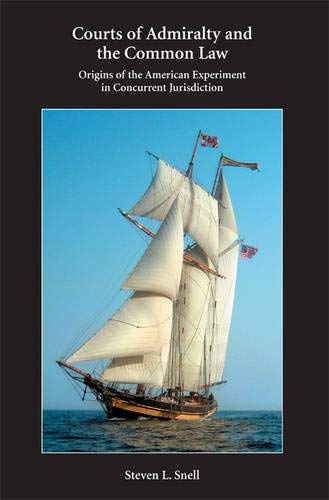

Courts of admiralty and the common law origins of the American experiment in concurrent jurisdiction Steven L. Snell.
Detalles de publicación: Durham, N.C. Carolina Academic Press c2007.Descripción: x, 481 p. 24 cmISBN:- 1594601739 (alk. paper)
- 9781594601736 (alk. paper)
- 343.7309/6 22
- KF 1112 .S645 2007
| Imagen de cubierta | Tipo de ítem | Biblioteca actual | Biblioteca de origen | Colección | Ubicación en estantería | Signatura topográfica | Materiales especificados | Info Vol | URL | Copia número | Estado | Notas | Fecha de vencimiento | Código de barras | Reserva de ítems | Prioridad de la cola de reserva de ejemplar | Reservas para cursos | |
|---|---|---|---|---|---|---|---|---|---|---|---|---|---|---|---|---|---|---|
| Libro | Biblioteca de Derecho Mons. Fremiot Torres Oliver Colección General biblioteca derecho | KF 1112 .S645 2007 (Navegar estantería(Abre debajo)) | Disponible | 70000000890405 |
Descripciones mejoradas de Syndetics:
Courts of Admiralty and the Common Law examines the origins of American admiralty jurisdiction. Drawing from a vast array of primary sources, ranging from Roman law to English records of the medieval and early modern periods, the author traces the development of English admiralty practice that provided the legal heritage of the new American nation. The book provides details of how the English High Court of Admiralty and its civil-law practitioners became embroiled in the struggle between Crown and Parliament in the seventeenth century, losing much of their traditional jurisdiction to the courts of common law at a time when the American colonies were just beginning to establish specialized tribunals for hearing maritime cases. With maritime jurisdiction in flux in the mother country, the Americans were free to adopt ad hoc solutions to the problem of jurisdiction, creating a system in which both the colonial common-law courts and the newly established colonial vice admiralty courts had concurrent power to adjudicate a wide range of maritime claims.
Courts of Admiralty and the Common Law also sheds fresh light on the origins of the federal judiciary, showing how the debate over maritime jurisdiction was instrumental both in shaping the language of Article III of the Constitution and later in determining the structure of the federal courts in the Judiciary Act of 1789. Building upon an assortment of materials from the Constitutional Convention, the states' ratifying conventions, and other contemporary sources, the author explores the pivotal role that the debate over maritime jurisdiction played in determining the structure of the federal courts and explains the reasons underlying the first Congress' decision to grant concurrent jurisdiction over some maritime cases to the states' courts of common law.
When the first Congress incorporated concurrent state/federal jurisdiction over several classes of maritime claims into the Judiciary Act of 1789, the author argues, it had not created a novel jurisdictional system, but merely had preserved the status quo established long ago in the colonial era. Congress had disregarded the dangers usually associated with two separate sets of courts interpreting the same body of substantive law, assuming that the lex maritima, as part of the law of nations, would be applied uniformly in both state and federal courts. Soon, however, both new technology, such as the introduction of steam power in maritime commerce, and changing views regarding the law of nations would challenge that assumption. As the original reasons for granting concurrent jurisdiction unraveled, American judges in the early nineteenth century sought to make overlapping jurisdiction work in a changing world. Courts of Admiralty and the Common Law concludes with an assessment of whether concurrent state/federal maritime jurisdiction continues to serve a practical purpose in the twenty-first century, examining how tensions between conflicting state and federal substantive rules may serve the greater interests of federalism and commerce.
Includes bibliographical references (p. 435-456) and index.
Maritime commerce and the eighteenth-century American economy -- The impact of independence on American maritime trade -- Maritime commerce and American foreign policy -- The continuity of substantive maritime law -- The struggle for jurisdiction -- Concurrent jurisdiction -- The early history of maritime litigation in the American colonies -- Vice admiralty courts and the Navigation Acts -- The provincial vice admiralty courts -- Factors influencing choice of forum -- Vice admiralty jurisdiction on the eve of the Revolution: a final appraisal -- The maritime jurisdiction of the states -- The Constitutional Convention -- General debate over Article III in the states' ratifying conventions -- Admiralty and the concept of concurrent jurisdiction in the state's ratifying conventions -- Admiralty jurisdiction and the structure of the federal courts -- Concurrent admiralty and maritime jurisdiction -- The Judiciary Act and the Constitution -- Admiralty jurisdiction and substantive law -- The law of nations in late eighteenth-century America -- Lex maritima as part of the law of nations -- Substantive maritime law and concurrent maritime jurisdiction: recapitulation -- Blue water: international and coastal maritime commerce in the antebellum republic -- Continental influence on the early federal courts -- Uniformity and the general maritime law -- Joseph Story and the maritime law -- Brown water: inland navigation in the antebellum republic -- Federal jurisdiction over inland waters.