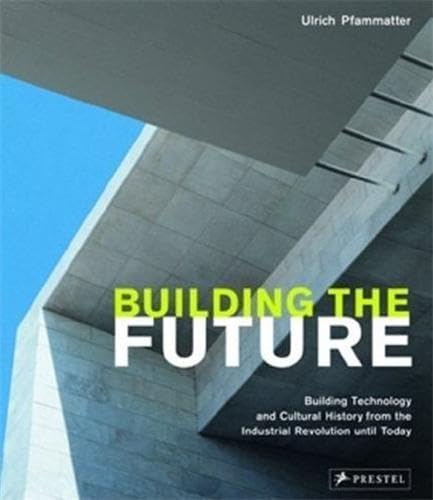
Imagen de portada de Amazon
Imagen de Amazon.com
Imagen de cubierta Syndetics
Portada de Syndetics
Imagen de OpenLibrary

Building the future : building technology and cultural history from the Industrial Revolution until today / Ulrich Pfammatter ; [translated from German by Jeremy Gaines and James Roderick O'Donovan]. txt

Por: Munich ; Berlin ; London ; New York : Prestel Verlag , 2008Descripción: 325 p. ill. (chiefly col.), plans 29 cmTipo de contenido:
  • text
Tipo de medio:
  • unmediaded
Tipo de soporte:
  • volume
ISBN:
  • 9783791339269
Títulos uniformes: Tema(s): Clasificación CDD:
  • 720.9 22
Clasificación LoC:
  • NA642 P43 2008
Contenidos:
From greenhouse to 'high-tech' hothouse' -- virtual experience space of industrial and communicative societies -- Building as an art or the art of building? Railway sheds, expo pavilions, terminals -- spatial landscapes of the future -- How concrete became lighter -- 100 years of concrete pioneers -- The 'liberated facade' -- from wall to partition to skin -- Process thinking conquers construction -- industrialisation from the balloon frame to the skyscraper -- "Sustainable building design" -- a future project -- Sir Ove Arup: the key search, 1970.
Valoración
    Valoración media: 0.0 (0 votos)
Existencias
Imagen de cubierta Tipo de ítem Biblioteca actual Biblioteca de origen Colección Ubicación en estantería Signatura topográfica Materiales especificados Info Vol URL Copia número Estado Notas Fecha de vencimiento Código de barras Reserva de ítems Prioridad de la cola de reserva de ejemplar Reservas para cursos
Libro CARIBET Biblioteca Arquitectura Colección General CARIBET General NA642 P43 2008 (Navegar estantería(Abre debajo)) 1 Disponible 91000000022582
Total de reservas: 0

Descripciones mejoradas de Syndetics:

"How have innovations in architecture and engineering come about? Who tested new approaches and when were important discoveries and experiments accepted? This book illuminates the history and development of building, in all its constructive, technical and cultural aspects, from the Industrial Revolution to the present and into the future. One hundred case scenarios articulate how new ideas, their context and ideology, became integral parts of the build environment. It also discusses which technical and creative mediums the pioneers and protagonists of the various trends and schools of thought used to articulate their ideas. The insightful texts and numerous images make this volume an essential handbook of architectural and structural history for students and professionals."--BOOK JACKET.

Includes bibliographical references (p. 313-317) and index.

From greenhouse to 'high-tech' hothouse' -- virtual experience space of industrial and communicative societies -- Building as an art or the art of building? Railway sheds, expo pavilions, terminals -- spatial landscapes of the future -- How concrete became lighter -- 100 years of concrete pioneers -- The 'liberated facade' -- from wall to partition to skin -- Process thinking conquers construction -- industrialisation from the balloon frame to the skyscraper -- "Sustainable building design" -- a future project -- Sir Ove Arup: the key search, 1970.

Reseñas proporcionadas por Syndetics

Library Journal Review

Pfammatter (building technology, Swiss Federal Inst. of Technology, Zurich) follows up his insightful The Making of the Modern Architect and Engineer with a peerless historical survey of modern architectural design and engineering. Distilled from a careerlong series of lectures, Pfammatter's sprawling, erudite treatise incorporates some 100 case studies, generously supplemented by high-quality photos, illustrations, and technical drawings. The case studies are grouped into six thematic chapters analyzing key building advances of the past 200 years, such as increasingly sophisticated uses of concrete and the evolution of the glass curtain wall from a static facade to an "intelligent envelope." Pfammatter's multidisciplinary approach offers American students of architecture and engineering a refreshingly international (tending toward Eurocentric) perspective on the evolution of their respective fields. One hopes that future editions will improve on the sometimes unidiomatic, pedantic English translation and will correct the obvious editorial errors, e.g., missing paragraphs and captions. Overall, this is highly recommended as a textbook and a reference resource for professional and academic collections.--David Soltesz, Cuyahoga Cty. P.L., Parma, OH (c) Copyright 2010. Library Journals LLC, a wholly owned subsidiary of Media Source, Inc. No redistribution permitted.

CHOICE Review

"The growing possibilities offered by industrial production form a permanent motor of development that repeatedly influences the world of building." Such is the theme of Building the Future by Pfammatter (Swiss Federal Institute of Technology). This well-written, well-researched, and beautifully presented book highlights epic design opportunities since 1775 that led to significant changes in architecture through the use of new materials technology. Organized into six chapters, it covers major new materials such as glass and concrete, along with structural space frame design and wall construction, ranging from skeletal to fabric skins. Each chapter begins with a historical overview with subheadings that become subchapters on specific topics. Three to five case studies (a hundred in all) follow each subchapter, showing the application of the material or structural concept. For example, the chapter on concrete has a case study on the mushroom column with the Johnson Wax Administration Building as one example. The book features detailed and informative historic illustrations, plus black-and-white and color photographs. It ends appropriately with Ove Arup's 1970 speech on modern ethics of design and building. Extensive notes, bibliography, index. Summing Up: Highly recommended. Lower-level undergraduates and above; general readers. L. B. Sickels Frank Lloyd Wright Foundation
Compartir
logopucpr-y-vive

Contáctanos

¡Queremos saber de ti!

Tel. 787.841.2000 Ext. 1801

bibliotecavaldes@pucpr.edu

⁣Búscanos en las redes

© 2026 Desarrollado por Ignite Online • All Rights Reserved • Powered by Koha.