Play, love and work -- Toys aren't us -- Screen play and iconic literacy -- Child play and parent angst -- Some misunderstandings about how young children learn -- Playing for a reason: building the units of math, reading, and science -- It isn't only a game: the role of play in becoming social -- Light-hearted parenting -- Schooling with heart, body, and mind -- Epilogue gifts for a lifetime.
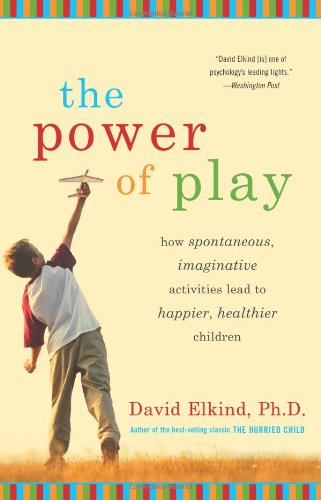
In modern childhood, free, unstructured play time is being replaced more and more by academics, lessons, competitive sports, and passive, electronic entertainment. While parents may worry that their children will be at a disadvantage if they are not engaged in constant, explicit learning or using the latest "educational" games, David Elkind's The Power of Play reassures us that unscheduled imaginative play goes far in preparing children for academic and social success. Through expert analysis of the research and powerful situational examples, Elkind shows that, indeed, creative spontaneous activity best sets the stage for academic learning in the first place: Children learn mutual respect and cooperation through role-playing and the negotiation of rules, which in turn prepare them for successful classroom learning; in simply playing with rocks, for example, a child could discover properties of counting and shapes that are the underpinnings of math; even a toddler's babbling is a necessary precursor to the acquisition of language. An important contribution to the literature about how children learn, The Power of Play suggests ways to restore play's respected place in children's lives, at home, at school, and in the larger community. In defense of unstructured "down time," it encourages parents to trust their instincts and resist the promise of the wide and dubious array of educational products on the market geared to youngsters.
Includes bibliographical references and index.
Play, love and work -- Toys aren't us -- Screen play and iconic literacy -- Child play and parent angst -- Some misunderstandings about how young children learn -- Playing for a reason: building the units of math, reading, and science -- It isn't only a game: the role of play in becoming social -- Light-hearted parenting -- Schooling with heart, body, and mind -- Epilogue gifts for a lifetime.
Tabla de contenidos provista por Syndetics
Introduction(p. ix)
I The Changing World of Play(p. 1)
1 Play, Love, and Work: An Essential Trio(p. 3)
2 Toys Aren't Us(p. 15)
3 Screen Play and Iconic Literacy(p. 37)
4 Child Play and Parent Angst(p. 63)
II Play, Learning, and Development(p. 87)
5 Misunderstandings About How Young Children Learn(p. 89)
6 Playing for a Reason: Building the Units of Math, Reading, and Science(p. 119)
7 It Isn't Only a Game: The Role of Play in Becoming Social(p. 145)
III The Power of Play(p. 169)
8 Lighthearted Parenting(p. 171)
9 Schooling with Heart, Mind, and Body(p. 195)
Epilogue: Gifts for a Lifetime(p. 217)
Acknowledgments(p. 219)
Notes(p. 221)
Other References(p. 227)
Index(p. 229)
Reseñas proporcionadas por Syndetics
Library Journal Review
Elkind (child development, Tufts Univ.; The Hurried Child: Growing Up Too Fast Too Soon) has contributed a timely book on the importance of unstructured play in the academic preparation and development of children, dispelling myths about kids being left behind if they are not submersed at an early age in organized sports and other controlled pursuits. Prescribing the trinity of play, love, and work, he shows how the integration of these elements at various stages of development, from infancy to adolescence, leads to happier, well-adjusted individuals with a greater potential for academic success. Elkind will connect with parents when he reveals that "Toys R Not Us" and argues that less is more; that children should use toys for inspiration, not distraction. This would then teach scientific curiosity and nourish concentration and attention skills. Replacing this unstructured time with formal instruction before the age of reason, he writes, only hinders motivation and creates frustration, as rote learning is anathema to critical thinking. He concludes by stating that the trinity of play, love, and work, which is successfully used in Montessori and Waldorf schools, should be the model for all education, not just early childhood programs. Highly recommended.-Julianne J. Smith, Ypsilanti Dist. Lib., MI (c) Copyright 2010. Library Journals LLC, a wholly owned subsidiary of Media Source, Inc. No redistribution permitted.
Publishers Weekly Review
In this fascinating look at the importance of letting kids be kids, Elkind argues that "Play is being silenced." According to Elkind, a child psychologist and author of All Grown Up and No Place to Go, important, unstructured play is too often replaced in modern times by organized activities, academics or passive leisure activities such as watching television and playing video games. Elkind explains how even toys have changed: "toys once served to socialize children into social roles, vocations, and academic tool skills. Today, they are more likely to encourage brand loyalties, fashion consciousness, and group think." Elkind acknowledges that technology has its place in the classroom, but debunks computer programs marketed toward babies and preschoolers whose young brains are not yet able to fully comprehend two-dimensional representations. "Parent peer pressure" is often to blame, causing parents to engage in "hyperparenting, overprotection, and overprogramming." Media-spread fears about everything from kidnapping and molestation to school shootings and SIDS can cause parents to forget that "children can play safely without adult organization; they have done so as long as people have been on earth." With clarity and insight, Elkind calls for society to bring back long recesses, encourage imagination and let children develop their minds at a natural pace. (Jan.) (c) Copyright PWxyz, LLC. All rights reserved
CHOICE Review
Older editions of The Random House Dictionary define "play" as "do[ing] something in sport that is not to be taken seriously." The notion of "not to be taken seriously" cannot be a part of anyone's understanding of play, at least if she is to heed the main point of this volume. Elkin (Tufts Univ.) means his book not as a summary of the most recent research on play. Rather, he intends it as an argument making the case for the developmental importance of play. Drawing on such diverse sources as Jean Piaget, Leo Tolstoy, and John Dewey, Elkind writes to convince parents and educators that they are doing right by their children if they facilitate, encourage, and, yes, even participate in their children's play. Although clearly aimed at teachers and parents, the book is full of helpful discussions and examples and will therefore be useful to a broad audience. Accordingly, the book's audience extends to anyone interested in parenting and child development. Summing Up: Recommended. Lower-/upper-division undergraduates; general readers; professionals. J. F. Heberle Albright College
Notas de autor provistas por Syndetics
David Elkind, PhD , is a professor emeritus of the Eliot-Pearson Department of Child Development at Tufts University and the author of more than a dozen books, including The Hurried Child and The Power of Play . Through his writings, media appearances, and lectures in the United States and abroad, he is recognized as one of the leading advocates for the preservation of childhood. He lives on Cape Cod.