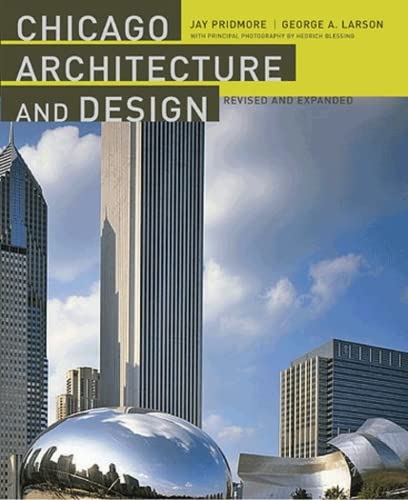
Imagen de portada de Amazon
Imagen de Amazon.com
Imagen de cubierta Syndetics
Portada de Syndetics
Imagen de OpenLibrary

Chicago architecture and design. Jay Pridmore, George A. Larson ; with principal photography by Hedrich Blessing. txt

Por: Colaborador(es): New York : Harry N. Abrams , 2005Edición: Rev. and expandedDescripción: 293 p. ill. ;col. ;photo. ; 29 cmTipo de contenido:
  • text
Tipo de medio:
  • unmediaded
Tipo de soporte:
  • volume
ISBN:
  • 9780810958920
  • 0810958929
Tema(s): Clasificación CDD:
  • 720.977311 22
Clasificación LoC:
  • NA735.C4 L37 2005
Contenidos:
Resumen: Chicago is world famous for an architectural tradition that has influenced building around the globe. It is the birthplace of the skyscraper and the cradle of modern architecture; it gave rise to the urban office building as we know it, and to the flowing, open floor plans of today's homes. This book chronicles Chicago's architectural tradition from the nineteenth through the early twenty-first century, examining its evolution in the context of broader historical, social, technological, and artistic currents. It explores Chicago architects' quest for a quintessentially American style, and the century of innovation that pushed buildings ever higher, opened them to space and light, and increasingly dissolved the boundaries between indoors and out. It looks at world-renowned structures from the inside out, giving special attention to the interiors that were and remain so important to Chicago's architects. Chicago School commercial building, to the low-slung Prairie School house, the streamlined Art Deco skyscraper, and the minimalist Miesian tower of glass and steel, all the way through to the strikingly original, diverse designs of the present day's so-called second modern movement. This eminently readable text vividly discusses both the life and work of such towering figures as Daniel Burnham, John Wellborn Root, Louis H. Sullivan, Frank Lloyd Wright, and Mies van der Rohe - as well as that of the many lesser-known architects who have made outstanding contributions.
Valoración
    Valoración media: 0.0 (0 votos)
Existencias
Imagen de cubierta Tipo de ítem Biblioteca actual Biblioteca de origen Colección Ubicación en estantería Signatura topográfica Materiales especificados Info Vol URL Copia número Estado Notas Fecha de vencimiento Código de barras Reserva de ítems Prioridad de la cola de reserva de ejemplar Reservas para cursos
Libro CARIBET Biblioteca Arquitectura Colección General CARIBET General NA735.C4 L37 2005 (Navegar estantería(Abre debajo)) 1 Disponible 91000000021303
Total de reservas: 0

Descripciones mejoradas de Syndetics:

The birthplace of the skyscraper, Chicago is noted for an architectural tradition that has influenced building around the globe. Now the most authoritative text on the subject is completely redesigned, revised, and expanded to bring the history up to date--with an all-new final chapter on the signature works of the last 20 years, up to and including Frank Gehry's Millennium Park band shell, whose curling ribbons of stainless steel added a dazzling new facet to the city's skyline in July 2004. Some 300 photographs, principally the work of the renowned Chicago studio Hedrich Blessing, illustrate the book. More than half of the photos are new. Looking at famous structures from the inside out, the book has won praise for its emphasis on the graceful interiors of Chicago's finest buildings. The vivid text discusses the life and work of such towering figures as Daniel Burnham, Louis H. Sullivan, Frank Lloyd Wright, and Mies van der Rohe, as well as that of the many lesser-known builders who have contributed to Chicago's reputation as "an architect's city.

Include index

Include Bibliography

Chapter one - Roots of modern architecture --
Chapter two - Chicago School --
Chapter three- Frank Lloyd Wright and the Prairie School --
Chapter four - From arts and crafts to art deco --
Chapter five - Meaning of Mies and the rise of modernism --
Chapter six - Modern and postmodern Chicago --
Chapter seven- Chicago's second modern period --

Chicago is world famous for an architectural tradition that has influenced building around the globe. It is the birthplace of the skyscraper and the cradle of modern architecture; it gave rise to the urban office building as we know it, and to the flowing, open floor plans of today's homes. This book chronicles Chicago's architectural tradition from the nineteenth through the early twenty-first century, examining its evolution in the context of broader historical, social, technological, and artistic currents. It explores Chicago architects' quest for a quintessentially American style, and the century of innovation that pushed buildings ever higher, opened them to space and light, and increasingly dissolved the boundaries between indoors and out. It looks at world-renowned structures from the inside out, giving special attention to the interiors that were and remain so important to Chicago's architects. Chicago School commercial building, to the low-slung Prairie School house, the streamlined Art Deco skyscraper, and the minimalist Miesian tower of glass and steel, all the way through to the strikingly original, diverse designs of the present day's so-called second modern movement. This eminently readable text vividly discusses both the life and work of such towering figures as Daniel Burnham, John Wellborn Root, Louis H. Sullivan, Frank Lloyd Wright, and Mies van der Rohe - as well as that of the many lesser-known architects who have made outstanding contributions.

Tabla de contenidos provista por Syndetics

  • Foreword(p. 7)
  • Preface(p. 11)
  • Acknowledgments(p. 14)
  • Chapter 1 The Roots of Modern Architecture(p. 19)
  • Chapter 2 The Chicago School(p. 41)
  • Chapter 3 Frank Lloyd Wright and the Prairie School(p. 87)
  • Chapter 4 From Arts and Crafts to Art Deco(p. 111)
  • Chapter 5 The Meaning of Mies and the Rise of Modernism(p. 137)
  • Chapter 6 Modern and Postmodern Chicago(p. 177)
  • Chapter 7 Chicago's Second Modern Period(p. 233)
  • Glossary(p. 279)
  • Bibliography(p. 283)
  • Index(p. 287)
  • Photograph Credits(p. 293)

Reseñas proporcionadas por Syndetics

Library Journal Review

Many books cover historic Chicago buildings, but this significant update of the 1993 classic is one of the few architecture histories to span the city's entire 170 years. Revisions include all-new chapters about the last 20 years in Chicago architecture, up to Frank Gehry's Millennium Park band shell (2004), and 150 brand-new photographs, bringing the total to 300. Pridmore, a freelance writer who has produced books about individual Chicago buildings, and Larson, director of design at Larson Associates, have crafted a solid chronological narrative of design trends and influential buildings of all types through the decades. While paying homage to such giants as Burnham, Sullivan, Wright, and Mies van der Rohe, they also discuss and illustrate the work of other significant Chicago-based architects and firms of various periods. Recommended for libraries with an interest in the region and for comprehensive architecture collections.-David R. Conn, Surrey P.L., B.C. (c) Copyright 2010. Library Journals LLC, a wholly owned subsidiary of Media Source, Inc. No redistribution permitted.

CHOICE Review

Although this handsome revised volume (1st ed. by George A. Larson and Pridmore, CH, Jan'94, 31-2482) predictably covers the long-known monuments from Chicago's well-documented architectural past, it also reveals numerous lesser-known but no less intriguing works, from small private residences to large civic structures, that deserve a wider audience. Some of these, like the 1930s residential work of Keck and Keck, when treated alongside examples by Mies or the Saarinens as they are here, reveal the breadth of Chicago modernist experimentation with form, structure, materials, or spatial layouts. Much of the most provocative information is conveyed in the (mostly) exquisite photographs and captions, such as that for the zany Nash Motors temporary pavilion for the 1933 Century of Progress Exposition. Its tall glass tower, filled with a vertically revolving belt of automobiles, presaged the postmodern building-as-advertising-sign (shades of Venturi and SITE!). The book culminates with the minimal severity of Tadao Ando's first major US project, a 1997 private house, and the expected exuberance of Frank Gehry's 2004 band shell at Millennium Park--a metaphor for the range and variety of the first-rank architectural work that this city has offered since the late 19th century. ^BSumming Up: Essential. All levels. R. J. Onorato University of Rhode Island

Notas de autor provistas por Syndetics

George A. Larson is chairman and director of design of Larson Associates, Chicago and New York.
Compartir
logopucpr-y-vive

Contáctanos

¡Queremos saber de ti!

Tel. 787.841.2000 Ext. 1801

bibliotecavaldes@pucpr.edu

⁣Búscanos en las redes

© 2026 Desarrollado por Ignite Online • All Rights Reserved • Powered by Koha.