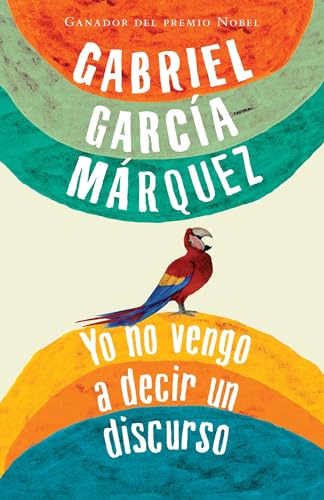

Yo no vengo a decir un discurso by Gabriel García Márquez.
Detalles de publicación: New York Vintage Español 2010.Edición: Primera edición Vintage EspañolDescripción: 151[3]p. 20cmISBN:- 9780307743459
- PQ8180.17.A73 A6 2010
| Imagen de cubierta | Tipo de ítem | Biblioteca actual | Biblioteca de origen | Colección | Ubicación en estantería | Signatura topográfica | Materiales especificados | Info Vol | URL | Copia número | Estado | Notas | Fecha de vencimiento | Código de barras | Reserva de ítems | Prioridad de la cola de reserva de ejemplar | Reservas para cursos | |
|---|---|---|---|---|---|---|---|---|---|---|---|---|---|---|---|---|---|---|
| Libro | Biblioteca Encarnación Valdés Colección General bev | Co 865 G216y 2010 (Navegar estantería(Abre debajo)) | Disponible | 80000002428822 | ||||||||||||||
| Libro | Biblioteca Mons. Iñaki Mallona (Arecibo) Colección General ab | Co 865 G216y (Navegar estantería(Abre debajo)) | Disponible | 60000010126164 |
Descripciones mejoradas de Syndetics:
"¿Qué hago yo encaramado en esta percha de honor, yo que siempre he considerado los discursos como el más terrorífico de los compromisos humanos?" --Gabriel García Márquez
nbsp;
Los textos que Gabriel García Márquez ha reunido en este libro fueron escritos por el autor con la intención de ser leídos por él mismo en público, ante una audiencia, y recorren prácticamente toda su vida, desde el primero, que escribe a los diecisiete años para despedir a sus compañeros del curso superior en Zipaquirá, hasta el que lee ante las Academias de la Lengua y los reyes de España al cumplir ochenta años.
nbsp;nbsp;nbsp;nbsp;nbsp;nbsp;nbsp;nbsp;nbsp;nbsp;nbsp; Estos discursos del premio Nobel nos ayudan a comprender más profundamente su vida y nos desvelan sus obsesiones fundamentales como escritor y ciudadano: su fervorosa vocación por la literatura, la pasión por el periodismo, su inquietud ante el desastre ecológico que se avecina, su propuesta de simplificar la gramática, los problemas de su tierra colombiana o el recuerdo emocionado de amigos escritores como Julio Cortázar o Álvaro Mutis, entre otros muchos.
nbsp;nbsp;nbsp;nbsp;nbsp;nbsp;nbsp;nbsp;nbsp;nbsp;nbsp; El lector tiene entra sus manos el complemento indispensable a una obra narrativa que nos seguirá hablando en un largo porvenir.
****
"What am I doing here on this perch of honor, when I have always considered speeches the most terrifying of human obligations?"
nbsp;
The speeches that Gabriel García Márquez has gathered in this collection were written by the author with the intention of being read by him before an audience, and span the course of nearly his entire life; from the first, a farewell written at seventeen to his fellow students at Zipaquirá, to his appearance before the Spanish-language Academies and the kings of Spain on his eightieth birthday.
Combined, these speeches provide a more profound understanding of the life of this Nobel Prize winner, revealing his fundamental creative and civil obsessions: his intense aptitude for literature and writing; his passion for journalism; his concerns over looming environmental dangers; his proposal for the simplification of grammar; the problems facing his beloved Colombian homeland; and the loving memory of fellow writers like Julio Cortázar and Álvaro Mutis, among many others.
In Yo no vengo a decir un discurso (I did not come to give a speech), the reader holds in his/her hands the essential complement to a body of work that will continue speaking to us for a long time to come.
Extracto provisto por Syndetics
Notas de autor provistas por Syndetics
Gabriel García Márquez was born in Aracataca, Colombia on March 6, 1927. After studying law and journalism at the National University of Colombia in Bogota, he became a journalist. In 1965, he left journalism, to devote himself to writing. His works included Leaf Storm, No One Writes to the Colonel, The Evil Hour, One Hundred Years of Solitude, Love in the Time of Cholera, The Autumn of the Patriarch, Chronicle of a Death Foretold, The General in His Labyrinth, Clandestine in Chile, and the memoir Living to Tell the Tale. He won the Nobel Prize for Literature in 1982. He died on April 17, 2014 at the age of 87.(Bowker Author Biography)