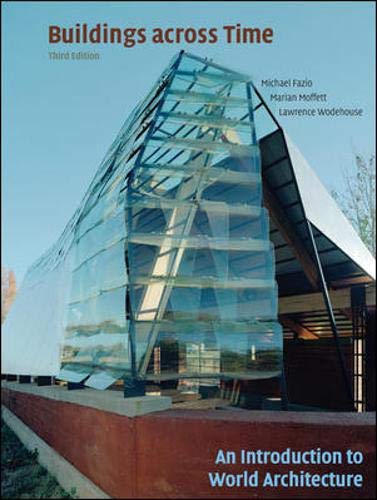

Buildings across time an introduction to world architecture Michael Fazio, Marian Moffett, Lawrence Wodehouse. txt
Boston McGraw-Hill Higher Education 2009Edición: Third editionDescripción: xvi, 592 p. ill. (some col.), col. maps 30 cmTipo de contenido:- text
- unmediaded
- volume
- 9780073053042
- 007305304X
- 720.9 21
- NA200 F395 2009
| Imagen de cubierta | Tipo de ítem | Biblioteca actual | Biblioteca de origen | Colección | Ubicación en estantería | Signatura topográfica | Materiales especificados | Info Vol | URL | Copia número | Estado | Notas | Fecha de vencimiento | Código de barras | Reserva de ítems | Prioridad de la cola de reserva de ejemplar | Reservas para cursos | |
|---|---|---|---|---|---|---|---|---|---|---|---|---|---|---|---|---|---|---|
| Libro | CARIBET Biblioteca Arquitectura Colección General CARIBET | General NA200 F395 2009 (Navegar estantería(Abre debajo)) | 1 | Disponible | 91000000019299 | |||||||||||||
| Reserva | CARIBET Biblioteca Arquitectura Colección de Referencia CARIBET | Referencia NA200 F395 2009 (Navegar estantería(Abre debajo)) | 2 | Disponible | 91000000016758 |
Descripciones mejoradas de Syndetics:
This heavily illustrated survey text provides students of both art history and architecture with a worldwide introduction to the history of architecture that is comprehensive and yet accessible. The third edition continues to offer comprehensive coverage in an accessible manner with expanded pedagogy, added social and historical context, and extended coverage of African and Andean architecture, as well as modern designs by women and non-Western architects.
Issued also under title: A world history of architecture.
Includes bibliographical references (p. 572-575) and index.
Tabla de contenidos provista por Syndetics
- Introduction A Word about Drawings and Images
- 1 The Beginnings of Architecture Prehistoric Settlements and Megalith Constructions Ancient Mesopotamia Ancient Egypt
- 2 The Greek World The Aegean Cultures The Minoans The Mycenaeans Greece
- The Archaic Period Greece: The Classical Period Greece: The Hellenistic Period Greek City Planning
- 3 The Architecture of Ancient India and Southeast Asia Religions of India Early Buddhist Shrines Hindu Temples
- 4 Traditional Architecture of China and Japan
- Chinese Architectural Principles Principles of City Planning Houses and Gardens
- Japanese Temple Architecture Japanese Houses and Castles Zen Buddhist Architecture and Its Derivatives
- 5 The Roman World Etruscan Imprints The Romans Building Techniques and Materials City Planning Temples Public Buildings Residences
- 6 Early Christian and Byzantine Architecture Early Christian Basilicas Martyria, Baptisteries, and Mausolea Byzantine Basilicas and Domed
- Basilicas Centrally Planned Byzantine Churches Churches in Russia
- 7 Islamic Architecture Early Shrines and Palaces Conception of the Mosque
- Regional Variations in Mosque Design Tombs Houses and Urban Patterns
- The Palace and the Garden
- 8 Early Medieval and Romanesque Architecture
- Carolingian Architecture Viking Architecture
- Early Romanesque Architecture
- Romanesque Architecture of the Holy Roman Empire Pilgrimage Road Churches
- The Order of Cluny Aquitaine and Provence Cistercian Monasteries Norman Architecture
- 9 Gothic Architecture Early Gothic High Gothic English Gothic German, Czech, and Italian Gothic
- Medieval Construction Medieval Houses and Castles Medieval Cities
- 10 Indigenous Architecture in the Pre-Columbian Americas North America Mexico and Central America South America
- The Andean World Africa
- 11 Renaissance Architecture Filippo Brunelleschi Michelozzo Bartolomeo and the
- Other Renaissance City Plans The Spread of the Renaissance Leonardo da Vinci Donato Bramante
- The Late Renaissance and Mannerism Michelangelo Andrea Palladio Palladio's Venice Garden Design
- The Renaissance in France
- The Renaissance in England
- 12 Baroque Architecture
- The Reformation and Counter Reformation Pope Sixtus V and the Replanning of Rome Gianlorenzo Bernini Francesco Borromini Urban
- Open Spaces in Baroque Rome The Spread of Baroque Architecture to Northern Italy
- The Baroque in Central Europe
- The Baroque in France Christopher Wren and the Baroque in England
- 13 The Eighteenth Century The English Neo-Palladians
- The Return to Antiquity
- Étienne-Louis Boullée and Claude-Nicolas Ledoux French Architects and the Aggrandizement of the State Designs by the Pensionnaires
- French Architectural Education and the Ecole de Beaux Arts
- The Challenge of the Industrial Revolution Romanticism and the Picturesque
- The Romantic Landscape Picturesque Buildings
- 14 Nineteenth Century Developments Neo-Classicism The Gothic Revival
- The Ecole des Beaux-Arts Developments in Steel Architectural Applications of Iron and Steel Construction Skeletal Construction in Concrete and Wood
- The Arts and Crafts Movement Art Nouveau
- The Viennese Secession
- The Search for an American Style
- 15 The Twentieth Century and Modernism The Idea of a Modern Architecture Adolf Loos
- The Modern Masters Frank Lloyd Wright Peter Behrens and the Deutscher Werkbund Futurism and Constructivism Dutch and German Expressionism Art
- Exploiting the Potential of Concrete Le Corbusier Walter Gropius Ludwig Mies
Notas de autor provistas por Syndetics
Michael Fazio is an architect and architectural historian. He holds a Bachelor of Architecture Degree from Auburn University, a Master of Architecture Degree from The Ohio State University, and a Ph.D. in the History of Architecture and Urban Development from Cornell University. He practices architecture in the southeast region, most often as a preservation consultant preparing historic structures reports. He teaches architectural design studios and architectural history in the School of Architecture at Mississippi State University. He is also an actively publishing scholar whose articles have appeared in the Society of Architectural Historians Journal, Arris (the journal of the Southeast Society of Architectural Historians), and the Journal of Architectural Education. His book (with co-author Patrick Snadon of the University of Cincinnati), Inventing the American House: the Domestic Architecture of Benjamin Henry Latrobe , was published in 2003 by The Johns Hopkins University Press and was accompanied by an exhibition at The Octagon and Decatur House in Washington, D.C.Marian Moffett earned a B.Arch. at North Carolina State University (1971) and the M.Arch. and PhD. at the Massachusetts Institute of Technology (1973 and 1975, respectively). She taught architectural history at he University of Tennessee from 1975 until her death in 2004 where she collaborated with Lawrence Wodehouse in producing exhibitions and catalogs on the architecture of the Tennessee Valley Authority and cantilever barns, as well as co-authoring A History of Western Architecture and East Tennessee Cantilever Barns . Her research included work on wooden architecture in Eastern Europe and town planning in Tennessee. She was active with the Southeast Chapter of the Society of Architectural Historians and has served as President of the UT Faculty Senate and as an academic administrator in the Office of the Provost.
Lawrence Wodehouse was an Architecture professor at the University of Tennessee, Knoxville from 1979 to 1993. Wodehouse worked as a professor of Architecture at the Pratt Institute in New York prior to coming to the University of Tennessee. Lawrence Wodehouse received his master's degree from Cornell in 1963 and his Ph.D. from St. Andrews University in 1980. His major research concentrations have been in 19th and 20th century architecture and also the vernacular architecture of East Tennessee. He has coauthored two books with Marian Moffett, The Cantilever Barn in East Tennessee , and also Built for the People of the United States: Fifty Years of TVA Architecture . Lawrence Wodehouse retired in the spring of 1993 and died in 2002.