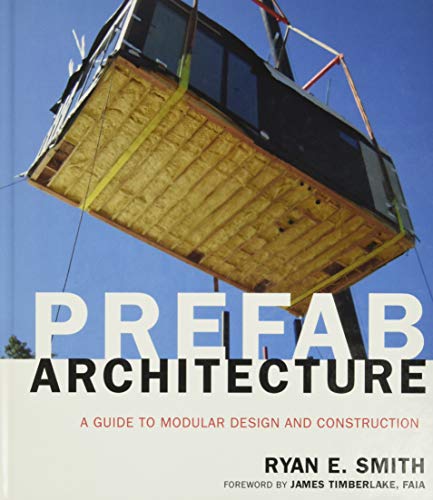

Prefab architecture a guide for architects and construction professionals Ryan E. Smith ; foreword by James Timberlake.
Idioma: Español Detalles de publicación: Hoboken, N.J. John Wiley & Sons 2011.Descripción: p. cmISBN:- 9780470275610
- Guide for architects and construction professionals
- 721/.04497 22
- NA8480 .S66 2011
| Imagen de cubierta | Tipo de ítem | Biblioteca actual | Biblioteca de origen | Colección | Ubicación en estantería | Signatura topográfica | Materiales especificados | Info Vol | URL | Copia número | Estado | Notas | Fecha de vencimiento | Código de barras | Reserva de ítems | Prioridad de la cola de reserva de ejemplar | Reservas para cursos | |
|---|---|---|---|---|---|---|---|---|---|---|---|---|---|---|---|---|---|---|
| Libro | CARIBET Biblioteca Arquitectura Colección General CARIBET | NA8480 .S66 2011 (Navegar estantería(Abre debajo)) | Disponible | 91000000019604 |
Descripciones mejoradas de Syndetics:
" Prefab Architecture . . . is beyond theory, and beyond most of what we think we know about pods, containers, mods, and joints. This book is more than 'Prefabrication 101.' It is the Joy of Cooking writ large for the architecture and construction industries." --From the Foreword by James Timberlake, FAIA
THE DEFINITIVE REFERENCE ON PREFAB ARCHITECTURE FOR ARCHITECTS AND CONSTRUCTION PROFESSIONALS
Written for architects and related design and construction professionals, Prefab Architecture is a guide to off-site construction, presenting the opportunities and challenges associated with designing and building with components, panels, and modules. It presents the drawbacks of building in situ (on-site) and demonstrates why prefabrication is the smarter choice for better integration of products and processes, more efficient delivery, and realizing more value in project life cycles. In addition, Prefab Architecture provides:
A selected history of prefabrication from the Industrial Revolution to current computer numerical control, and a theory of production from integrated processes to lean manufacturing Coverage on the tradeoffs of off-site fabrication including scope, schedule, and cost with the associated principles of labor, risk, and quality Up-to-date products featuring examples of prefabricated structure, enclosure, service, and nterior building systems Documentation on the constraints and execution of manufacturing, factory production, transportation, and assembly Dozens of recent examples of prefab projects by contemporary architects and fabricators including KieranTimberlake, SHoP Architects, Office dA, Michelle Kaufmann, and many othersIn Prefab Architecture , the fresh approaches toward creating buildings that accurately convey ature and expanded green building methodologies make this book an important voice for adopting change in a construction industry entrenched in traditions of the past.
Includes bibliographical references and index.
Context. History of industrialized building -- History of industrialized architecture -- Environment, organization, technology -- Application. principles --Fundamentals -- Elements -- Assembly -- Sustainability -- Case studies. Housing -- Commercial -- Conclusion.
Tabla de contenidos provista por Syndetics
- Foreword: James Timberlake, FAIA
- Introduction
- Acknowledgments
- Part A Context
- Chapter 1 History of Industrialized Building
- Chapter 2 History of Industrialized Architecture
- Chapter 3 Environment, Organization, Technology
- Part B Application
- Chapter 4 Principles
- Chapter 5 Fundamentals
- Chapter 6 Elements
- Chapter 7 Assembly
- Chapter 8 Sustainability
- Part C Case Studies
- Chapter 9 Housing
- Chapter 10 Commercial
- Part D Conclusion
- Chapter 11 Conclusion
- End Notes
- Illustration Credits
- Index
Notas de autor provistas por Syndetics
RYAN E. SMITH is Director of the Integrated Technology in Architecture Center (I TAC), an interdisciplinary research consortium at the University of Utah College of Architecture + Planning in Salt Lake City, Utah (www.itac.utah.edu). Smith's research and teaching focuses on promoting integration that leads to sustainable and lean design and construction practice.