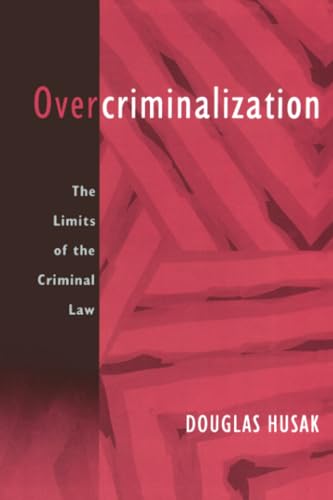

Overcriminalization the limits of the criminal law Douglas Husak.
Detalles de publicación: New York Oxford University Press 2008.Descripción: x, 231 p. 25 cmISBN:- 9780195399011
- Over criminalization
- 345.73 H968o 22
- KF9223 .H87 2008
| Imagen de cubierta | Tipo de ítem | Biblioteca actual | Biblioteca de origen | Colección | Ubicación en estantería | Signatura topográfica | Materiales especificados | Info Vol | URL | Copia número | Estado | Notas | Fecha de vencimiento | Código de barras | Reserva de ítems | Prioridad de la cola de reserva de ejemplar | Reservas para cursos | |
|---|---|---|---|---|---|---|---|---|---|---|---|---|---|---|---|---|---|---|
| Libro | Biblioteca Encarnación Valdés Colección General bev | 345.73 H968o (Navegar estantería(Abre debajo)) | Disponible | 80000002429259 |
Descripciones mejoradas de Syndetics:
The United States today suffers from too much criminal law and too much punishment. Husak describes the phenomena in some detail and explores their relation, and why these trends produce massive injustice. His primary goal is to defend a set of constraints that limit the authority of states to enact and enforce penal offenses. The book urges the weight and relevance of this topic in the real world, and notes that most Anglo-American legal philosophers have neglected it. Husak's secondary goal is to situate this endeavor in criminal theory as traditionally construed. He argues that many of the resources to reduce the size and scope of the criminal law can be derived from within the criminal law itself-even though these resources have not been used explicitly for this purpose. Additional constraints emerge from a political view about the conditions under which important rights such as the right implicated by punishment - may be infringed. When conjoined, these constraints produce what Husak calls a minimalist theory of criminal liability. Husak applies these constraints to a handful of examples-most notably, to the justifiability of drug proscriptions.
Includes bibliographical references (p. 209-224) and index.
Tabla de contenidos provista por Syndetics
- 1 The Amount of Criminal Law(p. 3)
- I Too Much Punishment, Too Many Crimes(p. 4)
- II How Mare Crimes Produce Injustice(p. 17)
- III The Content of New Offenses(p. 33)
- IV An Example of Overcriminalization(p. 45)
- 2 Internal Constraints on Criminalization(p. 55)
- I The "General Part" of Criminal Law(p. 58)
- II From Punishment to Criminalization(p. 77)
- III A Right Not to Be Punished?(p. 92)
- IV Malum Prohibitum(p. 103)
- 3 External Constraints on Criminalization(p. 120)
- I Infringing the Right Not to Be Punished(p. 122)
- II The Devil in the Details(p. 132)
- III Crimes of Risk Prevention(p. 159)
- 4 Alternative Theories of Criminalization(p. 178)
- I Law and Economics(p. 180)
- II Utilitarianism(p. 188)
- III Legal Moralism(p. 196)
- Table of Cases(p. 207)
- Bibliography(p. 209)
- Index(p. 225)