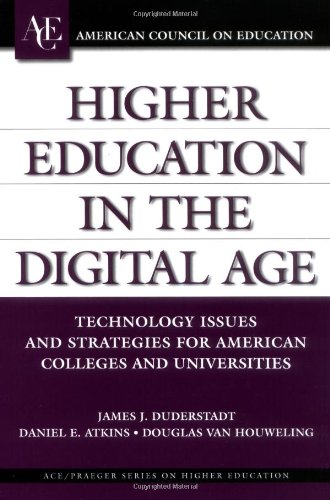

Higher education in the digital age technology issues and strategies for American colleges and universities James J. Duderstadt, Daniel E. Atkins, Douglas Van Houweling.
Series American Council on Education/Praeger series on higher educationDetalles de publicación: Westport, CT Praeger 2002.Descripción: xi, 288 p. 24 cmISBN:- 1573565202 (alk. paper)
- 378.73 D845h 21
- LB2395.7 .D83 2002
| Imagen de cubierta | Tipo de ítem | Biblioteca actual | Biblioteca de origen | Colección | Ubicación en estantería | Signatura topográfica | Materiales especificados | Info Vol | URL | Copia número | Estado | Notas | Fecha de vencimiento | Código de barras | Reserva de ítems | Prioridad de la cola de reserva de ejemplar | Reservas para cursos | |
|---|---|---|---|---|---|---|---|---|---|---|---|---|---|---|---|---|---|---|
| Libro | Biblioteca Encarnación Valdés Colección General bev | 378.73 D845h (Navegar estantería(Abre debajo)) | Disponible | 80000002427162 |
Descripciones mejoradas de Syndetics:
Academic management and administrative processes rely heavily on technology in business offices, virtual laboratories, digital libraries, and the like. Technology also has an impact upon teaching, freeing classrooms from constraints of time and space. Yet many university leaders are hesitant to set technology as a priority. This book is designed to address the subject from a perspective appropriate to leaders.
An important concept covered here is that the new advances in information technology drive a significant restructuring of our social institutions, which will provide access to knowledge and education that was formerly restricted to the privileged. The generation raised with this technology demands new approaches to teaching and learning-this poses a unique challenge to traditional faculty members.
The authors of this book believe "It is our collective challenge as scholars, educators, and academic leaders to develop a strategic framework capable of understanding and shaping the impact that this extraordinary technology will have on our institutions." They believe that academic institutions will change in form and character, and that such changes will affect the mission, function, and possibly even the concept of the university. The role of leadership is to both see over the horizon and adapt leadership styles to an environment of constant change. Leadership must formulate a clear and consistent institutional vision.
Includes bibliographical references (p. [277]-282) and index.
Tabla de contenidos provista por Syndetics
- Preface(p. vii)
- Part I Introduction(p. 1)
- Chapter 1 Higher Education Faces a Brave New World(p. 3)
- Chapter 2 The Evolution of Information Technology(p. 23)
- Part II Issues, Trends, and Themes(p. 53)
- Chapter 3 The Impact of Information Technology on the Activities of the University(p. 55)
- Chapter 4 The Impact of Information Technology on the Form, Function, and Financing of the University(p. 91)
- Chapter 5 The Impact of Information Technology on the Higher Education Enterprise(p. 117)
- Chapter 6 Visions for the Future of the University(p. 149)
- Part III Strategies and Recommendations(p. 171)
- Chapter 7 Institutional Strategies(p. 173)
- Chapter 8 Responding to Market Forces(p. 207)
- Chapter 9 Addressing the Needs of the Nation(p. 231)
- Chapter 10 The Future of the University in the Digital Age(p. 265)
- Notes(p. 275)
- Bibliography(p. 277)
- Index(p. 283)
- About the Authors(p. 289)
Notas de autor provistas por Syndetics
James J. Duderstadt is President Emeritus and University Professor of Science and Engineering at the University of MichiganDaniel E. Atkins is Professor of Computer Science and Information at the University of Michigan
Douglas Van Houweling is President and CEO of the University Corporation for Advanced Internet Development (UCAID)