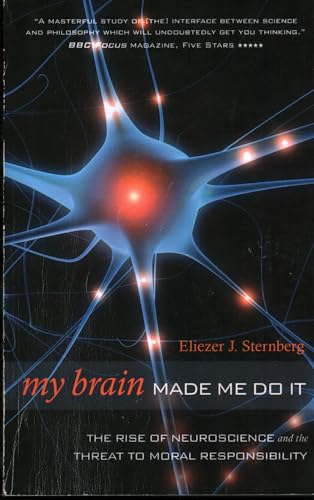

My brain made me do it : the rise of neuroscience and the threat to moral responsibility / Eliezer J. Sternberg.
Detalles de publicación: New York : Prometheus , 2010.Descripción: 244 p. 23cmTipo de contenido:- 9781616141653
| Imagen de cubierta | Tipo de ítem | Biblioteca actual | Biblioteca de origen | Colección | Ubicación en estantería | Signatura topográfica | Materiales especificados | Info Vol | URL | Copia número | Estado | Notas | Fecha de vencimiento | Código de barras | Reserva de ítems | Prioridad de la cola de reserva de ejemplar | Reservas para cursos | |
|---|---|---|---|---|---|---|---|---|---|---|---|---|---|---|---|---|---|---|
| Libro | Biblioteca de Mayagüez Colección General mb | BJ 1461 .S695 2010 (Navegar estantería(Abre debajo)) | Disponible | 50000003204806 |
Descripciones mejoradas de Syndetics:
As scientists continue to explore how the brain works, using ever more sophisticated technology, it seems likely that new findings will radically alter the traditional understanding of human nature. One aspect of human nature that is already being questioned by recent developments in neuroscience is free will. Do our decisions arise from purely mechanistic processes? Is our feeling of self-control merely an illusion created by our brains? If so, what will become of free will and moral responsibility? These thorny questions and many more are examined with great clarity and insight in this engaging exploration of neuroscience's potential impact on moral responsibility. The author delves into a host of fascinating topics, including:-the parts of the brain that scientists believe are involved in the exercise of will-what Parkinson's, Tourette's, and schizophrenia reveal about our ability to control our actions-whether criminal behavior is determined by brain chemistry-how self-reflective consciousness may have evolved from a largely deterministic brainUsing illustrative examples from philosophy, mythology, history, and criminology, and with thorough discussions of actual scientific experiments, the author explores the threat of neuroscience to moral responsibility as he attempts to answer the question: Are we truly in control of our actions?
Includes bibliographical references and index.
eigm 04/2011
Tabla de contenidos provista por Syndetics
- Foreword(p. 9)
- Acknowledgments(p. 15)
- Introduction(p. 17)
- 1 The Nefarious Neuron(p. 21)
- 2 The Shadow of Determinism(p. 27)
- 3 The Essential Freedom(p. 35)
- 4 A Tempest in the Brain(p. 43)
- 5 Neurological Disturbance(p. 53)
- 6 The Seat of the Will(p. 61)
- 7 The Somatic-Marker Hypothesis(p. 67)
- 8 The Readiness Potential(p. 77)
- 9 The Grand Illusion(p. 87)
- 10 Neuronal Destiny(p. 99)
- 11 The Revolution of the Brain(p. 111)
- 12 Seeds of Corruption(p. 121)
- 13 Morality's End(p. 135)
- 14 The Depths of Consciousness(p. 143)
- 15 A Challenge for Experience(p. 155)
- 16 The Boundlessness of Reason(p. 169)
- 17 Rise of the Moral Agent(p. 185)
- 18 The Palace of the Mind(p. 191)
- Further Readings(p. 201)
- Notes(p. 211)
- Bibliography(p. 227)
- Index(p. 239)