Descripciones mejoradas de Syndetics:
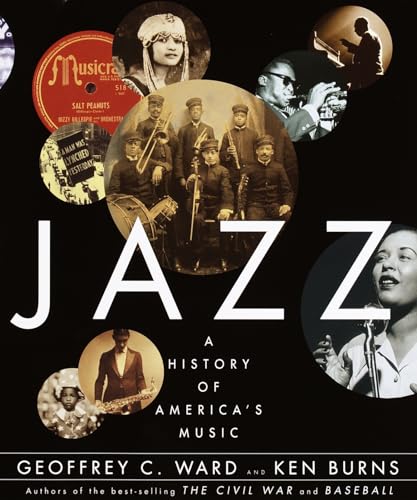
A masterpiece that brings to life the fascinating story of the quintessential American music--jazz. Visually stunning, with more than five hundred photographs, this companion volume to the acclaimed ten-part PBS TV series is an exploration of the music that celebrates all Americans at their best.
Here are the stories of the extraordinary men and women who made the music: Louis Armstrong, the fatherless waif whose unrivaled genius helped turn jazz into a soloist's art and influenced every singer, every instrumentalist who came after him; Duke Ellington, the pampered son of middle-class parents who turned a whole orchestra into his personal instrument, wrote nearly two thousand pieces for it, and captured more of American life than any other composer. Bix Beiderbecke, the doomed cornet prodigy who showed white musicians that they too could make an important contribution to the music; Benny Goodman, the immigrants' son who learned the clarinet to help feed his family, but who grew up to teach a whole country how to dance; Billie Holiday, whose distinctive style routinely transformed mediocre music into great art; Charlie Parker, who helped lead a musical revolution, only to destroy himself at thirty-four; and Miles Davis, whose search for fresh ways to sound made him the most influential jazz musician of his generation, and then led him to abandon jazz altogether. Buddy Bolden, Jelly Roll Morton, Dizzy Gillespie, Art Tatum, Count Basie, Dave Brubeck, Artie Shaw, and Ella Fitzgerald are all here; so are Sidney Bechet, Coleman Hawkins, Lester Young, John Coltrane, Ornette Coleman, and a host of others.
But Jazz is more than mere biography. The history of the music echoes the history of twentieth-century America. Jazz provided the background for the giddy era that F. Scott Fitzgerald called the Jazz Age. The irresistible pulse of big-band swing lifted the spirits and boosted American morale during the Great Depression and World War II. The virtuosic, demanding style called bebop mirrored the stepped-up pace and dislocation that came with peace. During the Cold War era, jazz served as a propaganda weapon--and forged links with the burgeoning counterculture. The story of jazz encompasses the story of American courtship and show business; the epic growth of great cities--New Orleans and Chicago, Kansas City and New York--and the struggle for civil rights and simple justice that continues into the new millennium.
Includes bibliographical references (p. 465-470) and index.
Reseñas proporcionadas por Syndetics
Library Journal Review
As a stand-alone volume, this fluidly written and visually satisfying book is highly recommended for all public libraries and for all academic libraries looking for an excellent general history of the musical genre. As a companion to Burns's 19-hour PBS television series of the same name, set to air in January 2001, it is an essential purchase. The authors, who previously collaborated on Baseball and The Civil War (also companions to Burns's films), have assembled a comprehensive history with a focus on the musicians and the sociology of jazz. Those looking for a highly technical, theoretical study of the music will have to look elsewhere, as this book, containing no notated musical examples and using little technical musical language, is clearly intended for the general public and for fans of jazz. However, this guide is so well written, well researched, and probing of the complex relationship between jazz and American society that even professional musicians and musicologists will find something of interest. The short articles by Wynton Marsalis, Dan Morgenstern, Gerald Early, Stanley Crouch, and Gary Giddins, which are woven into the text, provide a more specific focus on a number of jazz's aspects. While this reviewer suspects that a fair number of patrons will turn to public libraries for the documentary and purchase the book themselves, the acquisition of Jazz will undoubtedly and deservedly boost circulation statistics.DJames E. Perone, Mount Union Coll., Alliance, OH (c) Copyright 2010. Library Journals LLC, a wholly owned subsidiary of Media Source, Inc. No redistribution permitted.
Publishers Weekly Review
A companion volume to the new Burns and Ward documentaryDa 19-hour, 10-episode series set to air on PBS in January, 2001Dthis lavishly illustrated history describes the evolution of jazz during the 20th century, focusing on the careers of a key players like Duke Ellington, Louis Armstrong, Charlie Parker, Miles Davis and Benny Goodman. In his introduction to the massive volume, Burns writes that his decision to make Jazz was inspired by a comment made by Gerald Early, a writer he interviewed for the authors' last documentary, Baseball. "Two thousand years from now," Early said, "there will only be three things that Americans will be known for: The Constitution, baseball and jazz music." Burns admits he knew next to nothing about jazz before deciding to create "the most comprehensive treatment of jazz ever committed to film," and there lies the work's Achilles' heel. Burns has his conclusionDthat jazz is a metaphor for the United StatesDfirmly in hand before he begins to know his subject. This smugness translates into a rather tepid, conservative view of jazz. Not every subject or musician can be touched upon in one book; however, it does seem strange that such a sweepingly titled volume does not touch upon the musical roots of jazz, e.g. Africa's talking drums, or mention the Lockbourne Airforce Base, where many noted black jazz musicians received training. The entire 40-year period from 1960 forward is relegated to a single chapter, a rather pronounced statement about how the authors feel about more recent achievements. More than 500 illustrations and photos. (Nov. 6) (c) Copyright PWxyz, LLC. All rights reserved
School Library Journal Review
Adult/High School-A companion to Ken Burns's television series, this will be a welcome addition. Hundreds of photographs, a few of the more recent in color, but mostly in black and white, will draw teens into this wonderful introduction to an American art form. The images alone are worth the price. Many have never been published before. However, the detailed text is a resource for both the history of jazz and the people who developed it. Arranged chronologically, the work shows how music reflects the culture and events of its time. The reciprocal is also true; the events of the 20th century from boom, depression, and war are shown in the music of the period. Given the ethnic roots of jazz, this history also includes the roles of racist economic hardships. Although the emphasis is on the beginning years from the Creoles of color in New Orleans through Louis Armstrong, Jelly Roll Morton, Duke Ellington, and Sarah Vaughan, to name only a few, the current status is not forgotten; a photo of Wynton Marsalis concludes the book. The biographical details of first-person memories will be of interest to report writers. An outstanding resource.-Claudia Moore, W. T. Woodson High School, Fairfax, VA (c) Copyright 2010. Library Journals LLC, a wholly owned subsidiary of Media Source, Inc. No redistribution permitted.
Booklist Review
Ward, the writer, and Burns, the filmmaker, collaborated on the hugely popular Civil War and Baseball "packages" (a book accompanying a PBS television documentary). With Jazz, Burn states, "we complete our trilogy on American life, finding in the music's lines and phrases and riffs not only a meditation on American creativity, but a joyous and sublime celebration of its redemptive future possibilities." The 10-part documentary of the first American music is slated for broadcast in January 2001 and will run 19 hours. This book will assist in providing the advance publicity to ensure the film's success. Already the project is stirring up controversy among jazz critics and fans. The historical approach has particularly come under fire, for Burns uses the suspect "Great Man" perspective, relying on following the lives of Louis Armstrong, Duke Ellington, Charlie Parker, and Miles Davis to carry the history of jazz, for the most part, which is certain to raise cries, or rather screams, of protest. Also, many would rather have another proponent of the music besides Wynton Marsalis taking center stage as jazz authority, but that, too, is a quibble in terms of a history of jazz for the general public. The book follows that program, but, for a general survey of such a protean music, it's quite serviceable. Besides the Marsalis interview and numerous learned Marsalis quotes sprinkled throughout, Ward and Burns include essays by Dan Morgenstern, Gerald Early, Gary Giddens, and Stanley Crouch. The illustrations are copious, including about 500 pieces and running from cover to cover; the text, picture captions, and sidebars reflect the research that went into the six-year project. A very competent and lovingly rendered history. --Bonnie Smothers