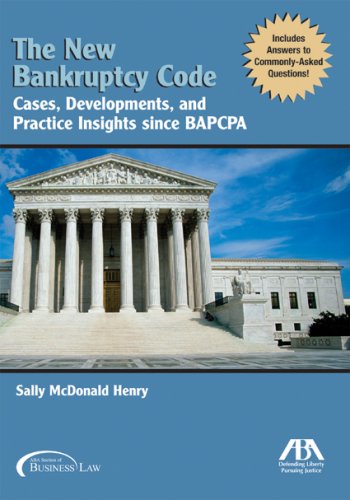

The new bankruptcy code cases, developments, and practice insights since BAPCPA Sally McDonald Henry.
Detalles de publicación: Chicago, Ill. American Bar Association Section of Business Law c2007.Descripción: vii, 663 p. forms 26 cmISBN:- 9781590318706 (pbk.)
- 1590318706 (pbk.)
- 346.7307/8 22
- KF 1524 .H46 2007
| Imagen de cubierta | Tipo de ítem | Biblioteca actual | Biblioteca de origen | Colección | Ubicación en estantería | Signatura topográfica | Materiales especificados | Info Vol | URL | Copia número | Estado | Notas | Fecha de vencimiento | Código de barras | Reserva de ítems | Prioridad de la cola de reserva de ejemplar | Reservas para cursos | |
|---|---|---|---|---|---|---|---|---|---|---|---|---|---|---|---|---|---|---|
| Libro | Biblioteca de Derecho Mons. Fremiot Torres Oliver Colección General bev | KF 1524 .H46 2007 (Navegar estantería(Abre debajo)) | Disponible | 70000000887189 |
Descripciones mejoradas de Syndetics:
This new Second Edition of The New Bankruptcy Code reports on the changes Congress made to bankruptcy laws in 2005 by taking a look at reported case law, unreported cases, and pulled orders, and also offers answers to commonly-asked questions. This essential guidebook, written in an engaging question and answer format, is a must-have for practitioners in the trenches.
What is a health care business under 101(27a)? -- What are the credit counseling requirements for individual debtors? -- Did Congress say what it meant to say in 362 (c)(3)? -- What are the consequences of serial filings on termination of the automatic stay? -- What happened to the automatic stay? -- Are attorneys debt relief agencies under BAPCPA? -- Are Chapter 7 debtors with primarily business debts exempt from filing official form B22A? -- Which 521(a) deadline controls? -- Does 521(e)(2) require a trustee to file a motion to dismiss for technical non-compliance? -- Can a debtor be exempt from the 521(e)(2) tax return requirement? -- Did BAPCPA eliminate the "ride-through option?" -- Does BAPCPA bless "ipso facto" clauses? -- Exactly what rights does 521 confer on creditors? -- Did Congress say what it meant in 521(i)? -- Are debtors in "opt-out" states still subject to the exemption limitation contained in 522? -- What is "equity" in relation to a 522 homestead exemption? -- What constitutes an "intent to hinder, delay, and defraud" in the context of 522? -- Can a debtor include monthly payments he does not intend to pay in order to pass the means test? -- What constitutes "special circumstances" sufficient to rebut the means test? -- If a debtor passes the mean test, is she home free? -- The IRS standards : cap or fixed deduction amount? -- The 401(k) loan repayment obligation : to deduct or not deduct -- What are the consequences of failing to complete a personal financial management course? -- When can a court approve bonus payments to employees? : Kerp orders -- Does the revised code require the creditors' committee disseminate material non-public information? : access to information orders, utilities orders -- What is adequate assurance for utility companies? -- Does 1112 set forth the exclusive basis for dismissal of a case? -- Does a Chapter 13 debtor have to file pre-petition tax returns before the 341 meeting even if a particular tax return is not yet due? -- Under what circumstances are payments to certain benefit plans not included in disposable income that must be used for Chapter 13 plan payments? -- After a Chapter 13 confirmation hearing, is it too late to object to claims? -- When can a debtor who has filed multiple cases obtain plan confirmation by showing his petition was filed in good faith? -- What is the effect of the "hanging paragraph" of section 1325(a)(9)? -- How is projected disposable income calculated? -- What expenses are "reasonably necessary" in determining what money a debtor has available to make plan payments? -- Can Chapter 13 debtors cut short the plan period of 1325(b)(4) by paying the amount they would have paid over the plan period? -- How does the section 1326 requirement of adequate protection for secured creditors operate? -- Is a pre-petition judgment necessary for the debt to be nondischargeable under section 1328? -- Are the provisions lengthening the time in which a debtor must wait for a subsequent discharge constitutional? -- How do the time periods of section 1328(f) operate? -- When is Chapter 15 relief available? -- When should a court recognize a foreign proceeding as a main proceeding rather than as a nonmain proceeding? -- Can a debtor cause a U.S. court to enforce a foreign claims resolution procedure? -- Is an adversary proceeding required under 1521(e) to seek a permanent injunction?
Microfiche. [Buffalo, NY] W.S. Hein Co. [1993- ]. microfiche : negative ; 11 x 15 cm. American Bar Association archive publications.
Tabla de contenidos provista por Syndetics
- Introduction(p. V)
- About the Book(p. VII)
- Chapter 1 Issues(p. 1)
- I What is a health care business under [section] 101 (27A)?(p. 1)
- II What are the credit counseling requirements for individual debtors?(p. 2)
- Chapter 3 Issues(p. 9)
- I Did Congress say what it meant to say in [section] 362 (c)(3)?(p. 9)
- II What are the consequences of serial filings on termination of the automatic stay?(p. 14)
- III What happened to the automatic stay?(p. 19)
- Chapter 5 Issues(p. 23)
- I Are attorneys debt relief agencies under BAPCPA?(p. 23)
- II Are Chapter 7 debtors with primarily business debts exempt from filing official form B22A?(p. 31)
- III Which [section] 521(a) deadline controls?(p. 32)
- IV Does [section] 521(e)(2) require a trustee to file a motion to dismiss for technical non-compliance?(p. 34)
- V Can a debtor be exempt from the [section] 521(e)(2) tax return requirement?(p. 37)
- VI Did BAPCPA eliminate the "Ride-Through Option?"(p. 38)
- VII Does BAPCPA bless "Ipso facto" clauses?(p. 40)
- VIII Exactly what rights does [section] 521 confer on creditors?(p. 40)
- IX Did Congress say what it meant in [section] 521(i)?(p. 41)
- X Are debtors in "Opt-Out" states still subject to the exemption limitation contained in [section] 522?(p. 46)
- XI What is "equity" in relation to a [section] 522 homestead exemption?(p. 52)
- XII What constitutes an "Intent to Hinder, Delay, and Defraud" in the context of [section] 522?(p. 55)
- Chapter 7 Issues(p. 57)
- I Can a debtor include monthly payments he does not intend to pay in order to pass the means test?(p. 57)
- II What constitutes "special circumstances" sufficient to rebut the means test?(p. 61)
- III If a debtor passes the mean test, is she home free?(p. 62)
- IV The IRS Standards: cap or fixed deduction amount?(p. 65)
- V The 401(k) loan repayment obligation: to deduct or not deduct(p. 67)
- VI What are the consequences of failing to complete a personal financial management course?(p. 69)
- Chapter 11 Issues(p. 73)
- I When can a court approve bonus payments to employees?(p. 73)
- Kerp Orders
- II Does the Revised Code require the creditors' committee disseminate material non-public information?(p. 218)
- Access to Information Orders
- Utilities Orders
- III What is adequate assurance for utility companies?(p. 281)
- IV Does [section] 1112 set forth the exclusive basis for dismissal of a case?(p. 317)
- Chapter 13 Issues(p. 319)
- I Does a Chapter 13 debtor have to file pre-petition tax returns before the [section] 341 meeting even if a particular tax return is not yet due?(p. 319)
- II Under what circumstances are payments to certain benefit plans not included in disposable income that must be used for Chapter 13 plan payments?(p. 320)
- III After a Chapter 13 confirmation hearing, is it too late to object to claims?(p. 321)
- IV When can a debtor who has filed multiple cases obtain plan confirmation by showing his petition was filed in good faith?(p. 322)
- V What is the effect of the "hanging paragraph" of section 1325(a)(9)(p. 324)
- VI How is projected disposable income calculated?(p. 338)
- VII What expenses are "reasonably necessary" in determining what money a debtor has available to make plan payments?(p. 344)
- VIII Can Chapter 13 debtors cut short the plan period of [section] 1325(b)(4) by paying the amount they would have paid over the plan period?(p. 347)
- IX How does the section 1326 requirement of adequate protection for secured creditors operate?(p. 350)
- X Is a pre-petition judgment necessary for the debt to be nondischargeable under section 1328??(p. 352)
- XI Are the provisions lengthening the time in which a debtor must wait for a subsequent discharge constitutional?(p. 353)
- XII How do the time periods of section 1328(f) operate?(p. 354)
- Chapter 15 Issues(p. 357)
- I When is Chapter 15 relief available?(p. 358)
- II When should a court recognize a foreign proceeding as a main proceeding rather than as a nonmain proceeding?(p. 358)
- III Can a debtor cause a U.S. court to enforce a foreign claims resolution procedure?(p. 360)
- IV Is an adversary proceeding required under [section] 1521(e) to seek a permanent injunction?(p. 361)
- New Deadlines(p. 363)
- New Forms(p. 371)
- Update of Additional Cases(p. 653)
- About The Author(p. 663)