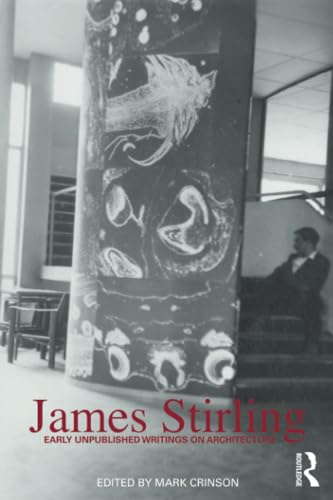

James Stirling early unpublished writings on architecture edited by Mark Crinson.
Idioma: Español Detalles de publicación: Milton Park, Abingdon,Oxon ;New York, NY Routledge 2010.Descripción: xiv, 146 p. ill. 24 cmISBN:- 9780415550598
- Early unpublished writings on architecture
- NA997 .S78 J36 2010
| Imagen de cubierta | Tipo de ítem | Biblioteca actual | Biblioteca de origen | Colección | Ubicación en estantería | Signatura topográfica | Materiales especificados | Info Vol | URL | Copia número | Estado | Notas | Fecha de vencimiento | Código de barras | Reserva de ítems | Prioridad de la cola de reserva de ejemplar | Reservas para cursos | |
|---|---|---|---|---|---|---|---|---|---|---|---|---|---|---|---|---|---|---|
| Libro | CARIBET Biblioteca Arquitectura Colección General CARIBET | NA997.S78 J36 2010 (Navegar estantería(Abre debajo)) | Disponible | 91000000011122 |
Descripciones mejoradas de Syndetics:
James Stirling (1924-1992) was, arguably, the most influential and controversial post-war British architect. Stirling's reputation is based primarily on such seminal buildings as the Leicester University Engineering Building (1959-63, with James Gowan), at one end of his career, and the Neue Staatsgalerie Stuttgart (1977-83, with Michael Wilford) at the other. Although he denied both labels, his work is seen as central to New Brutalism and Post-Modernism and his buildings attracted commentary and theory from the leading architectural thinkers of the day (including Frampton, Tafuri, Eisenman and Banham). Despite his significance, however, there has been very little recent research or creative re-interpretation of his work.
This fascinating insight into Stirling's work presents previously unavailable writings by him as well as new research on his early career, including:
'The Black Notebook' - the journal he kept in the mid-1950s the recorded talk he gave to the 'Team 10' group in 1962, as well as the discussion that followed that talk three sets of notes for lectures he gave an interview with Stirling and Gowan essays by the editor placing the texts in the context of Stirling's early work and discussing Stirling's relation to Le Corbusier.Profusely illustrated, with many photographs taken by Stirling himself, this book gives fresh understanding of Stirling's early career and the reasons why avant-garde architecture in post-war Britain became so widely influential outside the country.
Includes bibliographical references.
Introduction. The formation of a (post)modernist -- The Black notebook -- Notes for a lecture -- Influence of Corb on me now and when a student -- Eight questions to Stirling and Gowan -- Royaumont talk -- Urban redevelopment -- Architecte anglais : Stirling and Le Corbusier.
Tabla de contenidos provista por Syndetics
- List of illustrations(p. vii)
- Acknowledgements(p. xi)
- Credits(p. xii)
- List of Abbreviations(p. xiii)
- Note on the Text(p. xiv)
- Introduction -The Formation of a (Post-)Modernist(p. 1)
- 1 The Black Notebook(p. 17)
- 2 Notes for a Lecture(p. 69)
- 3 Influence of Corb on me now and when a Student(p. 74)
- 4 Eight Questions to Stirling and Gowan(p. 79)
- 5 Royaumont Talk(p. 85)
- 6 Urban Redevelopment(p. 101)
- 7 L'Architecte Anglais: Stirling and Le Corbusier(p. 108)
- Index(p. 141)
Notas de autor provistas por Syndetics
Mark Crinson is Professor of Art History at the University of Manchester. His previous books include Empire Building: Orientalism and Victorian Architecture (1996) and Modern Architecture and the End of Empire (2003).