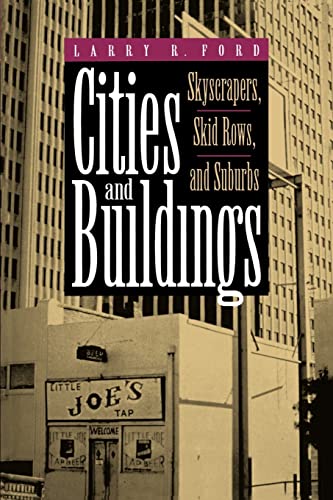
Imagen de portada de Amazon
Imagen de Amazon.com
Imagen de cubierta Syndetics
Portada de Syndetics
Imagen de OpenLibrary

Cities and Buildings Skyscrappers, skid rows, and suburbs Larry R. Ford. txt

Por: Idioma: Español Series Creating The North American LandscapeBaltimore : Johns Hopkins University Press 1994Descripción: iii,304p. ill. 25cmTipo de contenido:
  • text
Tipo de medio:
  • unmediaded
Tipo de soporte:
  • volume
ISBN:
  • 0801846471
  • 0801846463
Tema(s): Clasificación LoC:
  • NA705 F67 1994
Contenidos:
Contents: Preface: Thinking about Cities; or, My World and Welcome to It -- Introduction: Merging the Traditions of Space and Place -- 1. Downtown Buildings: The Role of the Skyscraper in Shaping the American Central Business District -- 2. The Downtown Frame: Buildings in Transition -- 3. Places to Shop: Arcades, Bazaars, and Festival Centers -- 4. The American Single-Family House -- 5. Multiunit Housing and City Structure -- 6. Drive-in Dreams: Decades of Design on the American Commercial Strip -- 7. Architectural Innovations at Home and Abroad: Some Speculations on Future Trends.
Resumen: In offering an account of the relationship between urban architecture - especially vernacular architecture - and the spatial arrangement and development of cities in North America, this book shows how changes in the built environment parallel changes in urban economies and human culture.
Valoración
    Valoración media: 0.0 (0 votos)
Existencias
Imagen de cubierta Tipo de ítem Biblioteca actual Biblioteca de origen Colección Ubicación en estantería Signatura topográfica Materiales especificados Info Vol URL Copia número Estado Notas Fecha de vencimiento Código de barras Reserva de ítems Prioridad de la cola de reserva de ejemplar Reservas para cursos
Libro CARIBET Biblioteca Arquitectura Colección General CARIBET General NA705 F67 1994 (Navegar estantería(Abre debajo)) 1 Disponible 91000000003590
Total de reservas: 0

Descripciones mejoradas de Syndetics:

In this text, Ford offers an account of the relationship between urban architecture - especially vernacular architecture - and the spatial arrangement and development of cities in North America. From office towers in the central business district to commercial strips in the edge city, Ford shows how changes in the built environment parallel changes in urban economies and human culture. Focusing on ordinary structures rather than famous landmarks, the book aims to provide a guide to understanding the changing character of any urban landscape.

Includes Bibliographical references (p. 281-296) and index.

Include index

Contents: Preface: Thinking about Cities; or, My World and Welcome to It --
Introduction: Merging the Traditions of Space and Place --
1. Downtown Buildings: The Role of the Skyscraper in Shaping the American Central Business District --
2. The Downtown Frame: Buildings in Transition --
3. Places to Shop: Arcades, Bazaars, and Festival Centers --
4. The American Single-Family House --
5. Multiunit Housing and City Structure --
6. Drive-in Dreams: Decades of Design on the American Commercial Strip --
7. Architectural Innovations at Home and Abroad: Some Speculations on Future Trends.

In offering an account of the relationship between urban architecture - especially vernacular architecture - and the spatial arrangement and development of cities in North America, this book shows how changes in the built environment parallel changes in urban economies and human culture.

Reseñas proporcionadas por Syndetics

CHOICE Review

Ford embraces an admirable goal: to better relate space, the primary concern of geographers, with place, the traditional interest of architectural and social historians. He succeeds at one level by drawing on a great deal of secondary information on the built environment to develop general rules for the placement of such divergent building types as skyscrapers and garden apartments. He incorporates some unusual original sources as well, including real estate multiple listing service guides. He draws his examples widely from the US and abroad and documents them well with his own photographs. In the process, he provides many arguments for the importance of design in understanding social change. Although he of necessity divides the examination of building types into different chapters, in doing so he blurs the effects of one phenomenon on another, especially the way the latest stage in concentrated suburban development affects the historic downtown. Not a thoroughly documented or entirely original book, this study nonetheless provides an able synthesis while at the same time suggesting new avenues for future research. General; advanced undergraduate; faculty. H. Gillette Jr.; George Washington University
Compartir
logopucpr-y-vive

Contáctanos

¡Queremos saber de ti!

Tel. 787.841.2000 Ext. 1801

bibliotecavaldes@pucpr.edu

⁣Búscanos en las redes

© 2026 Desarrollado por Ignite Online • All Rights Reserved • Powered by Koha.