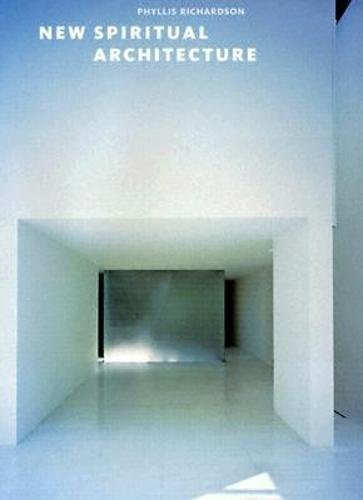
Imagen de portada de Amazon
Imagen de Amazon.com
Imagen de cubierta Syndetics
Portada de Syndetics
Imagen de OpenLibrary

New spiritual architecture / Phyllis Richardson. txt

Por: New York ; London : Abbeville Press Publishers, 2004Edición: First editionDescripción: 224 pages : illustrations (chiefly color), plans ; 30 cmTipo de contenido:
  • text
Tipo de medio:
  • unmediaded
Tipo de soporte:
  • volume
ISBN:
  • 0789208350
  • 9780789208354
Tema(s): Clasificación CDD:
  • 726/.09/049 22
Clasificación LoC:
  • NA4600 R53 2004
Contenidos:
INTRODUCTION A Legacy of Inspired Innovation 6 1 NEW TRADITIONS Experimenting with Form 16 01 Chapel of St. Ignatius 18 Seattle, Washington, USA, Steven Holl Architects, 1997 02 Caltex Terminal Mosque 22 Karachi, Pakistan, Mirza Abdelkader Baig, 1998 03 Korean Presbyterian Church of New York 26 Long Island City, New York, USA, Garofalo, Lynn, McInturf Architects, 1998 04 Jubilee Church 30 Rome, Italy, Richard Meier & Partners, 2004 05 Jewish Cultural Centre and Synagogue 34 Duisburg, Germany, Zvi Hecker Architekt, 1999 06 Private Chapel 38 Valleaceron, Spain, Estudio Sancho-Madridejos, 2001 07 Glass Temple 44 Kyoto, Japan, Takashi Yamaguchi & Associates, 2000 08 Chapel of St Mary of the Angels 48 Rotterdam, The Netherlands, Meccano Architecten, 2000 09 New Synagogue 52 Chemnitz, Germany, Alfred Jacoby, 2002 10 Mosque Design 58 Strasbourg, France, Zaha Hadid, project 2000 2 INTERVENTIONS Fitting into the Built Landscape 62 01 Our Lady of the Ark of the Covenant Church 64 Paris, France, Architecture Studio, 1998 02 Jamat Khana 70 University of Natal, Durban-Natal, South Africa, Architects' Collaborative, 1995 03 Interfaith Spiritual Center 74 Northeastern University, Boston, Massachusetts, USA, Office d'A, 19999 04 Chapel of Reconciliation 78 Berlin, Germany, Reitermann/Sassenroth Architekten, 2000 05 Kol Ami Synagogue 82 Hollywood, California, USA, Schweitzer BIM, 2002 06 Ismaili Centre 86 Lisbon, Portugal, Raj Rewal Associates, 2002 07 Sacred Heart Catholic Church and Parish Centre 92 Volklingen, Germany, Lamott Architekten, 2001 08 Christ Church Donau City, Vienna, Austria, Heinz Tesar, 2000 09 Kassell Synagogue 102 Kassell, Germany, Alfred Jacoby, 2000 10 Komyo-Ji Temple 106 Saijo, Japan, Tadao Ando Architect & Associates, 2000 3 RETREATS Rural Sanctuaries 112 01 Meditation Centre 114 Frejus, France, Bernard Desmoulin, 1997 02 Faith House 118 Holton Lee, Dorset, UK, Tony Bretton Architects, 2002 03 Shingon-Shu Buddhist Temple and Ossuary 122 Kagoshima, Japan, Thomas Heatherwick Studio, in progress 04 Center of Gravity Hall 124 New Mexico, USA, Predock_Frane Architects, 2003 05 Monastery of Novy Dour 130 Plzen, Czech Republic, John Pawson, 2004 06 Night Pilgrimage Chapel 134 Locherboden, Austria, Gerold Wiederin, 1997 07 White Temple 138 Kyoto, Japan, Takashi Yamaguchi & Associates, 2000 08 Santo Ovidio Estate Chapel 142 Douro, Portugal, Alvaro Siza, 2001 4 GRAND ICONS Prayer and Worship on a Large Scale 146 01 Church of the Sacred Heart 148 Munich, Germany, Allmann Sattler Wappner, 2000 02 Imam Mohamed Ibn Saud Mosque 152 Riyadh, Saudi Arabia, Abdelhalim I. Abdelhalim, 1998 03 Islamic Cultural Centre 156 Dublin, Ireland, Michael Collins Associates, 1996 04 Cathedral Church of Our Lady of the Angels 162 Los Angeles, California, USA, Rafael Moneo, 2002 05 Church of San Giovanni Rotondo 170 Foggia, Italy, Renzo Piano Building Workshop, 2004 06 New Synagogue 176 Dresden, Germany, Wandel, Hoffer, Lorch + Hirsch, 2002 07 Los Nogales School Chapel 180 Bogota, Colombia, Daniel Bonilla Arquitectos, 2002 5 MODEST MAGNIFICENCE High Ideals and Humble Materials 186 01 Yancey Chapel 188 Sawyerville, Alabama, USA, Rural Studio, 1996 02 Church and Community Centre 192 Urubo, Bolivia, Jae Cha, 2000 03 Church 196 Mortensrud, Oslo, Norway, Jensen & Skodvin, 2002 04 Paper Church 202 Kobe, Japan, Shigeru Ban Architect, 1995 05 Antioch Baptist Church 206 Perry County, Alabama, USA, Samuel Mockbee and Rural Studio, 2002 06 Jesuit Retreat Chapel 210 Navas del Marques, Avila, Spain, Ruiz Barbarin Arquitectos, 2000 Notes 214 Glossary 215 Bibliography 216 Project credits 217 Index 222 Credits and acknowledgements 224
Resumen: "New Spiritual Architecture looks at ways in which contemporary architects are approaching religious or meditative space. The book focuses on churches, chapels, temples, synagogues and mosques that have been built in the last few years and that represent a late-twentieth/early-twenty-first century aesthetic. These buildings demonstrate how new ideas and developments in urban, domestic and public architecture are being used to inform design that is intended for inspiration, worship or meditation. The text discusses the ways in which architects manipulate light and space and considers the placement of these buildings in their surroundings. Following a brief introduction, the book explores the following five themes: New Traditions, Interventions, Retreats, Grand Icons, and Modest Magnificence. It includes 200 full-color illustrations and 100 line drawings."--Jacket.
Valoración
    Valoración media: 0.0 (0 votos)
Existencias
Imagen de cubierta Tipo de ítem Biblioteca actual Biblioteca de origen Colección Ubicación en estantería Signatura topográfica Materiales especificados Info Vol URL Copia número Estado Notas Fecha de vencimiento Código de barras Reserva de ítems Prioridad de la cola de reserva de ejemplar Reservas para cursos
Libro CARIBET Biblioteca Arquitectura Colección General CARIBET General NA4600 R53 2004 (Navegar estantería(Abre debajo)) 1 Disponible 91000000008524
Total de reservas: 0

Descripciones mejoradas de Syndetics:

While Spain's Rafael Monco has just completed a cathedral in Los Angeles, Britain's Thomas Heatherwick is designing a Buddhist temple in Japan, John Pawson is working on a Cistercian monastery in the Czech Republic, and Richard Meier has completed his Millennium Cathedral in Rome. As one Wallpaper* pundit commented, "religion is getting a redesign," and the architect's faith is as unimportant as his nationality. These buildings represent not only new ways of looking at religious architecture, but a vibrant cultural exchange that brings together the highest aesthetic and spiritual ideals, transcending religious and national boundaries.

New Spiritual Architecture looks at the approaches contemporary architects have taken to religious or meditative space, focusing on churches, chapels, temples, synagogues, and mosques that have been built in the last few years and represent a late-twentieth/early-twenty-first century aesthetic. These buildings demonstrate how new ideas and developments in urban, domestic, and public architecture inform designs for spaces intended for inspiration, worship, or meditation. The book is organized into five categories. "New Traditions" features buildings with radical formal idiosyncrasies. "Interventions" looks at urban sites designed to fit into the built landscape. "Retreats" are isolated sanctuaries that incorporate their natural settings as vital elements. "Grand Icons" examines the recent revival of large-scale religious architecture. Finally, the buildings in "Modest Magnificence" mold humble materials to generate a contemplative simplicity.

Each of the dozens of sites explored is graced with thorough documentation, including interior and exterior photography, both close-up and birds-eye views, alongside detailed floor plans accompanied by detailed captions. A sophisticated text by renowned architecture critic Phyllis Richardson weaves together the various themes and provides a crucial framework for considering what architecture has to say about the changing conditions of contemporary society, its beliefs, relationships, and material production.

INTRODUCTION A Legacy of Inspired Innovation 6 1 NEW TRADITIONS Experimenting with Form 16 01 Chapel of St. Ignatius 18 Seattle, Washington, USA, Steven Holl Architects, 1997 02 Caltex Terminal Mosque 22 Karachi, Pakistan, Mirza Abdelkader Baig, 1998 03 Korean Presbyterian Church of New York 26 Long Island City, New York, USA, Garofalo, Lynn, McInturf Architects, 1998 04 Jubilee Church 30 Rome, Italy, Richard Meier & Partners, 2004 05 Jewish Cultural Centre and Synagogue 34 Duisburg, Germany, Zvi Hecker Architekt, 1999 06 Private Chapel 38 Valleaceron, Spain, Estudio Sancho-Madridejos, 2001 07 Glass Temple 44 Kyoto, Japan, Takashi Yamaguchi & Associates, 2000 08 Chapel of St Mary of the Angels 48 Rotterdam, The Netherlands, Meccano Architecten, 2000 09 New Synagogue 52 Chemnitz, Germany, Alfred Jacoby, 2002 10 Mosque Design 58 Strasbourg, France, Zaha Hadid, project 2000 2 INTERVENTIONS Fitting into the Built Landscape 62 01 Our Lady of the Ark of the Covenant Church 64 Paris, France, Architecture Studio, 1998 02 Jamat Khana 70 University of Natal, Durban-Natal, South Africa, Architects' Collaborative, 1995 03 Interfaith Spiritual Center 74 Northeastern University, Boston, Massachusetts, USA, Office d'A, 19999 04 Chapel of Reconciliation 78 Berlin, Germany, Reitermann/Sassenroth Architekten, 2000 05 Kol Ami Synagogue 82 Hollywood, California, USA, Schweitzer BIM, 2002 06 Ismaili Centre 86 Lisbon, Portugal, Raj Rewal Associates, 2002 07 Sacred Heart Catholic Church and Parish Centre 92 Volklingen, Germany, Lamott Architekten, 2001 08 Christ Church Donau City, Vienna, Austria, Heinz Tesar, 2000 09 Kassell Synagogue 102 Kassell, Germany, Alfred Jacoby, 2000 10 Komyo-Ji Temple 106 Saijo, Japan, Tadao Ando Architect & Associates, 2000 3 RETREATS Rural Sanctuaries 112 01 Meditation Centre 114 Frejus, France, Bernard Desmoulin, 1997 02 Faith House 118 Holton Lee, Dorset, UK, Tony Bretton Architects, 2002 03 Shingon-Shu Buddhist Temple and Ossuary 122 Kagoshima, Japan, Thomas Heatherwick Studio, in progress 04 Center of Gravity Hall 124 New Mexico, USA, Predock_Frane Architects, 2003 05 Monastery of Novy Dour 130 Plzen, Czech Republic, John Pawson, 2004 06 Night Pilgrimage Chapel 134 Locherboden, Austria, Gerold Wiederin, 1997 07 White Temple 138 Kyoto, Japan, Takashi Yamaguchi & Associates, 2000 08 Santo Ovidio Estate Chapel 142 Douro, Portugal, Alvaro Siza, 2001 4 GRAND ICONS Prayer and Worship on a Large Scale 146 01 Church of the Sacred Heart 148 Munich, Germany, Allmann Sattler Wappner, 2000 02 Imam Mohamed Ibn Saud Mosque 152 Riyadh, Saudi Arabia, Abdelhalim I. Abdelhalim, 1998 03 Islamic Cultural Centre 156 Dublin, Ireland, Michael Collins Associates, 1996 04 Cathedral Church of Our Lady of the Angels 162 Los Angeles, California, USA, Rafael Moneo, 2002 05 Church of San Giovanni Rotondo 170 Foggia, Italy, Renzo Piano Building Workshop, 2004 06 New Synagogue 176 Dresden, Germany, Wandel, Hoffer, Lorch + Hirsch, 2002 07 Los Nogales School Chapel 180 Bogota, Colombia, Daniel Bonilla Arquitectos, 2002 5 MODEST MAGNIFICENCE High Ideals and Humble Materials 186 01 Yancey Chapel 188 Sawyerville, Alabama, USA, Rural Studio, 1996 02 Church and Community Centre 192 Urubo, Bolivia, Jae Cha, 2000 03 Church 196 Mortensrud, Oslo, Norway, Jensen & Skodvin, 2002 04 Paper Church 202 Kobe, Japan, Shigeru Ban Architect, 1995 05 Antioch Baptist Church 206 Perry County, Alabama, USA, Samuel Mockbee and Rural Studio, 2002 06 Jesuit Retreat Chapel 210 Navas del Marques, Avila, Spain, Ruiz Barbarin Arquitectos, 2000 Notes 214 Glossary 215 Bibliography 216 Project credits 217 Index 222 Credits and acknowledgements 224


"New Spiritual Architecture looks at ways in which contemporary architects are approaching religious or meditative space. The book focuses on churches, chapels, temples, synagogues and mosques that have been built in the last few years and that represent a late-twentieth/early-twenty-first century aesthetic. These buildings demonstrate how new ideas and developments in urban, domestic and public architecture are being used to inform design that is intended for inspiration, worship or meditation. The text discusses the ways in which architects manipulate light and space and considers the placement of these buildings in their surroundings. Following a brief introduction, the book explores the following five themes: New Traditions, Interventions, Retreats, Grand Icons, and Modest Magnificence. It includes 200 full-color illustrations and 100 line drawings."--Jacket.

Extracto provisto por Syndetics

INTRODUCTION 'I wanted to create a place of silence, of prayer, of peace and of internal joy.' Le Corbusier on the chapel of Notre-Dame-du-Haut Architecture is asked to deliver many things to many people &ndash shelter, comfort and perhaps beauty, expanding to more specialized programmatic or formalistic requirements. The demands of religious structures may include all of these, but it is the extra thing that they must provide or at least facilitate - spirituality &ndsah; that sets them apart from secular buildings. This is a quality that contributes greatly to their cultural value since they are meant to inspire something beyond the physical satisfactions of space and, in many cases, say something about the community that they serve. Their inherent transcendent aspect is what makes them more curious to lay people and what has made them a proving ground for talent through the ages. However, what this book seeks to explore is not the inherent 'differentness' of religious buildings, though that is part of their appeal, but the way in which these buildings become an alembic for ideas, for innovation: though some would dismiss modern religious buildings as unlikely harbingers of cutting-edge design, the projects included here will show that they are just that. The reasons for the decision to include buildings from different religions and to group them thematically, rather than according to denomination, were the same that drove the decision to make the book in the first place: the buildings have inherent value as significant works of architecture with or without their religious affiliations. The focus in these pages is on how contemporary practice and formal invention have been brought to bear on sacred buildings, and on how these elements make technological, formal, environmental and material contributions to the art of building. This is not a new phenomenon, merely a continuation of a practice that has been going on for centuries - the patronage of new architecture by religious bodies. St Peter's in Rome was groundbreaking in its day not only for its size and succession of lead architects, but for its modified Greek-cross plan, its chamfered piers creating wider spaces, its sumptuous decoration helping to achieve the aim of Pope Julius II to outshine the ancient monuments of Rome. Creating the largest dome since the construction of the Pantheon also helped to seal this triumph. It deviated from Leon Battista Alberti's guidelines for a religious building, which he laid down in his fifteenth-century treatise on architecture, the most prevalent being the adherence to pure form (a circle or a shape derived from a circle, such as a square, hexagon, etc.) and total harmony. However, then, as now, there were people willing to see beyond what was expected to what was possible. Following is a brief and very general overview of the traditional requirements of the kinds of religious buildings included in the book. This is not a definitive study, but it helps to give an idea of what the architects are working with and how they are departed from or adhered to tradition. The forms of synagogue and mosque have been much less prescribed than their Christian counterparts. However, both require certain elements which share some similarities with those in Christian churches. A synagogue should have a bimah, a table on a raised platform from which the Torah is read. The ark is another important feature, as it and the Torah scrolls which are kept inside it are considered 'the holiest features in the synagogue'. Though it was once meant to be a portable furnishing, the ark is now largely a significant fixed element - often elaborately decorated - that, along with the bimah, helps focus the prayer space of the synagogue. The ark, bimah and sometimes the pulpit can be placed in an apse-like space in the eastern side of the room, but the more traditional, Orthodox method is to keep them toward the centre. Like mosques, synagogues usually have space for worshippers to wash before attending prayers. Traditionally, too, men and women are seated separately, with women either on another level or behind a curtain, though in a Reformed movement there is no such separation. The mosque accommodates prayers that could as easily be said out of doors, and often are. Prayer rugs are important and laid out in courtyard spaces and then taken up again when prayers are finished. Muslims pray facing Mecca, and the orientation of a mosque or indoor prayer space is denoted by the location of the qibla wall which contains the mihrab, a niche of elaborate decoration, pointing to the exact location of the holy shrine, with the minbar, or pulpit, set nearby. Architects in far-flung parts of the world will spend a great deal of time and effort ensuring that the orientation is exactly right. Michael Collins Architects consulted several experts, including an airline pilot, to help calculate and then confirm the direction of Mecca for their Islamic Cultural Centre in Dublin. In their gridded layout, all of the rooms face the qibla so that people can orient themselves for prayer within any space. Most Islamic prayer facilities include a space for ablutions, which, at least in projects here, are not mere public washrooms, but are designed to signal the transition to the prayer space. Inside, the main prayer space in a mosque usually has room for rows of men to face the qibla wall shoulder-to-shoulder in a hypostyle hall articulated with a series of columns and horseshoe arches, which are used to great rhythmic effect in some of the most celebrated Islamic buildings, such as the Alhambra in Granada. Men and women pray separately, and if a mosque accommodates women they usually sit in a mezzanine space overlooking the main prayer space and are separated by carved wooden screens. Though there are no strict rules governing the look or shape of a mosque, many traditionalists favor the use of at least one dome over the main prayer space, and minarets to distinguish the building. Furthermore, the use of geometric patterning, elaborate carving and other traditional craftwork has come to signify the mosque building, which can be a simple enclosed prayer space or a complex masjid-i jami. The masjid-i jami, or congregational mosque, often includes facilities such as classrooms, a library, residential accommodation and other community services. It goes without saying that a nondenominational space has no traditional requirements except for that necessary sense of sanctuary. However, spaces that are meant to accommodate more than one faith (as opposed to no particular faith) must present themselves as flexible at the very least, and welcoming to all in the ideal scenario. One project in the book contains elements for four separate faiths (see p.114), while another can be easily transformed from one congregation to another (see p.74), and a third offers contemplation space for all (see p.118). The majority of the projects in this book are devoted to Christian worship, a consequence of the availability and proliferation of new projects. To the Western reader, the form will be very familiar. And, even if Alberti had lost reigning influence by the time Rome's best minds were arguing over the form of St Peter's, the basic layout of the Christian church, with its origins in the Latin basilica, has remained largely intact - a cruciform shape with seating in the nave, altar above the transepts, and whole structure facing east. There have of course been many other elements and variations through the centuries, and the form continues to inspire alternatives - as in a number of projects here. Though there are projects from 18 countries there are some points of geographic concentration that were not deliberate, but arose from the proliferation of such buildings in those areas. Most of the churches in the book are located in western Europe or the USA. Three of the four synagogues included in these chapters are located in Germany, which again is a consequence of the abundance of building work that has been taking place. In post-war, post-reunification Germany, many Jewish and Christian communities are building (and rebuilding) houses of worship, many destroyed in the Holocaust and the aftermath of the Second World War. Such weighty precedents have given some architects a deep motivation to produce buildings that are somehow both distinctive and sobering, forward-looking and mindful of the past. For any study of innovation in religious buildings it is helpful to look at some hallmark developments. As in the past (but without the vast coffers of patronage of previous centuries) well-known modern architects have been solicited to produce works for religious communities, and those buildings continue to influence projects both secular and divine. Le Corbusier's chapel of Notre-Dame-du-Haut, Ronchamp, has become a modern icon. Strangely enough, as it was designed as a piece of one-off craftsmanship and is distinct departure from the rational forms with which the architect is generally associated, its use of sprayed-on concrete and organic shapes brought the Catholic Church firmly into the world of modern architecture. (Perhaps it is a telling sign of a renewed reverence for both the architect and spiritual buildings that Corbusier's Saint-Pierre Church in Firminy, France, is now due for completion, 30 years after it was abandoned, unfinished.) Frank Lloyd Wright's design for the Beth Shalom Synagogue in Elkins Park, Pennsylvania (largely influenced by his designs for a steel cathedral which was sadly never build), and his various other churches and chapels, helped bring his particular style of craftsmanship married with modular design to the wider public. Philip Johnson's Crystal Cathedral in California, recently enhanced by a partner building designed by Richard Meier, remains one of the great achievements of twentieth-century architecture. (Johnson's Cathedral of Hope for Dallas, Texas, was completed in 2004). The sweeping grace of Oscar Niemeyer's cathedral for Brasilia, and his other buildings for the capital, still reign as some of the twentieth century's most forward-looking works of architecture. Twentieth-century landmarks in mosque design can be seen in the work of Babr Hameed, whose Masjid-i Tooba in Karachi, built in 1969, is a Modernist statement of white concrete shells and sculptural arches, not so far removed from Niemeyer's futuristic forms. Hassan Fathy may be the mosque architect most known to Westerners, having achieved a reputation for his designs that integrate mosques within the larger context of a planned community, as in New Gourna, Egypt, and the Dar al-Islam community of Abiquiu, New Mexico. Once a student of Hassan Fathy, Abdel Wahed El-Wakil has moved on to become one of the foremost architects of mosque buildings in the Middle East. Though he has never set out to directly challenge traditional precedent, in the words of James Steele, Wahid's 'eclecticism continues to redefine traditional architectural perceptions.' The KingSaud Mosque (1989), modelled on the fourteenth-century Sultan Hasan Mosque in Cairo, demonstrates his ability to translate history with a modern sense of subtlety. More adventurous is Kenzo Tang's Al-Khairia complex and mosque in Riyadh, which is an unusual example of an architect imposing largely non-Islamic forms, as the design reduces the geometric patterning to essential shapes expressed in separate built elements. Excerpted from New Spiritual Architecture by Phyllis Richardson All rights reserved by the original copyright owners. Excerpts are provided for display purposes only and may not be reproduced, reprinted or distributed without the written permission of the publisher.

Notas de autor provistas por Syndetics

Phyllis Richardson is a former Research Editor for Architectural Digest magazine in Los Angeles and is the author of XS: Big Ideas, Small Buildings (2001) and Contemporary Natural (2002).
Compartir
logopucpr-y-vive

Contáctanos

¡Queremos saber de ti!

Tel. 787.841.2000 Ext. 1801

bibliotecavaldes@pucpr.edu

⁣Búscanos en las redes

© 2026 Desarrollado por Ignite Online • All Rights Reserved • Powered by Koha.