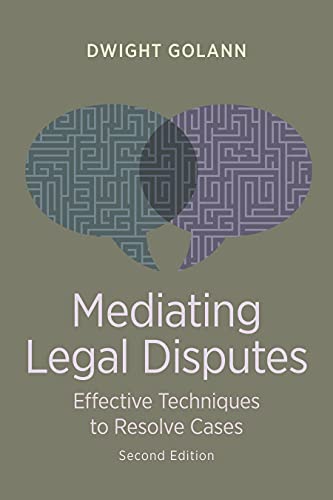

Mediating legal disputes effective strategies for neutrals and advocates Dwight Golann.
Detalles de publicación: Chicago ABA Section of Dispute Resolution c2009.Descripción: xix, 370 p. forms 23 cm. 1 CD-ROM (4 3/4 in.)ISBN:- 9781604423037 (pbk.)
- 160442303X (pbk.)
- 347.73/9 22
- KF 9085 .G63 2009
| Imagen de cubierta | Tipo de ítem | Biblioteca actual | Biblioteca de origen | Colección | Ubicación en estantería | Signatura topográfica | Materiales especificados | Info Vol | URL | Copia número | Estado | Notas | Fecha de vencimiento | Código de barras | Reserva de ítems | Prioridad de la cola de reserva de ejemplar | Reservas para cursos | |
|---|---|---|---|---|---|---|---|---|---|---|---|---|---|---|---|---|---|---|
| Libro | Biblioteca de Derecho Mons. Fremiot Torres Oliver Colección General biblioteca derecho | KF 9085 .G63 2009 (Navegar estantería(Abre debajo)) | Disponible | 70000000886295 |
Descripciones mejoradas de Syndetics:
An updated and revised edition of Mediating Legal Disputes: Effective Strategies for Lawyers and Mediators, the 1996 CPR Institute for Dispute Resolution co-winner for best book. Mediating Legal Disputes combines theory with intensely practical techniques that the reader can use to resolve difficult legal disputes. It provides dozens of examples, drawn from the author's extensive experience, that bring tactical suggestions to life. This book will teach you how to: Mediate effectively between hostile lawyers and parties. Deal with hard bargaining tactics such as "insulting" offers and reneging. Predict litigation outcomes without alienating disputants. Use impasse-breaking techniques such as confidential listener, range bargaining, and the mediator's proposal to achieve settlements. As a litigator, take advantage of a mediator's special powers to achieve better outcomes for clients. An exclusive video This book includes a unique DVD that demonstrates its techniques. You will see experienced mediators conduct an opening session, elicit offers, deliver an evaluation, apply impasse tactics and use other essential skills. Book jacket.
Includes bibliographical references (p. 357-360) and index.
A basic strategy -- The stages of mediation -- Before the mediation session -- Process obstacles : positional bargaining -- Process obstacles : based negotiation and other issues -- Psychological issues : strong emotions and cognitive forces -- Merits barriers : information exchange and analysis -- Merits barriers : evaluation and decision analysis -- Resolving impasse and closure -- Ethical and legal issues -- Representing clients in mediation : advice for lawyers -- How to borrow a mediator's powers -- Advocacy at specific stages -- Employment disputes -- Insured claims and other monetary disputes -- Intellectual property cases -- Environmental contamination disputes -- Mega-disputes and class actions.
Tabla de contenidos provista por Syndetics
- About the Contributors(p. xiii)
- Introduction(p. xvii)
- Part I An Overview of the Process: Advice for Novices(p. 1)
- Chapter 1 A Basic Strategy(p. 3)
- 1 Build a Foundation for Success(p. 4)
- 2 Allow Participants to Argue and Express Feelings(p. 5)
- 3 Moderate the Bargaining(p. 7)
- 4 Seek Out and Address Hidden Issues(p. 8)
- 5 Test the Parties' Alternatives; If Necessary, Evaluate the Adjudication Option(p. 9)
- 6 Break Bargaining Impasses(p. 12)
- Conclusion(p. 13)
- 7 A Strategy Chart(p. 14)
- Chapter 2 The Stages of Mediation(p. 15)
- 1 The Opening Session(p. 15)
- a Goals(p. 17)
- b Techniques(p. 19)
- 2 Private Caucuses(p. 22)
- a Early Caucuses(p. 23)
- (1) Goals(p. 23)
- (2) Techniques(p. 24)
- b Middle Caucuses(p. 26)
- c Later Caucuses(p. 28)
- 3 Follow-up Efforts(p. 30)
- Conclusion(p. 30)
- 4 Summary of Key Points(p. 30)
- Part II In the Process: Practical Strategies and More Complex Techniques(p. 33)
- A Reminder about the Importance of Rapport(p. 33)
- Chapter 3 Before the Mediation Session(p. 35)
- 1 First Contacts(p. 35)
- 2 Administrative Issues(p. 37)
- 3 Dealing with Inadequate Authority and Missing Stakeholders(p. 39)
- 4 Information Gathering and Private Meetings(p. 43)
- 5 Early Bargaining Problems: Preconditions and Backward Steps(p. 47)
- 6 A Pre-Mediation Checklist(p. 49)
- 7 Summary of Key Points(p. 49)
- Chapter 4 Process Obstacles: Positional Bargaining(p. 51)
- 1 Give Parties the Initiative(p. 52)
- 2 Coach Participants in Effective Tactics(p. 52)
- 3 Moderate Money Bargaining(p. 58)
- 4 Address Special Problems(p. 62)
- a "Insulting" First Offers(p. 62)
- b Impatience(p. 64)
- c Backward Steps(p. 64)
- Conclusion(p. 67)
- 5 Summary of Key Points(p. 67)
- Chapter 5 Process Obstacles: Interest-Based Negotiation and Other Issues(p. 69)
- 1 Inability to Bargain over Interests(p. 69)
- a How Likely Are Interest-Based Settlements?(p. 70)
- b Obstacles to Interest-Based Bargaining(p. 72)
- c Helping Parties Identify Interests(p. 78)
- d Assisting Parties to Develop Settlement Options(p. 81)
- 2 Clashes of Style and Tactics(p. 83)
- 3 Omission of Key Stakeholders or Decision Makers(p. 87)
- 4 Inconsistent Interests(p. 89)
- 5 Summary of Key Points(p. 91)
- Chapter 6 Psychological Issues: Strong Emotions and Cognitive Forces(p. 93)
- 1 Strong Emotions(p. 95)
- 2 Cognitive Forces(p. 105)
- a Reactive Devaluation(p. 105)
- b Attraction to Certainty and Familiarity(p. 107)
- c Loss Aversion(p. 108)
- d Delayed Loss Reactions(p. 114)
- 3 Moral and Symbolic Issues(p. 116)
- Conclusion(p. 120)
- 4 Summary of Key Points(p. 120)
- Chapter 7 Merits Barriers: Information Exchange and Analysis(p. 123)
- 1 Lack of Information(p. 124)
- 2 Poor Analysis of the Litigation Alternative(p. 129)
- a Responses to Cognitive Distortions(p. 129)
- b General Suggestions(p. 136)
- 3 Concerns about Precedent and Reputation(p. 141)
- Conclusion(p. 143)
- 4 Summary of Key Points(p. 144)
- Chapter 8 Merits Barriers: Evaluation and Decision Analysis(p. 145)
- 1 Evaluation(p. 147)
- a Benefits and Dangers(p. 147)
- b Whether to Evaluate(p. 151)
- c When to Evaluate(p. 152)
- d Structuring the Evaluation(p. 155)
- e Delivering the Evaluation(p. 158)
- f After the Evaluation(p. 162)
- 2 Decision Analysis(p. 162)
- Chapter 9 Resolving Impasse and Closure(p. 179)
- 1 Tactics at Impasse(p. 180)
- a Persevere(p. 180)
- b Ask for Help, and Wait(p. 181)
- c Restart the Bargaining(p. 181)
- d Modify the Mix or Structure(p. 183)
- e Offer an Opinion(p. 186)
- f Manage the End Game(p. 187)
- g Adjourn and Try Again(p. 191)
- 2 Managing Settlements(p. 194)
- a Confirmatory Acts(p. 194)
- b Drafting(p. 196)
- c Ratification(p. 199)
- d Implementation(p. 199)
- 3 Dealing with Final Impasse(p. 201)
- a Termination with the Possibility of Recommencing(p. 201)
- b Litigation Plans(p. 201)
- c Binding Arbitration(p. 201)
- 4 Summary of Key Points(p. 202)
- Chapter 10 Ethical and Legal Issues(p. 205)
- 1 Mediating Ethically(p. 205)
- a Ethical Codes and Guidance(p. 206)
- b Problems from Practice(p. 207)
- 2 The Law of Mediation(p. 216)
- a Confidentiality(p. 216)
- (1) Disclosures outside the Process(p. 217)
- (2) Disclosures between Caucuses(p. 220)
- b Enforcement of Participation in Mediation(p. 222)
- c Enforcement of Mediated Settlements(p. 223)
- 3 Mediator Liability(p. 224)
- 4 Additional Sources of Information(p. 225)
- Part III Representing Clients in Mediation: Advice for Lawyers(p. 227)
- Chapter 11 How to Borrow a Mediator's Powers(p. 229)
- 1 Manage the Structure and Flow of Information(p. 229)
- 2 Influence the Bargaining Process(p. 238)
- 3 Achieve Closure(p. 245)
- Conclusion(p. 253)
- 4 Summary of Key Points(p. 253)
- Chapter 12 Advocacy at Specific Stages(p. 255)
- 1 A Case Example: The Death of a Student(p. 255)
- 2 Structuring the Process(p. 258)
- 3 Preparing to Mediate(p. 264)
- 4 The Opening Session(p. 268)
- 5 Caucusing(p. 272)
- a Early Caucusing(p. 273)
- b Later Caucusing(p. 274)
- 6 After the Mediation(p. 275)
- Part IV Specialized Areas of Practice(p. 277)
- Chapter 13 Employment Disputes(p. 279)
- 1 Special Issues(p. 279)
- 2 Challenges for the Mediator(p. 282)
- 3 Preparing for Mediation(p. 285)
- 4 Combining Mediation with Other ADR Procedures(p. 286)
- 5 A Case Example: Wrongful Termination and Race Discrimination(p. 287)
- Chapter 14 Insured Claims and Other Monetary Disputes(p. 291)
- 1 Limitations of the Problem Solving Method(p. 291)
- 2 Important Features of the Mediation of Insured Claims(p. 292)
- 3 A Working Model for the Mediation of Insured Claims(p. 294)
- 4 Develop a Variety of Mediation Models(p. 301)
- Chapter 15 Intellectual Property Cases(p. 303)
- 1 Characteristics of Intellectual Property Mediation(p. 303)
- 2 Preparing for Mediation(p. 304)
- 3 Other Important Considerations(p. 309)
- a Confidentiality(p. 309)
- b Mediator's Qualifications(p. 310)
- c Communication and Culture(p. 311)
- 4 Intellectual Property Mediation Works(p. 311)
- Chapter 16 Environmental Contamination Disputes(p. 313)
- 1 Characteristics of Environmental Contamination Disputes(p. 313)
- 2 Common Obstacles to Settlement in Environmental Contamination Disputes(p. 315)
- a Process Issues(p. 315)
- b Psychological Issues(p. 318)
- c Disagreement over Scientific Issues(p. 319)
- d Disagreement over Allocation among Defendants(p. 320)
- Chapter 17 Mega-Disputes and Class Actions(p. 325)
- 1 Why Mediation of Mega-Cases is Different(p. 325)
- 2 Facilitating Roles(p. 328)
- 3 The Importance of Timing(p. 332)
- 4 Judicial-Mediator Cooperation(p. 333)
- 5 Science and Mediation(p. 334)
- 6 The Evolving Role of the Judge in Complex Mediation(p. 336)
- Appendix(p. 341)
- Resources(p. 357)
- Index(p. 361)