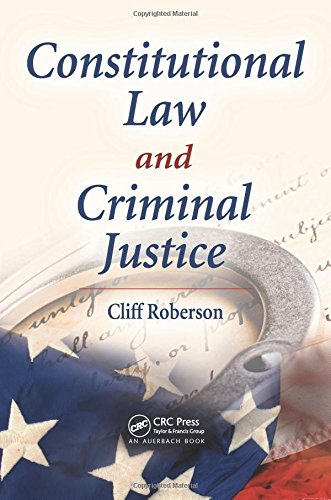

Constitutional law and criminal justice Cliff Roberson.
Detalles de publicación: Boca Raton CRC Press c2009.Descripción: xix, 364 p. ill., map, forms 25 cmISBN:- 9781420086102 (hbk. : alk. paper)
- 1420086103 (hbk. : alk. paper)
- 342.73 R638c 22
- KF4550 .R578 2009
| Imagen de cubierta | Tipo de ítem | Biblioteca actual | Biblioteca de origen | Colección | Ubicación en estantería | Signatura topográfica | Materiales especificados | Info Vol | URL | Copia número | Estado | Notas | Fecha de vencimiento | Código de barras | Reserva de ítems | Prioridad de la cola de reserva de ejemplar | Reservas para cursos | |
|---|---|---|---|---|---|---|---|---|---|---|---|---|---|---|---|---|---|---|
| Libro | Biblioteca Encarnación Valdés Colección General bev | 342.73 R638c (Navegar estantería(Abre debajo)) | Disponible | 80000002409426 |
Descripciones mejoradas de Syndetics:
When evidence is excluded or a case is dismissed or overturned, it is puzzling that the redress of constitutional rights violations is spoken of so derisively. As a check on improper police and governmental behavior, the constitution is one of our strongest allies against corruption and malfeasance. Yet comprehension of this often vague document and the cases which seek to interpret it is frequently difficult. Written in a simple, straightforward manner, Constitutional Law and Criminal Justiceexamines the U.S. Constitution and its implication for criminal justice system policies and practices, clarifying principles in a concise yet comprehensive format. The book is carefully crafted to provide students with an easy-to-read explanation of the relationship between the two.
Plain Language Explanations of Constitutional Rights
Following an overview of the Bill of Rights, the book examines the components of the judiciary before focusing on due process; the first, fourth, fifth, sixth, and eighth amendments; and the exclusionary rule. Additional chapters address civil liability and the criminal justice professional as well as the impact of terrorism on the right of habeas corpus.
Using review questions and relevant cases in each chapter to illustrate legal applications, this volume illuminates the concepts in plain language, eliminates unnecessary legal jargon, and clarifies the nuances in the law, making complicated concepts approachable by those without advanced legal training.
Includes bibliographical references (p. 287-299) and index.
Introduction to the U.S. Constitution -- The concept of due process -- Fourth Amendment -- Fourth Amendment issues -- Exclusionary rule -- Fifth Amendment issues -- Sixth Amendment issues -- The Eighth Amendment -- The First Amendment -- Civil liability and the criminal justice professional -- Terrorism and the writ of habeas corpus.
"An Auerbach book."
Tabla de contenidos provista por Syndetics
- List of Illustrations(p. xv)
- Preface(p. xvii)
- The Author(p. xix)
- 1 Introduction to the U.S. Constitution(p. 1)
- Introduction(p. 1)
- Original Constitution(p. 1)
- Bill of Rights(p. 2)
- First Amendment(p. 3)
- Second Amendment(p. 3)
- District of Columbia v. Heller, 2008 U.S. LEXIS 5268 (2008)(p. 4)
- Third Amendment(p. 9)
- Fourth Amendment(p. 10)
- Fifth Amendment(p. 10)
- Sixth Amendment(p. 11)
- Seventh Amendment(p. 11)
- Eighth Amendment(p. 12)
- Ninth Amendment(p. 12)
- Tenth Amendment(p. 13)
- Application of the Bill of Rights to State and Local Prosecutions(p. 13)
- Supreme Law of the Land(p. 14)
- Overview of the Judiciary(p. 15)
- State or Federal Issue(p. 16)
- Appellate Courts(p. 17)
- New York State Court of Appeals(p. 17)
- Necessity for Criminal Leave Application(p. 18)
- Article III Federal Courts(p. 18)
- Organization of Federal Courts(p. 18)
- Article III, Section 1, U.S. Constitution(p. 18)
- Article III, Section 2, U.S. Constitution(p. 19)
- Supreme Court Procedures(p. 21)
- Judicial Authority and Power(p. 22)
- Supreme Court Justices (2008-2009 Term)(p. 23)
- Chief Justice(p. 23)
- Associate Justices(p. 23)
- Capstone Case: United States v. Lopez, 514 U.S. 549 (1995)(p. 27)
- Background(p. 27)
- Facts of the Case(p. 29)
- Majority Opinion(p. 30)
- Concurring Opinions(p. 30)
- Dissents(p. 31)
- Subsequent Congressional Action(p. 31)
- Questions in Review(p. 31)
- 2 The Concept of Due Process(p. 33)
- Introduction(p. 33)
- Defining Due Process(p. 33)
- Early History of Due Process Clause(p. 35)
- States and the Fourteenth Amendment(p. 36)
- Application of the Bill of Rights to the States(p. 38)
- Due Process beyond the Bill of Rights(p. 43)
- Facts(p. 43)
- Court's Opinion(p. 44)
- Procedural Due Process(p. 45)
- Substantive Due Process(p. 45)
- Police Power(p. 46)
- Vagueness(p. 46)
- Equal Protection of the Law(p. 48)
- Capstone Case: Medina v. California, 505 U.S. 437 (1992)(p. 49)
- Questions in Review(p. 51)
- 3 Fourth Amendment(p. 53)
- History(p. 53)
- Overview of the Amendment(p. 53)
- What Constitutes a Search?(p. 54)
- Reasonable Expectation of Privacy(p. 56)
- Plain View(p. 57)
- Government Intrusion(p. 59)
- Protected Areas(p. 66)
- Probable Cause(p. 69)
- Warrants(p. 73)
- Sufficiency of the Affidavit(p. 73)
- Mistakes in the Place to Be Searched(p. 74)
- Using Informants to Establish Probable Cause(p. 77)
- Arrests(p. 82)
- Capstone Case: Atwater v. City of Lago Vista, 149 L. Ed. 2d 549 (2001)(p. 84)
- Questions in Review(p. 85)
- 4 Fourth Amendment Issues(p. 87)
- Introduction(p. 87)
- Searches without Warrants(p. 87)
- With Probable Cause(p. 87)
- Probable Cause Not Needed(p. 89)
- Searches Incident to Arrest(p. 89)
- Searches of Probationers and Parolees(p. 92)
- No Reasonable Expection of Privacy Situations(p. 94)
- Consent Searches(p. 94)
- Open Fields(p. 95)
- Plain View(p. 96)
- Abandoned of Property(p. 98)
- Aerial Observations(p. 100)
- Student Searches(p. 101)
- Arrests without Warrants(p. 104)
- Selected Court Cases on Arrests(p. 105)
- Terry Stops(p. 105)
- Selected Court Cases on Terry Stops(p. 108)
- Traffic Stops(p. 109)
- Scope of the Search(p. 111)
- Search of a Residence(p. 111)
- Search of Students(p. 111)
- Vehicle Searches(p. 112)
- Wiretaps(p. 112)
- Cellular Telephones(p. 114)
- Capstone Case: Virginia v. Moore, 128 S. Ct. 1598 (2008)(p. 115)
- Questions in Review(p. 117)
- 5 Exclusionary Rule(p. 119)
- Introduction(p. 119)
- Mapp v. Ohio(p. 119)
- Brief History of the Rule(p. 121)
- Standing to Object(p. 121)
- Fruit of the Poisonous Tree(p. 124)
- Exceptions to the Rule(p. 125)
- Good Faith Exception(p. 125)
- Purged Taint(p. 126)
- Independent Source(p. 127)
- Inevitable Discovery(p. 127)
- Impeachment of Defendant(p. 128)
- Noncriminal Trial Proceedings(p. 130)
- Civil Tax Proceedings(p. 130)
- Quasi-Criminal Proceedings(p. 131)
- Deportation Hearings(p. 131)
- Probation Revocation Hearings(p. 132)
- Situations Where the Rule Has Not Been Applied(p. 132)
- Violation of the Knock-and-Announce Requirement(p. 132)
- Searches Based on Erroneous Information(p. 133)
- Exclusionary Rule and the Fifth Amendment(p. 133)
- Exclusionary Rule and the Sixth Amendment(p. 134)
- Capstone Case: Groh v. Ramirez, 540 U.S. 551 (2004)(p. 135)
- Questions in Review(p. 139)
- 6 Fifth Amendment Issues(p. 141)
- Introduction(p. 141)
- Grand Jury(p. 141)
- Infamous Crime(p. 142)
- Discrimination in Selection of Grand Jury Members(p. 142)
- Evidence(p. 142)
- Sufficiency of an Indictment(p. 143)
- Double Jeopardy(p. 143)
- Application of Prohibition(p. 144)
- Collateral Estoppel(p. 145)
- Self-Incrimination(p. 145)
- Coverage of the Privilege(p. 146)
- Establishing Voluntariness of Statement(p. 148)
- Miranda Warning(p. 149)
- The Warning(p. 153)
- In-Custody Requirement(p. 153)
- What Constitutes Interrogation?(p. 156)
- When Interrogation Must Stop(p. 156)
- Exceptions to the Rule(p. 157)
- Public Safety Exception(p. 157)
- Where Vienna Convention Was Violated(p. 158)
- Statements Made during Medical Treatment(p. 158)
- Undercover Agents(p. 159)
- Deportation Proceedings(p. 159)
- Initial Inquiry and Booking(p. 159)
- Failure to Advise Defendant of Other Suspected Crimes(p. 160)
- Fruit of the Poisonous Tree(p. 161)
- Involuntary Confessions(p. 162)
- Commenting on Defendant's Silence(p. 163)
- Capstone Case: Missouri v. Seibert, 542 U.S. 600 (2004)(p. 163)
- Questions in Review(p. 166)
- 7 Sixth Amendment Issues(p. 167)
- Introduction(p. 167)
- Speedy Trial(p. 167)
- Constitutional Right to a Speedy Trial(p. 168)
- Statutory Right to a Speedy Trial(p. 169)
- Public Trial(p. 170)
- Impartial Jury(p. 173)
- Right to Jury Trial(p. 174)
- Impartial Jury(p. 175)
- Pretrial Publicity(p. 176)
- Voir Dire of Jury(p. 176)
- Selection of Jurors(p. 177)
- Attitude toward Death Penalty(p. 179)
- Number of Jurors(p. 179)
- Nonunanimous Verdicts in State Courts(p. 180)
- Judge Commenting on Evidence(p. 180)
- Judicial Instructions(p. 180)
- Questioning(p. 181)
- Urging Jury to Reach Verdict(p. 181)
- Penalty for Exercising Right to Jury Trial(p. 182)
- Trial in the Judicial District in Which the Crime Was Committed(p. 182)
- To Be Informed of the Nature and Cause of the Accusation(p. 183)
- Right to Confront the Witnesses(p. 184)
- To Have a Compulsory Process for Obtaining Witnesses in His Favor(p. 187)
- To Have Assistance of Counsel for His Defense(p. 188)
- Right to Appointed Counsel(p. 188)
- Effective Assistance of Counsel(p. 189)
- Right to Represent Self(p. 190)
- Standard of Competence Required for Self-Representation(p. 192)
- When the Right to Appointed Counsel Attaches(p. 195)
- Right to Counsel on Appeal for Indigent Defendants(p. 196)
- Guilty Pleas(p. 196)
- Capstone Case: United States v. Gonzalez-Lopez, 548 U.S. 140 (2006)(p. 197)
- Questions in Review(p. 200)
- 8 The Eighth Amendment(p. 201)
- Introduction(p. 201)
- Death Penalty as Cruel and Unusual(p. 202)
- Is the Death Penalty Cruel and Unusual?(p. 203)
- Executing the Mentally Retarded(p. 204)
- History of Death Penalty's Methods of Execution(p. 206)
- Death Penalty for Crimes Other than Murder(p. 209)
- Noncapital Punishments(p. 213)
- Robinson v. California(p. 213)
- Other Cruel and Unusual Punishments(p. 215)
- Jail and Prison Conditions as Cruel and Unusual(p. 217)
- Prison Conditions and Treatment(p. 217)
- Jails(p. 218)
- Court Sentences as Cruel and Unusual(p. 219)
- Bail(p. 221)
- Excessive Bail(p. 221)
- Protective Custody Awaiting Trial(p. 222)
- Capstone Case: Overton v. Bazzetta, 539 U.S. 126 (2003)(p. 224)
- Questions in Review(p. 228)
- Endnote(p. 228)
- 9 The First Amendment(p. 229)
- Introduction(p. 229)
- Religious Issues(p. 230)
- Freedom of the Press(p. 232)
- Prior Restraints on Publications(p. 232)
- Distribution of Publications(p. 234)
- Right to Assemble and Free Speech(p. 235)
- Petitions to the Government(p. 236)
- Right of Privacy(p. 237)
- Obscenity(p. 239)
- Students and the First Amendment(p. 242)
- Freedom of Expression in Schools(p. 242)
- School Assignments(p. 242)
- Public Funding of Education(p. 242)
- Use of School Property(p. 243)
- School Prayers(p. 243)
- Prisoners and the First Amendment(p. 243)
- Regulation of Incoming Publications(p. 243)
- Prisoner's Mail(p. 244)
- Right of Association(p. 245)
- Capstone Case: Morse v. Frederick, 127 S. Ct. 2618 (2007)(p. 245)
- Questions in Review(p. 251)
- 10 Civil Liability and the Criminal Justice Professional(p. 253)
- Introduction(p. 253)
- Federal Civil Rights(p. 253)
- Under Color of Law(p. 254)
- Excessive Force Used in an Arrest(p. 254)
- Use of Deadly Force(p. 255)
- Private Correctional Officers(p. 256)
- False Arrest Statute of Limitations(p. 256)
- Abusive Interrogations(p. 256)
- Violations of Constitutional Rights in a Foreign Country(p. 257)
- General Rules of Liability(p. 258)
- Liability of Federal Agents under 42 USCS § 1983(p. 258)
- Officer's Duty to Arrest(p. 259)
- Liability of a Public Agency for Failure to Train Its Police Officers(p. 261)
- Immunity from Liability(p. 262)
- Prosecutors(p. 265)
- Capstone Case: Wilson v. Layne, 526 U.S. 603, 628 (1999)(p. 266)
- Questions in Review(p. 270)
- 11 Terrorism and the Writ of Habeas Corpus(p. 271)
- Introduction(p. 271)
- Boumediene v. Bush Case(p. 272)
- Subsequent Proceedings(p. 278)
- Questions in Review(p. 278)
- Glossary(p. 279)
- References(p. 287)
- Appendix A U.S. Constitution(p. 301)
- Appendix B Search Warrants(p. 321)
- Appendix C Grand Jury Indictment, August 2005-at Alexandria, Virginia(p. 337)
- Index(p. 353)
Notas de autor provistas por Syndetics
In 2009, a research study conducted by a group of professors from Sam Houston State University determined that Cliff Roberson was the leading criminal justice author in the United States based upon on his publications and their relevance to the profession.
--Southwest Journal of Criminal Justice, Vol.6, issue 1, 2009