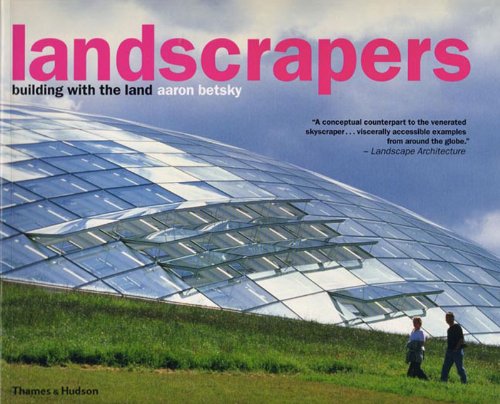

Landscrapers : building with the land / Aaron Betsky. txt
New York : Thames & Hudson , 2006Edición: First paperback 2006Descripción: 191 p. chiefly col. ill., plans 23 cmTipo de contenido:- text
- unmediaded
- volume
- 9780500285381
- 0500285381
- NA2542.35 B48 2006
| Imagen de cubierta | Tipo de ítem | Biblioteca actual | Biblioteca de origen | Colección | Ubicación en estantería | Signatura topográfica | Materiales especificados | Info Vol | URL | Copia número | Estado | Notas | Fecha de vencimiento | Código de barras | Reserva de ítems | Prioridad de la cola de reserva de ejemplar | Reservas para cursos | |
|---|---|---|---|---|---|---|---|---|---|---|---|---|---|---|---|---|---|---|
| Libro | CARIBET Biblioteca Arquitectura Colección General CARIBET | General NA2542.35 B48 2006 (Navegar estantería(Abre debajo)) | 1 | Disponible | 91000000009050 |
Descripciones mejoradas de Syndetics:
"An introductory historical survey on the many and creative ways humans have fought for and against the earth beneath our feet reveals an architecture that reads the text and texture of the land in three dimensions." Architecture
Developments in structural engineering have made it possible to engage the earth's surface as a building element. With an increased awareness of the planet's limited natural resources and with landscape architects exerting ever-greater influence on contemporary design, architects around the world are building into the earth, merging man-made forms with the contours of the land.
The results are at once preternatural and breathtaking. From Zaha Hadid's Tram Terminal in France to Antoine Predock's Spencer Theater in the United States, over fifty projects expose the breadth and depth of this new direction in architecture.
Aaron Betsky first considers our historical preoccupation with communing with the land through building. He then explores the ways in which geotecture responds to, becomes a part of, and yet remains distinctive within our natural landscape. With the subtext of our planet's power and beauty, Landscrapers reveals some of the most important, influential, and appealing building forms for today and the future. 367 illustrations, 290 in color.
Includes bibliographical references (p. 178-183) and index.
Tabla de contenidos provista por Syndetics
- Engineered Utopias(p. 16)
- Future Systems: House in Wales(p. 26)
- Neil Denari: Corrugated Duct House(p. 28)
- Hargreaves Associates: Guadalupe River Park(p. 30)
- Foster and Partners: Great Glass House(p. 32)
- Shuhei Endo: Springtecture A(p. 34)
- Ian Ritchie Architects: Terrasson Greenhouse(p. 36)
- Dominique Perrault: Olympic Velodrome(p. 38)
- Michael Sorkin: House of the Future(p. 40)
- Nox: Water Pavilion(p. 42)
- West 8: Secret Garden(p. 46)
- Emilio Ambasz: Fukuoka Prefectural International Hall(p. 48)
- Hitoshi Abe: Miyagi Stadium(p. 50)
- Kolatan/Mac Donald Studio: Raybould House(p. 52)
- Renzo Piano Building Workshop: Punta Nave Building(p. 54)
- Caves and Caverns(p. 56)
- Fumihiko Maki: Kaze-No-Oka Crematorium(p. 66)
- Tadao Ando: Hompukuji Water Temple(p. 68)
- Neutelings Riedijk: Minnaert Building(p. 70)
- Maya Lin: Vietnam Veterans Memorial(p. 72)
- Tadao Ando: Naoshima Contemporary Art Museum(p. 74)
- Enric Miralles and Carme Pinos: Igualada Cemetery(p. 76)
- Peter Zumthor: Thermal Baths(p. 78)
- Francois et Associes: Larrenguade Tunnel(p. 82)
- Kazuyo Sejima + Ryue Nishizawa/Sanaa: Multimedia Workshop(p. 84)
- William Bruder: Deer Valley Rock Art Center(p. 86)
- Un Studio: Villa Wilbrink(p. 88)
- Massimiliano Fuksas: Entrance Pavilion(p. 90)
- Steven Holl: Nelson-Atkins Museum of Art Expansion(p. 92)
- Claudine Lorenz, Florian Musso: Hydroelectric Plant(p. 94)
- Unfolding the Land(p. 96)
- Zaha Hadid: Tram Terminal(p. 106)
- Mecanoo: Central Library(p. 108)
- Abalos + Herreros: Casa Verde(p. 110)
- Morphosis: Diamond Ranch High School(p. 112)
- Weiss/Manfredi Architects: Museum of the Earth(p. 114)
- Antoine Predock: Spencer Theater(p. 116)
- Tod Williams and Billie Tsien: Neurosciences Institute(p. 118)
- Behnisch, Behnisch & Partner: Institute For Forestry and Nature Research(p. 120)
- Zaha Hadid: Landesgartenschau Pavilion(p. 122)
- Gustav Peichl: Satellite Tracking Station(p. 124)
- Enric Miralles and Carme Pinos: Archery Range(p. 126)
- Antoine Predock: American Heritage Center and Art Museum(p. 128)
- Norihiko Dan: Hiyoshi Community Center(p. 130)
- Hans-Joerg Ruch: Electrical Substation(p. 132)
- Angelil/Graham: Adidas Campus(p. 134)
- A New Nature(p. 136)
- James Turrell: Roden Crater(p. 146)
- Mvrdv: Dutch Pavilion(p. 150)
- Marc Barani: Nice Tramway Terminal(p. 152)
- Ian Ritchie Architects: Crystal Palace Concert Platform(p. 154)
- SHoP: Dunescape(p. 156)
- Herzog & De Meuron: Dominus Winery(p. 158)
- Peter Eisenman: City of Culture(p. 160)
- Allied Works Architecture: Maryhill Nature Overlook(p. 162)
- Njiric & Njiric: Baumaxx Hypermarket(p. 164)
- Vicente Guallart: Denia Castle Cultural Park(p. 166)
- Snohetta: Bibliotheca Alexandrina(p. 168)
- Steven Holl: Edge of a City(p. 172)
- Francois et Associes: Rural Holiday Houses(p. 174)