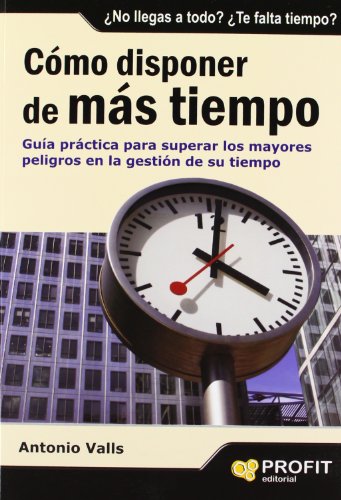

Cómo disponer de más tiempo guía práctica para superar los mayores peligros en la gestión de su tiempo Antonio Valls.
Series Habilidades directivasDetalles de publicación: Barcelona Profit Editorial 2009.Descripción: 158 p. ill. 23cmISBN:- 8496998037
- 9788496998032
| Imagen de cubierta | Tipo de ítem | Biblioteca actual | Biblioteca de origen | Colección | Ubicación en estantería | Signatura topográfica | Materiales especificados | Info Vol | URL | Copia número | Estado | Notas | Fecha de vencimiento | Código de barras | Reserva de ítems | Prioridad de la cola de reserva de ejemplar | Reservas para cursos | |
|---|---|---|---|---|---|---|---|---|---|---|---|---|---|---|---|---|---|---|
| Libro | Biblioteca de Mayagüez Colección General mb | HD69 .T54 V355 2009 (Navegar estantería(Abre debajo)) | Disponible | 50000003207668 | ||||||||||||||
| Libro | Biblioteca Encarnación Valdés Colección General bev | 658.4093 V 195c 2009 (Navegar estantería(Abre debajo)) | Disponible | 80000002427568 |
Descripciones mejoradas de Syndetics:
Traditionally, human cognition has been seen and studied as existing solely Âinside a personÂs head, with relative disregard for the social, physical, and artifactual surroundings in which cognition takes place. This book is a bold attempt to re-examine the nature of cognitions and to propose that a clearer understanding of human cognition would be achieved if it were conceptualized and studied as distributed among individuals, that knowledge is socially constructed through collaborative efforts toward shared objectives within cultural surroundings and that information is processed between individuals and the tools and artifacts provided by culture. The authors use illustrations from daily life and educational activities and suggest implications for education.
eigm 11/2011
Includes bibliographical references (p.155- 158 ).