Imagen de portada de Amazon
Imagen de Amazon.com
Imagen de cubierta Syndetics
Portada de Syndetics
Imagen de OpenLibrary

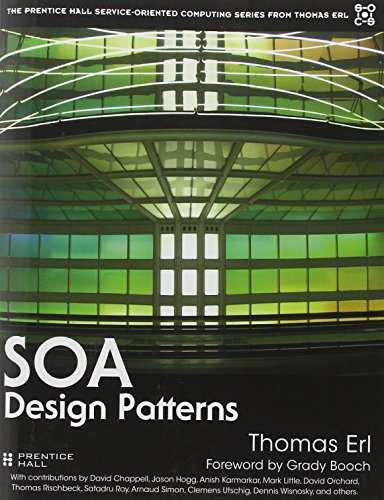
SOA design patterns Thomas Erl ; with additional contributors.

Por: Idioma: Español Series Prentice Hall service-oriented computing series from Thomas ErlDetalles de publicación: Upper Saddle River, NJ Prentice Hall c2009.Edición: 1st edDescripción: xliii, 814 p. ill. (chiefly col.) 24 cmISBN:
  • 9780136135166 (hardback : alk. paper)
Tema(s): Clasificación CDD:
  • 006.7 22
Clasificación LoC:
  • TK5105.88813 .E745 2009
Valoración
    Valoración media: 0.0 (0 votos)
Existencias
Imagen de cubierta Tipo de ítem Biblioteca actual Biblioteca de origen Colección Ubicación en estantería Signatura topográfica Materiales especificados Info Vol URL Copia número Estado Notas Fecha de vencimiento Código de barras Reserva de ítems Prioridad de la cola de reserva de ejemplar Reservas para cursos
Libro CARIBET Biblioteca Arquitectura Colección General CARIBET TK5105.88813.E745 2009 (Navegar estantería(Abre debajo)) Disponible 91000000004887
Total de reservas: 0

Descripciones mejoradas de Syndetics:

" SOA Design Patterns is an important contribution to the literature and practice
of building and delivering quality software-intensive systems."

- Grady Booch, IBM Fellow

"With the continued explosion of services and the increased rate of adoption of SOA through the market, there is a critical need for comprehensive, actionable guidance that provides the fastest possible time to results. Microsoft is honored to contribute to the SOA Design Patterns book, and to continue working with the community to realize the value of Real World SOA."

- Steven Martin, Senior Director, Developer Platform Product Management, Microsoft

nbsp;

" SOA Design Patterns provides the proper guidance with the right level of abstraction to be adapted to each organization''s needs, and Oracle is pleased to have contributed to the patterns contained in this book."

- Dr. Mohamad Afshar, Director of Product Management, Oracle Fusion Middleware, Oracle

nbsp;

"Red Hat is pleased to be involved in the SOA Design Patterns book and contribute important SOA design patterns to the community that we and our customers have used within our own SOA platforms. I am sure this will be a great resource for future SOA practitioners."

- Pierre Fricke Director, Product Line Management, JBoss SOA Platform, Red Hat

nbsp;

"A wealth of proven, reusable SOA design patterns, clearly explained and illustrated with examples. An invaluable resource for all those involved in the design of service-oriented solutions."

- Phil Thomas, Consulting IT Specialist, IBM Software Group

nbsp;

"This obligatory almanac of SOA design patterns will become the foundation on which many organizations will build their successful SOA solutions. It will allow organizations to build their own focused SOA design patterns catalog in an expedited fashion knowing that it contains the wealth and expertise of proven SOA best practices."

- Stephen Bennett, Director, Technology Business Unit, Oracle Corporation

nbsp;

"The technical differences between service orientation and object orientation are subtle

enough to confuse even the most advanced developers. Thomas Erl''s book provides a great service by clearly articulating SOA design patterns and differentiating them from similar OO design patterns."

- Anne Thomas Manes, VP & Research Director, Burton Group

nbsp;

" SOA Design Patterns does an excellent job of laying out and discussing the areas of SOA design that a competent SOA practitioner should understand and employ."

- Robert Laird, SOA Architect, IBM

nbsp;

"As always, Thomas delivers again. In a well-structured and easy-to-understand way, this book provides a wonderful collection of patterns each addressing a typical set of SOA design problems with well articulated solutions. The plain language and hundreds of diagrams included in the book help make the complicated subjects of SOA design comprehensible even to those who are new to the SOA design world. It''s a must-have reference book for all SOA practitioners, especially for enterprise architects, solution architects, developers, managers, and business process experts."

- Canyang Kevin Liu, Solution Architecture Manager, SAP

nbsp;

"The concept of service oriented architecture has long promised visions of agile organizations being able to swap out interfaces and applications as business needs change. SOA also promises incredible developer and IT productivity, with the idea that key services would be candidates for cross-enterprise sharing or reuse. But many organizations'' efforts to move to SOA have been mired-by organizational issues, by conflicting vendor messages, and by architectures that may amount to little more than Just a Bunch of Web Services. There''s been a lot of confusion in the SOA marketplace about exactly what SOA is, what it''s supposed to accomplish, and how an enterprise goes about in making it work.

nbsp;

SOA Design Patterns is a definitive work that offers clarity on the purpose and functioning of service oriented architecture. SOA Design Patterns not only helps the IT practitioner lay the groundwork for a well-functioning SOA effort across the enterprise, but also connects the dots between SOA and the business requirements in a very concrete way. Plus, this book is completely technology agnostic-- SOA Design Patterns rightly focuses on infrastructure and architecture, and it doesn''t matter whether you''re using components of one kind or another, or Java, or .NET, or Web services, or REST-style interfaces.

nbsp;

While no two SOA implementations are alike, Thomas Erl and his team of contributors have effectively identified the similarities in composition services need to have at a sub-atomic level in order to interact with each other as we hope they will. The book identifies 85 SOA design patterns which have been developed and thoroughly vetted to ensure that a service-oriented architecture does achieve the flexibility and loose coupling promised. The book is also compelling in that it is a living document, if you will, inviting participation in an open process to identify and formulate new patterns to this growing body of knowledge."

- Joe McKendrick, Independent Analyst, Author of ZDNet''s SOA Blog

nbsp;

"If you want to truly educate yourself on SOA, read this book."

- Sona Srinivasan, Global Client Services & Operations, CISCO

nbsp;

"An impressive decomposition of the process and architectural elements that support serviceoriented analysis, design, and delivery. Right-sized and terminologically consistent.

nbsp;

Overall, the book represents a patient separation of concerns in respect of the process and architectural parts that underpin any serious SOA undertaking. Two things stand out. First, the pattern relationship diagrams provide rich views into the systemic relationships that structure a service-oriented architecture: these patterns are not discrete, isolated templates to be applied mechanically to the problem space; rather, they form a network of forces and constraints that guide the practitioner to consider the task at hand in the context of its inter-dependencies. Second, the pattern sequence diagrams and accompanying notes provide a useful framework for planning and executing the many activities that comprise an SOA engagement."

- Ian Robinson, Principal Technology Consultant, ThoughtWorks

nbsp;

"Successful implementation of SOA principles requires a shift in focus from software system means, or the way capabilities are developed, to the desired end results, or real-world effects required to satisfy organizational business processes. In SOA Design Patterns , Thomas Erl provides service architects with a broad palette of reusable service patterns that describe service capabilities that can cut across many SOA applications. Service architects taking advantage of these patterns will save a great deal of time describing and assembling services to deliver the real world effects they need to meet their organization''s specific business objectives."

- Chuck Georgo, Public Safety and National Security Architect

nbsp;

"In IT, we have increasingly come to see the value of having catalogs of good solution patterns in programming and systems design. With this book, Thomas Erl brings a comprehensive set of patterns to bear on the world of SOA. These patterns enable easily communicated, reusable, and effective solutions, allowing us to more rapidly design and build out the large, complicated and interoperable enterprise SOAs into which our IT environments are evolving."

- Al Gough, Business Systems Solutions CTO, CACI International Inc.

nbsp;

"This book provides a comprehensive and pragmatic review of design issues in service-centric design, development, and evolution. The Web site related to this book [SOAPatterns.org] is a wonderful platform and gives the opportunity for the software community to maintain this catalogue...."

- Veronica Gacitua Decar, Dublin City University

nbsp;

"Erl''s SOA Design Patterns is for the IT decision maker determined to make smart architecture design choices, smart investments, and long term enterprise impact. For those IT professionals committed to service-orientation as a value-added design and implementation option, Patterns offers a credible, repeatable approach to engineering an adaptable business enterprise. This is a must read for all IT architect professionals."

- Larry Gloss, VP and General Manager,
Includes indexes.

Tabla de contenidos provista por Syndetics

  • Foreword(p. xxxvii)
  • Chapter 1 Introduction(p. 1)
  • 1.1 Objectives of this Book(p. 4)
  • 1.2 Who this Book is For(p. 4)
  • 1.3 What this Book Does Not Cover(p. 4)
  • Topics Covered by Other Books(p. 4)
  • Web Service and Rest Service Design Patterns(p. 5)
  • SOA Standardization Efforts(p. 5)
  • 1.4 Recommended Reading(p. 6)
  • 1.5 How this Book is Organized(p. 7)
  • Part I Fundamentals(p. 8)
  • Part II Service Inventory Design Patterns(p. 8)
  • Part III Service Design Patterns(p. 8)
  • Part IV Service Composition Design Patterns(p. 9)
  • Part V Supplemental(p. 10)
  • Part VI Appendices(p. 10)
  • 1.6 Symbols, Figures, Style Conventions(p. 11)
  • Symbol Legend(p. 11)
  • How Color is Used(p. 11)
  • Data Flow and Directionality Conventions(p. 11)
  • Pattern Documentation Conventions(p. 11)
  • 1.7 Additional Information(p. 11)
  • Updates, Errata, and Resources (www.soabooks.com)(p. 11)
  • Visio Stencil (www.soabooks.com)(p. 12)
  • Community Patterns Site (www.soapatterns.org)(p. 12)
  • Master Glossary (www.soaglossary.com)(p. 12)
  • Supplementary Posters (www.soaposters.com)(p. 12)
  • The SOA Magazine (www.soamag.com)(p. 12)
  • Referenced Specifications (www.soaspecs.com)(p. 12)
  • Notification Service(p. 13)
  • Contact the Author(p. 13)
  • Chapter 2 Case Study Background(p. 15)
  • 2.1 Case #1 Background: Cutit Saws Ltd(p. 17)
  • History(p. 18)
  • Technical Infrastructure and Automation Environment(p. 18)
  • Business Goals and Obstacles(p. 18)
  • 2.2 Case #2 Background: Alleywood Lumber Company(p. 19)
  • History(p. 19)
  • Technical Infrastructure and Automation Environment(p. 20)
  • Business Goals and Obstacles(p. 20)
  • 2.3 Case #3 Background: Forestry Regulatory Commission (FRC)(p. 21)
  • History(p. 21)
  • Technical Infrastructure and Automation Environment(p. 21)
  • Business Goals and Obstacles(p. 22)
  • Part I Fundamentals
  • Chapter 3 Basic Terms and Concepts(p. 25)
  • Purpose of this Introductory Chapter(p. 26)
  • 3.1 Architecture Fundamentals(p. 26)
  • A Classic Analogy for Architecture and Infrastructure(p. 27)
  • Technology Architecture(p. 27)
  • Technology Infrastructure(p. 30)
  • Software Program(p. 32)
  • Relationship to Design Framework(p. 33)
  • 3.2 Service-Oriented Computing Fundamentals(p. 35)
  • Service-Oriented Computing(p. 35

Extracto provisto por Syndetics

Foreword The entire history of software engineering can be characterized as one of rising levels of abstraction. We see this in our languages, our tools, our platforms, and our methods. Indeed, abstraction is the primary way that we as humans attend to complexity--and software-intensive systems are among the most complex artifacts ever created. I would also observe that one of the most important advances in software engineering over the past two decades has been the practice of patterns. Patterns are yet another example of this rise in abstraction: A pattern specifies a common solution to a common problem in the form of a society of components that collaborate with one another. Influenced by the writings of Christopher Alexander, Kent Beck and Ward Cunningham began to codify various design patterns from their experience with Smalltalk. Growing slowly but steadily, these concepts began to gain traction among other developers. The publication of the seminal book Design Patterns by Erich Gamma, John Vlissides, Ralph Johnson, and Richard Helm marked the introduction of these ideas to the mainstream. The subsequent activities of the Hillside Group provided a forum for this growing community, yielding a very vibrant literature and practice. Now the practice of patterns is very much mainstream: Every well-structured software-intensive system tends to be full of patterns (whether their architects name them intentionally or not). The emerging dominant architectural style for many enterprise systems is that of a service-oriented architecture, a style that at its core is essentially a message passing architecture. However, therein are many patterns that work (and anti-patterns that should be avoided). Thomas' work is therefore the right book at the right time. He really groks the nature of SOA systems: There are many hard design decisions to be made, ranging from data-orientation to the problems of legacy integration and even security. Thomas offers wise counsel on each of these issues and many more, all in the language of design patterns. There are many things I like about this work. It's comprehensive. It's written in a very accessible pattern language. It offers patterns that play well with one another. Finally, Thomas covers not just the technical details, but also sets these patterns in the context of economic and other considerations. SOA Design Patterns is an important contribution to the literature and practice of building and delivering quality software-intensive systems. --Grady Booch, IBM Fellow September, 2008 (c) Copyright Pearson Education. All rights reserved. Excerpted from SOA Design Patterns by Thomas Erl All rights reserved by the original copyright owners. Excerpts are provided for display purposes only and may not be reproduced, reprinted or distributed without the written permission of the publisher.

Notas de autor provistas por Syndetics

Thomas Erl is a best-selling IT author and founder of CloudSchool.com (tm) and SOASchool.com ®. Thomas has been the world's top-selling service technology author for over five years and is the series editor of the Prentice Hall Service Technology Series from Thomas Erl ( www.servicetechbooks.com ), as well as the editor of the Service Technology Magazine ( www.servicetechmag.com ). With over 175,000 copies in print world-wide, his eight published books have become international bestsellers and have been formally endorsed by senior members of major IT organizations, such as IBM, Microsoft, Oracle, Intel, Accenture, IEEE, HL7, MITRE, SAP, CISCO, HP, and others.

Four of his books, Cloud Computing: Concepts, Technology & Architecture, SOA Design Patterns, SOA Principles of Service Design, and SOA Governance, were authored in collaboration with the IT community and have contributed to the definition of cloud computing technology mechanisms, the service-oriented architectural model and service-orientation as a distinct paradigm. Thomas is currently working with over 20 authors on several new books dedicated to specialized topic areas such as cloud computing, Big Data, modern service technologies, and service-orientation.

As CEO of Arcitura Education Inc. and in cooperation with CloudSchool.com (tm) and SOASchool.com ®, Thomas has led the development of curricula for the internationally recognized SOA Certified Professional (SOACP) and Cloud Certified Professional (CCP) accreditation programs, which have established a series of formal, vendor-neutral industry certifications.

Thomas is the founding member of the SOA Manifesto Working Group and author of the Annotated SOA Manifesto ( www.soa-manifesto.com ). He is a member of the Cloud Education & Credential Committee, SOA Education Committee, and he further oversees the SOAPatterns.org and CloudPatterns.org initiatives, which are dedicated to the on-going development of master pattern catalogs for service-oriented computing and cloud computing.

Thomas has toured over 20 countries as a speaker and instructor for public and private events, and regularly participates in international conferences, including SOA, Cloud + Service Technology Symposium and Gartner events. Over 100 articles and interviews by Thomas have been published in numerous publications, including the Wall Street Journal and CIO Magazine.

Compartir
logopucpr-y-vive

Contáctanos

¡Queremos saber de ti!

Tel. 787.841.2000 Ext. 1801

bibliotecavaldes@pucpr.edu

⁣Búscanos en las redes

© 2026 Desarrollado por Ignite Online • All Rights Reserved • Powered by Koha.