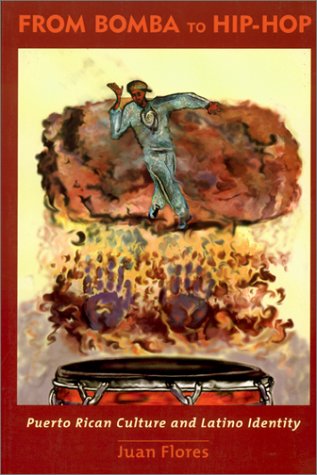

From bomba to hip-hop Puerto Rican culture and Latino identity Juan Flores.
Series Popular cultures, everyday livesDetalles de publicación: New York Columbia University Press 2000.Descripción: 265 p. ill. 24 cmISBN:- 0231110766 (acid-free paper)
- 0231110774 (pbk. : acid-free paper)
- 305.868/7295073 21
- E184.P85 F58 2000
| Imagen de cubierta | Tipo de ítem | Biblioteca actual | Biblioteca de origen | Colección | Ubicación en estantería | Signatura topográfica | Materiales especificados | Info Vol | URL | Copia número | Estado | Notas | Fecha de vencimiento | Código de barras | Reserva de ítems | Prioridad de la cola de reserva de ejemplar | Reservas para cursos | |
|---|---|---|---|---|---|---|---|---|---|---|---|---|---|---|---|---|---|---|
| Libro | Biblioteca Encarnación Valdés Colección de Puerto Rico | 305.868 F6341f (Navegar estantería(Abre debajo)) | Disponible | 80000002408832 |
Descripciones mejoradas de Syndetics:
As the populations of Latin American and Caribbean background in the USA proliferate, it becomes all the more important to understand the distinctions among nationalities and regional groups. To this end, this text investigates the historical experience of Puerto Ricans in New York.
Includes bibliographical references (p. 249-251) and index.
"Essential reading for understanding both national and panethnic issues that influence cultural expression and the construction of Puerto Rican identity in the US. Analyzes distinctiveness of Puerto Rican culture in New York in relation to that of other US Latino groups. Theoretically grounded essays address many of the contradictions behind the complex process of identity construction among Puerto Ricans and other Latinos. Focuses on popular music and literature"--Handbook of Latin American Studies, v. 58.
Tabla de contenidos provista por Syndetics
- Prelude: From Bomba to Hip-Hop
- Introduction
- 1 "pueblo pueblo": Popular Culture in Time
- 2 The Lite Colonial: Diversions of Puerto Rican Discourse
- 3 Broken English Memories: Languages in the Trans-Colony
- 4 "Salvacion Casita": Space, Performance, and Community
- 5 "Cha-Cha with a Backbeat": Songs and Stories of Latin Boogaloo
- 6 Puerto Rocks: Rap, Roots, and Amnesia
- 7 Pan-Latino/Trans-Latino: Puerto Ricans in the "New Nueva York"
- 8 Life Off the Hyphen: Latino Literature and Nuyorican Traditions
- 9 The Latino Imaginary: Meanings of Community and Identity
- 10 Latino Studies: New Contexts, New Concepts
- Postscript 1998: "None of the Above"
Reseñas proporcionadas por Syndetics
Library Journal Review
Flores (black and Puerto Rican studies, Hunter Coll.; sociology, CUNY Graduate Ctr.) has written widely on Latino and Puerto Rican culture. In this new book, he focuses on the progression of Puerto Rican culture in the United States over the past half-century. He analyzes developments in music, literature, and other elements of popular culture and compares Puerto Rican culture to that of other Latino groups in the United States. He follows some interesting trends, such as the building of casitas, shacks modeled after the traditional rural homes in Puerto Rico, as cultural centers in urban U.S. settings. Flores also discusses aspects of Puerto Rican musical influence, including the Latin Boogaloo craze of 1966-68. He celebrates Puerto Rican cultural accomplishments while encouraging further achievement. While academic in format and tone, Flores's writing is accessible to the interested lay reader. For academic libraries or public libraries with a special interest in the subject.DGwen M. Gregory, New Mexico State Univ., Las Cruces (c) Copyright 2010. Library Journals LLC, a wholly owned subsidiary of Media Source, Inc. No redistribution permitted.CHOICE Review
Flores's invaluable book establishes a new parameter for the field of Latino/a studies. Poignant and full of moving accounts, this volume does an inestimable service to both scholars and general readers--complicating considerably the story of Latinos/as in the US while challenging prevailing notions and theories. One of Flores's basic premises is that "while there is a certain inevitability in the formation of pan-ethnic concepts like 'Latino,'... their validity as sociological constructs depends overridingly on the attention paid to the specifics of each of the constituents groups and their historical placement within US society." Accordingly, Flores analyzes Latinos/as from the point of view of one of their most important groups: Puerto Ricans. A collection of very well written essays, the book deals with issues of music and identity, grass roots organizations among Puerto Ricans, popular culture and time, the future of Latino/a studies, literature, and the thorny issue of Hispanic/Latino/a identity. The complexity and the clarity of argument, the detailed research, the sophistication of the theory involved, and the compelling narrative make this a book that can, and should, be read by beginners and experts alike in a variety of fields. Highly recommended. ; University of Texas at San AntonioNotas de autor provistas por Syndetics
John Martin Flores was born in Alexandria, Virginia on September 29, 1943. He received a bachelor's degree in German-language studies at Queens College and a master's degree and Ph.D. in German literature at Yale University. He began teaching German at Stanford University in 1970. While there, he became involved in the movement to develop Chicano studies curriculums in California. He also changed his name to Juan.In 1975, he returned to New York to work at Centro, where the Latino studies curriculum was being developed for the City University system. Through his work there, he was hired as a professor of black and Puerto Rican studies at Hunter College, where he taught before becoming a professor of social and cultural analysis at New York University in 2006. He was a leading theorist of Latin American studies and a pioneer in the field of "Nuyorican" culture, the arts and language of Puerto Ricans in New York.
He wrote more than a dozen books and edited many collections of essays. His books included From Bomba to Hip-Hop and The Diaspora Strikes Back. He died from complications of Guillain-Barre syndrome on December 2, 2014 at the age of 71.
(Bowker Author Biography)