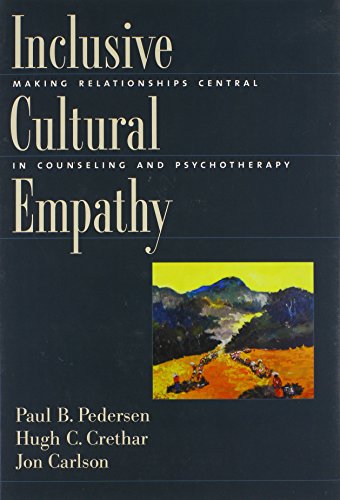

Inclusive cultural empathy making relationships central in counseling and psychotherapy Paul B. Pedersen, Hugh C. Crethar, Jon Carlson.
Detalles de publicación: Washington, DC American Psychological Association c2008.Edición: 1st edDescripción: xvii, 300 p. ill. 27 cmISBN:- 9780979212512
- 0979212510
- 158.3 P3713i 22
- BF636.7.C76 P43 2008
| Imagen de cubierta | Tipo de ítem | Biblioteca actual | Biblioteca de origen | Colección | Ubicación en estantería | Signatura topográfica | Materiales especificados | Info Vol | URL | Copia número | Estado | Notas | Fecha de vencimiento | Código de barras | Reserva de ítems | Prioridad de la cola de reserva de ejemplar | Reservas para cursos | |
|---|---|---|---|---|---|---|---|---|---|---|---|---|---|---|---|---|---|---|
| Libro | Biblioteca Encarnación Valdés Colección General bev | 158.3 P3713i (Navegar estantería(Abre debajo)) | Disponible | 80000002406349 |
Descripciones mejoradas de Syndetics:
Inclusive Cultural Empathy shows readers how to reach beyond the comfort zone of an individualistic perspective and increase competence in a relationship-centered context. The authors weave their own layered multicultural experiences with procedural, theoretical, and practical lessons to bring readers a model for how they might infuse their own clinical work with inclusion and multicultural sensitivity.The authors present a broad definition of culture - to include nationality, ethnicity, language, age, gender, socioeconomic status, family roles, and other affiliations - and engage the reader with lively examples and exercises that can be adapted for classroom, supervision groups, or individual use. With this book readers will learn how to help clients explore, discover, and leverage those internalized voices of their ""culture teachers"" that teach us who we are, how to behave, and how to resolve our problems or find life balance.
Includes bibliographical references (p. 255-276) and indexes.
Tabla de contenidos provista por Syndetics
- List of Tables, Figures, and Exhibits(p. xi)
- Preface(p. xv)
- Introduction(p. 3)
- Chapter 1 Traditional and Nontraditional Perspectives on Empathy, Help-Seeking, and Healthy Outcomes(p. 7)
- The Historical Roots of Empathy(p. 8)
- Cultural Assumptions of Empathy: A Critique(p. 12)
- Globalization of Counseling and Psychotherapy(p. 14)
- The Inclusion of Formal and Informal Support Systems(p. 16)
- Conclusion: Possibilities for Empathy(p. 20)
- Chapter 2 Toward More Inclusive Empathy: A Survey of Relational Worldviews and Alternative Modes of Helping(p. 23)
- The Importance of Collectivistic and Individualistic Theories(p. 24)
- The Importance of High- and Low-Context Theories(p. 26)
- What Is the Essence of Self?(p. 27)
- Synthetic Culture Examples of Cultural Diversity(p. 34)
- A Survey of Non-Western Therapies(p. 37)
- Conclusion(p. 39)
- Chapter 3 Defining Inclusive Cultural Empathy(p. 41)
- A Conceptual Model of Inclusive Cultural Empathy(p. 41)
- How ICE Incorporates and Adds to Multicultural Competence(p. 44)
- An Inclusive Definition of Culture(p. 47)
- An Inclusive Definition of Positive Therapy Outcomes(p. 50)
- Developing Inclusive Cultural Empathy(p. 53)
- The Contrasting Process of Moral Exclusion(p. 57)
- Conclusion(p. 59)
- Chapter 4 Affective Acceptance: Relating to and Understanding Ourselves and Others(p. 61)
- Assumption 1 We Are Both Similar and Different at the Same Time(p. 62)
- Assumption 2 Culture Is Complex and Not Simple(p. 70)
- Assumption 3 Behaviors by Themselves Are Not Meaningful(p. 76)
- Assumption 4 Not All Racism Is Intentional(p. 80)
- Conclusion(p. 91)
- Chapter 5 Affective Acceptance: Embracing Inclusion and Developing Empathy(p. 93)
- Assumption 5 Counselors Are All Vulnerable to Cultural Encapsulation(p. 93)
- Assumption 6 Inclusion Is More Likely to Define a Cultural Context Than Exclusion(p. 101)
- Assumption 7 Internal Spiritual Resources Are Important(p. 104)
- Assumption 8 Ambiguity, Although Inconvenient, Has Potentially Positive Value(p. 109)
- Final Thoughts on Affective Acceptance(p. 112)
- Chapter 6 Intellectual Understanding: Race, Gender, Religion, and Spirituality(p. 115)
- Key Cultural Identity Constructs(p. 116)
- The Importance of Salience(p. 117)
- Race(p. 119)
- Gender(p. 125)
- Religion/Spirituality(p. 129)
- Conclusion(p. 134)
- Chapter 7 Intellectual Understanding: Examining Other Key Cultural Identity Constructs(p. 135)
- Affectional Orientation(p. 135)
- Age(p. 139)
- Physical and Mental Capacity Issues(p. 144)
- Class and Socioeconomic Status(p. 145)
- Convergence and Salience(p. 151)
- Final Thoughts on Intellectual Understanding(p. 151)
- Chapter 8 Integral Skills: Hearing Our Culture Teachers Through Empathy(p. 155)
- Purpose of Internal Dialogue(p. 156)
- The Triad Training Model as a Way to Practice Hearing Internal Dialogue(p. 161)
- Debriefing(p. 164)
- Other Internal Dialogue Training Models(p. 167)
- Reflection of Feelings(p. 169)
- Reflection of Meanings(p. 175)
- Combining Feeling and Meaning: A Balancing Act(p. 177)
- Conclusion(p. 178)
- Chapter 9 Integral Skills: Microskills for Inclusive Cultural Empathy(p. 181)
- Mistakes and Recoveries(p. 182)
- Articulating the Problem From the Client's Perspective(p. 183)
- Recognizing Client Resistance to the Helper or Helping Process(p. 184)
- Overcoming Defensiveness Toward Clients(p. 185)
- Developing Multicultural Competencies With the Triad Training Model(p. 186)
- Demonstrating the Triad Training Model in Action(p. 195)
- Conclusion(p. 198)
- Chapter 10 Empowerment Applications of Inclusive Cultural Empathy(p. 199)
- Multiculturalism Is Inclusive and Broadly Defined(p. 200)
- Empowerment Through Inclusive Cultural Empathy(p. 202)
- The Dangers of Cultural Encapsulation and Exclusion(p. 209)
- The Intrapersonal Cultural Grid(p. 210)
- The Interpersonal Cultural Grid(p. 211)
- Conclusion(p. 222)
- Chapter 11 Conclusion: Developing Multicultural Awareness, Knowledge, and Skill(p. 223)
- Multiculturalism as a Fourth Force(p. 224)
- Culture-Centered Advocacy Competencies(p. 228)
- The Awareness-Knowledge-Skill Model(p. 230)
- The Benefits of Multicultural Awareness(p. 232)
- The Generic Importance of Multicultural Knowledge(p. 233)
- The Generic Application of Multicultural Skill(p. 235)
- Conclusion(p. 241)
- Appendix A Guidelines for the Four Synthetic Cultures(p. 243)
- Appendix B Practicing Inclusive Cultural Empathy With Synthetic Cultures(p. 249)
- References(p. 255)
- Author Index(p. 277)
- Subject Index(p. 285)
- About the Authors(p. 299)