Reseñas proporcionadas por Syndetics
Library Journal Review
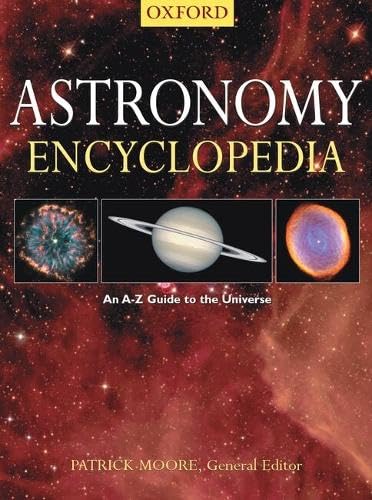
With the assistance of more than 40 contributors, astronomy popularizer Moore has revised and expanded The International Encyclopedia of Astronomy, his 1987 contribution to the field. This attractive book covers all aspects of astronomy and astrophysics: celestial objects and phenomena, astronomers (famous and less well known, from antiquity to the present), places (chiefly observatories), projects, instruments, historical developments, organizations, and even journals. The alphabetically arranged articles (over 3000, some 500 more than in the previous work) vary in length from one-sentence definitions to nearly one-and-a-half pages of text. The entries are extensively illustrated (although, strangely, the entries for constellations lack diagrams), and ample cross-referencing mitigates the need for an index. Color-coded insets list information about the constellations (the brightest stars and associated deep-sky objects), planets (vital statistics such as diameter, density, mass, surface gravity, and surface temperature), and other topics, including the nearest stars, the brightest stars, annual meteor showers, and the Caldwell and Messier catalogs of deep-sky objects. Also included are eight star maps, created by renowned celestial cartographer Wil Tirion (The Cambridge Star Atlas), that cover all 88 constellations and include major deep-sky objects. One notable weakness is the absence of either a comprehensive bibliography or references within individual entries. Given the breadth of this work and its price, the only comparable alternative currently in print is The Illustrated Encyclopedia of the Universe, edited by Ian Ridpath. Both titles are mid-level surveys of the discipline-too simple to be the only encyclopeda in an astronomy library, too technical for a high school library, but a great choice for patrons with some scientific knowledge. Libraries should consider purchasing both. For those limited to buying just one title, Moore's alphabetical arrangement makes for easier use than Ridpath's thematic organization. Recommended for academic and larger public libraries.-Nancy R. Curtis, Univ. of Maine Lib., Orono (c) Copyright 2010. Library Journals LLC, a wholly owned subsidiary of Media Source, Inc. No redistribution permitted.
School Library Journal Review
Gr 9 Up-This revision of the International Encyclopedia of Astronomy (Orion, 1987; o.p.) is more than just an update, as many entries have been rewritten and offer greater detail. Seven major essays from the original have been deleted, but there are approximately 500 additional articles and numerous color photos. The more than 3000 alphabetical entries cover celestial objects of all kinds; concepts, theories, and methodology of astronomy; observatories; space exploration; and biographical entries on astronomers, astronauts, and cosmonauts. Articles average 5 to 10 per page, but are thorough in their explication of the essentials. While very readable, the subject matter may challenge some students. However, excellent cross-references ease the search for further clarification. Sidebars add information on constellations, and numerous tables provide data on astronomical formations, planets, the Moon, and stars. A list of almost 150 contributors is included, but the individual articles are not signed. The layout of this edition is fresher and more colorful. Spectacular, informative photos appear throughout and outstanding diagrams help explain concepts and equipment. Also included are star maps and keys to symbols, measurements, conversion factors, and the Greek alphabet. This sophisticated encyclopedia fills a gap between Valerie Illingworth and John O. E. Clark's less comprehensive Facts On File Dictionary of Astronomy (Checkmark, 2000), and Paul Murdin's more expansive but less attractive Encyclopedia of Astronomy and Astrophysics (Institute of Physics, 2001). Due to significant changes in the field, libraries will want to replace their older edition with this superior, up-to-date version.-Jeffrey A. French, Euclid Public Library, OH (c) Copyright 2010. Library Journals LLC, a wholly owned subsidiary of Media Source, Inc. No redistribution permitted.
CHOICE Review
The face of the universe has not changed since 1987, when the first edition of this reference work appeared, but our knowledge of the cosmos has grown dramatically. This beautifully illustrated encyclopedic dictionary draws on a stellar list of international contributors; its editor, Sir Patrick Moore, is Britain's answer to Carl Sagan. Entries range from a brief paragraph to several columns, and are unsigned. The writing style varies greatly; most entries are accessible to general readers, but some are written at an advanced undergraduate level. The entries (more than 3,000) include some 500 photographs, and an appendix offers basic star charts. ^BSumming Up: Highly recommended. Academic and large public libraries. B. E. Fleury Tulane University
Booklist Review
This encyclopedia is actually a revised and expanded edition of The Astronomy Encyclopedia (Orion, 1987), edited by Moore. The field of astronomy has expanded, new discoveries have been made, new theories developed, and new interpretations voiced. The general public has always been fascinated with the mysteries of the heavens, which makes the revised work a must-have for most libraries. Moore's numerous publications are the "granddaddies" of books for the general reader that explain all that one needs to know about stars, planets, moons, and other heavenly bodies. Here, some 3,000 alphabetically arranged topics and definitions have been brought together with beautiful photographs (most in color), star maps, and explanatory diagrams. With the capability of sending more space probes into outer space, we have seen more photographs of far-off planets and their moons. Many of these photographs are in this encyclopedia, for example, Proteus, the largest of the inner satellites of Neptune discovered by Voyager 2 during its 1989 flyby. Most of the articles are brief but informative and understandable by any educated layperson. Definitions are concise, and there is a generous use of see references. Brief biographical information is given on individuals who have been associated with astronomy and related fields. The two-column text makes good use of white space and boldface headings. There is at least one photograph, diagram, or chart on every page. All photographs are fully described. Throughout the book are highlighted boxes of information or articles that focus on objects in the sky, from planets to stars to asteroids. Eight star maps at the end of the book cover northern, equatorial, and southern stars. There is no index, but words and terms encountered in an article that have their own entries are printed in full capitals. This is a beautiful book, replacing many older encyclopedias that may be on the reference shelves. If a library has funds to purchase only one encyclopedia covering astronomy, this is the one to select.