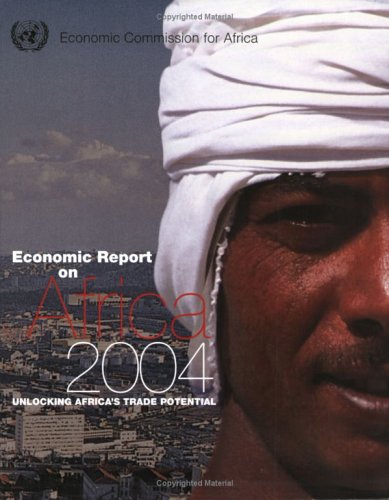

Economic report on Africa 2004 unlocking Africa's trade potential
Detalles de publicación: Addis Ababa UN ECA 2004Descripción: iii, 215 p. charts, graphs, tables 24 cmISBN:- 9211250943
- E/ECA(058)/E2/2004
| Imagen de cubierta | Tipo de ítem | Biblioteca actual | Biblioteca de origen | Colección | Ubicación en estantería | Signatura topográfica | Materiales especificados | Info Vol | URL | Copia número | Estado | Notas | Fecha de vencimiento | Código de barras | Reserva de ítems | Prioridad de la cola de reserva de ejemplar | Reservas para cursos | |
|---|---|---|---|---|---|---|---|---|---|---|---|---|---|---|---|---|---|---|
| Libro | Biblioteca de Derecho Mons. Fremiot Torres Oliver sala Naciones Unidas, edif. Spellman | E/ECA(058)/E2/2004 (Navegar estantería(Abre debajo)) | Disponible | 70000000885494 |
Descripciones mejoradas de Syndetics:
The Economic Report on Africa 2004 is the fifth in an annual series that reviews the continent's economic performance and near-term prospects. In 2003, Africa was the second fastest-growing developing region with real GDP growth of 3.8 per cent, driven by higher oil prices and production, rising commodity prices, increased foreign direct investment (FDI), better macroeconomic management, and good weather conditions. But the report takes the view that OECD trade policies are a serious constraint to Africa's integration into the global economy. African exports have been handicapped by industrial country policies such as tari. escalation, tari. peaks and agricultural protectionism. Africa's share in world merchandise exports fell from 6.3 per cent in 1980 to 2.5 per cent in 2000 in value terms. But the report also argues that strengthening Africa's supply side capacity is essential to more successful integration into the global economy. Weak infrastructure, poor trade facilitation services, and inadequate physical and human capital are impediments to the development of Africa's export sectors. Faster overall growth is needed if Africa is to make progress toward achieving the Millennium Development Goal of halving poverty by 2015.
Available also at UNECA website (viewed 20 Nov. 2008).
Includes bibliographical references.
Tabla de contenidos provista por Syndetics
- Foreword(p. xi)
- Acknowledgements(p. xiii)
- Overview(p. 1)
- 1 Recent Economic Trends in Africa and Prospects for 2004(p. 21)
- Strong global recovery in the second half of 2003(p. 23)
- Higher commodity prices, especially for minerals(p. 30)
- Africa's improving economic performance in 2003(p. 38)
- Broadly positive medium-term outlook(p. 50)
- References(p. 53)
- 2 Trade Liberalization-Panacea or Mirage?(p. 55)
- The challenge of multilateral liberalization(p. 65)
- Africa has to diversify its exports - as an ECA study underlines(p. 68)
- How trade liberalization affects human welfare(p. 69)
- Conclusions(p. 76)
- Notes(p. 78)
- References(p. 78)
- 3 Measuring Africa's Trade Competitiveness(p. 83)
- Measuring trade competitiveness(p. 84)
- Africa's overall competitiveness is improving(p. 88)
- Improved macroeconomic stability and institutional quality are enabling trade in Africa(p. 92)
- Africa's productive resources are moderately competitive and relatively stable(p. 96)
- Infrastructure has been improving but is still poor in too many countries(p. 98)
- Competitiveness clearly improves trade performance(p. 103)
- Conclusions(p. 106)
- Notes(p. 115)
- References(p. 116)
- 4 Poor Energy Infrastructure Hobbles Export Diversification(p. 117)
- Diversification is the way forward(p. 118)
- Africa's power sector today-untapped potential and Challenges(p. 127)
- Reforming the sector through restructuring and competition(p. 132)
- A new agenda for Africa's power sector(p. 136)
- Conclusions(p. 146)
- References(p. 149)
- 5 Trade Facilitation to Integrate Africa into the World Economy(p. 155)
- The growing importance of trade facilitation(p. 156)
- Africa's physical and procedural constraints on trade(p. 158)
- Africa's pervasive customs barriers(p. 169)
- Information and communications technologies(p. 175)
- Payments mechanisms(p. 176)
- International trade standards(p. 177)
- Facilitating trade for the future(p. 178)
- Trade facilitation in the multilateral framework - Africa's position(p. 184)
- Conclusions(p. 186)
- References(p. 188)
- 6 Fiscal Implications of Trade Liberalization(p. 191)
- Africa's deficits persist, despite increasing tax revenues(p. 191)
- The risks and challenges of trade liberalization(p. 194)
- How fast liberalizers have performed(p. 198)
- Country experiences and lessons(p. 204)
- Conclusions(p. 209)
- References(p. 214)