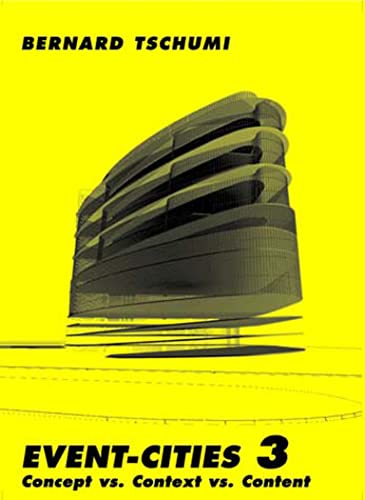

Event-cities 3 : Bernard Tschumi. txt
Idioma: Español London : The Mit Press, 2005Descripción: 637 p. ill. ; plans ; 23 cmTipo de contenido:- text
- unmediaded
- volume
- 0262701103 (pbk. : alk. paper)
- Event-cities three
- NA1353.T78 A35 2005
- NA1353.T78 A35 2005
| Imagen de cubierta | Tipo de ítem | Biblioteca actual | Biblioteca de origen | Colección | Ubicación en estantería | Signatura topográfica | Materiales especificados | Info Vol | URL | Copia número | Estado | Notas | Fecha de vencimiento | Código de barras | Reserva de ítems | Prioridad de la cola de reserva de ejemplar | Reservas para cursos | |
|---|---|---|---|---|---|---|---|---|---|---|---|---|---|---|---|---|---|---|
| Libro Col. General CARIBET | CARIBET Biblioteca Arquitectura Colección General CARIBET | General NA1353.T78.A35 2004 (Navegar estantería(Abre debajo)) | 1 | Disponible | 91000000007161 |
Descripciones mejoradas de Syndetics:
How concept, context, and content interact in architecture; provocative examples from recent projects by Bernard Tschumi.
In Event-Cities 3 , Bernard Tschumi explores the complex and productive triangulation of architectural concept, context, and content. There is no architecture without a concept, an overriding idea that gives coherence and identity to a building. But there is also no architecture without context--historical, geographical, cultural--or content (what happens inside). Concept, context, and content may be in unison or purposely discordant. Against the contextualist movement of the 1980s and 1990s, which called for architecture to blend in with its surroundings, Tschumi argues that buildings may or may not conform to their settings--but that the decision should always be strategic.
Through documentation of recent projects--including the new Acropolis Museum in Athens, a campus athletic center in Cincinnati, museums in Sao Paolo, New York, and Antwerp, concert halls in France, and a speculative urban project in Beijing--Tschumi examines different ways that concept, context, and content relate to each other in his work. In the new Acropolis Museum, for example, Tschumi looks at the interaction of the concept--a simple and precise museum with the clarity of ancient Greek buildings--with the context (its location at the base of the Acropolis, 800 feet from the Parthenon) and the content, which incorporates archaeological excavations on the building site into the fabric of the museum. Through provocative examples, Tschumi demonstrates that the relationship of concept, context, and content may be one of indifference, reciprocity, or conflict--all of which, he argues, are valid architectural approaches. Above all, he suggests that the activity of architecture is less about the making of forms than the investigation and materialization of concepts.
Includes bibliographical (p. [628]-[636]) references.
Contents:
Introduction: Concept, Context, Content 11 --
New York, Urban Glass House, 2000: Vision Glass 16 --
A. Tactical Indifference --
Angouleme, Exhibition Center, 2000: Concept Decontextualized 30 --
Geneva, Vacheron Constantin Headquarters, 2001-04: Manufacturing Time 44 --
Strasbourg, Concert Hall, 2003: Megaspan 84 --
B. Reciprocity and Conflict --
Pittsburgh, Carnegie Science Center, 2000: Phagocyte 112 --
Limoges, Concert Hall, 2003 Concept Recontextualized 138 --
Vendee, International Sports Center, 2001: Double Content 172 --
C. Contextualizing Concept --
Rome, Italian Space Agency, 2000: Fractal Cantilever 192 --
Antwerp, Museum aan de Stroom, 2000: Fractal Matrix 212 --
Sao Paulo, Museum of Contemporary Art, 2001: A Vertical Museum Sketchbook 236 --
Troy, Electronic Media and Performing Arts Center, 2001: Double Envelope 306 --
D. Conceptualizing Context --
New York, Museum for African Art, Version 1, 2000-02: Wood Curves, Glass Box 334 --
New York, Museum for African Art, Version 2, 2003-04: The tower vs. the Museum 368 --
Cincinnati, Athletic Center, 2001-: Contextual Free Form 390 --
Athens, New Acropolis Museum, 2000-: Paradoxes, Paraboxes 428 --
E. Context Becoming Concept --
Nice, Sophia Antipolis Campus, 2004: Camouflage 478 --
F. Large Scale: Concepts Becoming Contexts --
Paris, Expo 2004, 2001: Virtual City of Images 498 --
Toronto, Downsview Park, 2000: Natural Artifice 538 --
New York, Tri-Towers of Babel: Questioning Ground Zero, 2002: Whose Context? 552 --
Beijing, Factory 798, 2003 Superposition 582 --
Project Teams 621 --
Project List 624 --
Bibliography 628 --
Containing examples from recent projects by Bernard Tschumi, 'Event-Cities 3' describes how concept, context and content interact in architecture --
Tabla de contenidos provista por Syndetics
- Introduction: Concept, Context, Content(p. 11)
- New York, Urban Glass House, 2000: Vision Glass(p. 16)
- A Tactical Indifference
- Angouleme, Exhibition Center, 2000: Concept Decontextualized(p. 30)
- Geneva, Vacheron Constantin Headquarters, 2001--2004: Manufacturing Time(p. 44)
- Strasbourg, Concert Hall, 2003: Megaspan(p. 84)
- B Reciprocity and Conflict
- Pittsburgh, Carnegie Science Center, 2000: Phagocyte(p. 112)
- Limoges, Concert Hall, 2003--: Concept Recontextualized(p. 138)
- Vendee, International Sports Center, 2001: Double Content(p. 172)
- C Contextualizing Concept
- Rome, Italian Space Agency, 2000: Fractal Cantilever(p. 192)
- Antwerp, Museum aan de Stroom, 2000: Fractal Matrix(p. 212)
- Sao Paulo, Museum of Contemporary Art, 2001: A Vertical Museum Sketchbook(p. 236)
- Troy, Electronic Media and Performing Arts Center, 2001: Double Envelope(p. 306)
- D Conceptualizing Context
- New York, Museum for African Art, Version 1, 2000--2002: Wood Curves, Glass Box(p. 334)
- New York, Museum for African Art, Version 2, 2003--2004: The Tower versus the Museum(p. 368)
- Cincinnati, Athletic Center, 2001--: Contextual Free Form(p. 390)
- Athens, New Acropolis Museum, 2000--: Paradoxes, Paraboxes(p. 428)
- E Context Becoming Concept
- Nice, Sophia-Antipolis Campus, 2004: Camouflage(p. 478)
- F Large Scale: Concepts Becoming Contexts
- Paris, Expo 2004, 2001: Virtual City of Images(p. 498)
- Toronto, Downsview Park, 2000: Natural Artifice(p. 538)
- New York, Tri-Towers of Babel: Questioning Ground Zero, 2002: Whose Context?(p. 552)
- Beijing, Factory 798, 2003--: Superposition(p. 582)
- Project Teams(p. 621)
- Project List(p. 624)
- Bibliography(p. 628)