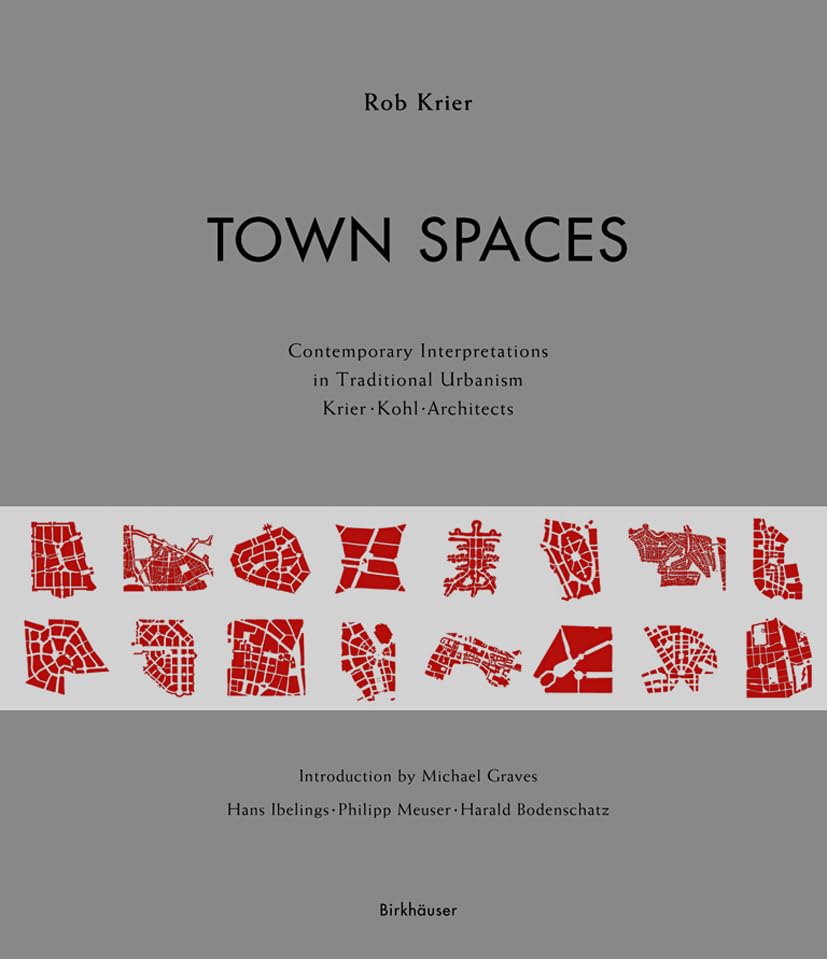

Town Spaces : contemporary interpretations in traditional urbanism : Krier.Kohl Architects. / Rob Krier, Rob Krier-Christoph Kohl Architects ; introduction by Michael Graves ; with essays by Hans Ibelings, Philipp Meuser, Harald Bodenschatz ; [translation, Fiona Greenwood Fincannon]. txt
Idioma: Español Swizerland : Birkhauser , 2006Descripción: 288 p. ill. (some col.) ; plans ; 28 cmTipo de contenido:- text
- unmediaded
- volume
- 3764369426 (hardcover : alk. paper)
- NA1153.R59 K75 2006 c.2
| Imagen de cubierta | Tipo de ítem | Biblioteca actual | Biblioteca de origen | Colección | Ubicación en estantería | Signatura topográfica | Materiales especificados | Info Vol | URL | Copia número | Estado | Notas | Fecha de vencimiento | Código de barras | Reserva de ítems | Prioridad de la cola de reserva de ejemplar | Reservas para cursos | |
|---|---|---|---|---|---|---|---|---|---|---|---|---|---|---|---|---|---|---|
| Libro Col. General CARIBET | CARIBET Biblioteca Arquitectura Colección General CARIBET | General NA1153.R59 K75 2006 C.2 (Navegar estantería(Abre debajo)) | 2 | Disponible | 91000000005546 |
Descripciones mejoradas de Syndetics:
In response to the sense of crisis in many of today s towns the proponents of new traditionalism offer a form of urban planning which looks back to more traditional styles whilst firmly integrating the requirements of modern life. Their designs are easily accessible and characterized by a sense of public spirit, identification and order. The contributions in this book reveal how these principles relate to the specific European city in the 20th century as well as to the writings of theoreticians from Camillo Sitte up to Rem Koolhaas. The authors reveal why the provocatively conservative approach has enjoyed so much success in the avant-garde Netherlands. They draw comparisons with the New Urbanism found in the USA and above all develop a systematic approach to town planning. New towns, the rebuilding of town areas, the restructuring of city centres and the extension of towns and urban areas are investigated in the chapters on urban composition. All examples in this part are from the Krier Kohl office and demonstrate in details the design process up to the realized buildings in particular the architectural realization by a wide range of architects, including Michael Graves, Cesar Pelli and others, shows that new traditionalism in urban planning can fruitfully work together with a wide range of architectural approaches.
Include index
Include biography
Contents:
Michael Graves Introduction: The Figural City 6 --
Rob Krier Composition of Urban Space 8 --
I New Towns Expert Opinion on Brabant 200 – 2050, Netherlands Leidsche Rijn, Utrecht, Netherlands Centrumgebied Vleuterweide, Ultrecht, Netherlands Slot Haverleij, ‘s-Hertogenbosch, Netherlands Citadel Broekpolder, Beverwijk / Heemskerk, Netherlands Bussy St. Georges, Marne le Vallée, France Sistiana Bay, Trieste, Italy Holiday Village in Burgenland, Austria SOS Children’s Village, Yemen 19 Brandevoort, Helmond, Netherlands --
II New City Districts 59 Spreebogen Government Centre, Berlin, Germany Karow Nord, Berlin, Germany Eiche – Altes Rad, Potsdam, Germany Babelsberg Media City, Potsdam, Germany Bornstedter Feld, Potsdam, Germany Housing for the Elderly, Mülheim, Germany Window in the Woods, Almere, Netherlands Kloosterveste Assen, Netherlands Lloyd Pier, Rotterdam, Netherlands Cité Judiciare, Luxemburg, Luxemburg World EXPO ’92, Sevilla, Spain Venta Berri, San Sebastian, Spain Lignano, Italy Sannegards Hamnen, Goteborg, Sweden Forellenweg, Salzburg, Austria Kirchsteigfeld, Postdam, Germany --
III Reshaping Urban Centres 101 Spreeinsel with City Castle, Berlin, Germany Southern Friedrichstadt, Berlin, Germany At Berlin Museum, Berlin, Germany Schinkelplatz, Berlin, Germany Tacheles – Johannisviertel, Berlin, Germany West Berlin City Centre, Germany West Berlin, Three squares, Germany Viktoria – Quartier, Berlin, Germany Prager Platz, Berlin, Germany Sluttgart Inner City, Germany Postplatz, Dresden, Germany Pforzheim Inner City, Germany Via Triumphalis, Karlsruhe, Germany Rivierenbuurt, The Hague, Netherlands De Parade, Bergen op Zoom, Netherlands Irun City Centre, Spain Amiens City Centre, France Piazzale Matteotti, Vicenza, Italy Kirgate Markets, Leeds, Great Britain De Resident, The Hague, Netherlands --
IV Restructuring Towns and Cities 163 St. Pauli, Altona-Nord, Hamburg, Germany Strijp S, former Philips Works, Eindhoven, Netherlands Batavia Harbour, Lelystad, Netherlands Verkade Terrein, Zaandam, Netherlands Aalter, Flanders, Belgium ZAC du Parc, Vitré, France Cité Jardins Plessis-Robinson, Paris, France SDO Via Tiburtina, Rome, Italy Rennweg, Vienna, Austria Breitenfurther Strabe, Vienna, Austria Liesing Residential Quarter, Vienna, Austria Royal Mint Square, London, Great Britain Grain Island, Gdansk, Poland ZAC Consuls de Mer, Montpellier, France Noorderhof, Amsterdam, Netherlands Meander, Amsterdam, Netherlands --
Hans Ibelings Anti Modernist Megastructures The Architecture and Urbanism of Krier and Kohl in the Dutch Context 236 --
Philipp Meuser Experiments with Convention European Urban Planning from Camillo Sitte to New Urbanism 248 --
Herald Bodenschatz New Urbanism and the European Perspective Presumption, Rivalry or Challenge? 266 --
Appendix 281 --
Index of Projects 282 --
Index of Places 284 --
Biographies 286 --
Projects Staff 287 --
Illustration Credits 288 --
Coti, Jun/09/03, 2003-915.
Tabla de contenidos provista por Syndetics
- Introduction: The Figural City(p. 6)
- Composition of Urban Spaces(p. 8)
- I New Towns(p. 19)
- II New City Districts(p. 59)
- III Reshaping Urban Centres(p. 101)
- IV Restructuring Towns and Cities(p. 163)
- Anti-Modernist Megastructures: The Architecture and Urbanism of Krier and Kohl in the Dutch Context(p. 236)
- Experiments with Convention: European Urban Planning from Camillo Sitte to New Urbanism(p. 248)
- New Urbanism and the European Perspective: Presumption, Rivalry or Challenge?(p. 266)
- Illustration Credits(p. 281)
- Biographies(p. 282)
- Project Staff(p. 283)
Notas de autor provistas por Syndetics
Rob Krier and Christoph Kohl practice an urbanism orientated towards traditional architecture. They respect the specific history of a town and aim to reanimate it by drawing on up-to-date resources. By emphasizing the spatial context, they prove themselves to be anti-modernist, without being antiinnovative. Rob Krier and Christoph Kohl readily apply the terms "normal" building and "normal" house, by which they mean the observation of human proportions in architecture. For them, the future of the city lies in a social "down-scaling" of architecture, and in reanimating sections of the city that unify different facets of social life.Hans Ibelings, born in 1963, is an art historian and independent architecture critic
Philipp Meuser, born in 1969, Dipl.-Ing. Architekt BDA, is a member of the Association of German Architects and a freelance journalist. He studied architecture in Berlin and Zurich, specializing in history and theory. From 1996 to 2002 he was coordinator of the Berliner Stadtforum and editor in chief of the journal Foyer. Since 2003 he has been editor in chief of the international architectural journal area (German edition). He is the author of a variety of books
Harald Bodenschatz, born in 1946, is professor of the sociology of planning and architecture at the Berlin Technical University. He has published numerous books