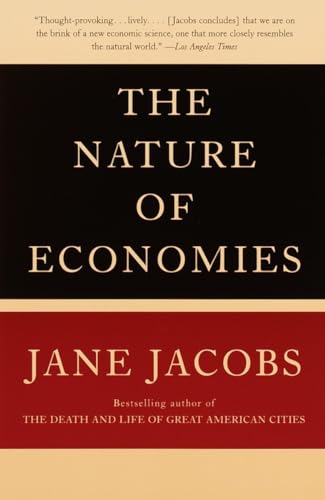

The Nature of Economies : Jane Jacobs. txt
New York : Vintage Books, 2001Edición: First vintage books editionDescripción: ix, 190 p. 20 cmTipo de contenido:- text
- unmediaded
- volume
- 0375702431
- 330 21
- HD75.6 J33 2001
| Imagen de cubierta | Tipo de ítem | Biblioteca actual | Biblioteca de origen | Colección | Ubicación en estantería | Signatura topográfica | Materiales especificados | Info Vol | URL | Copia número | Estado | Notas | Fecha de vencimiento | Código de barras | Reserva de ítems | Prioridad de la cola de reserva de ejemplar | Reservas para cursos | |
|---|---|---|---|---|---|---|---|---|---|---|---|---|---|---|---|---|---|---|
| Libro | CARIBET Biblioteca Arquitectura Colección General CARIBET | General HD75.6 J33 2001 (Navegar estantería(Abre debajo)) | 1 | Disponible | 91000000000711 |
Descripciones mejoradas de Syndetics:
From the revered author of the classic The Death and Life of Great American Cities comes a new book that will revolutionize the way we think about the economy.
Starting from the premise that human beings "exist wholly within nature as part of natural order in every respect," Jane Jacobs has focused her singular eye on the natural world in order to discover the fundamental models for a vibrant economy. The lessons she discloses come from fields as diverse as ecology, evolution, and cell biology. Written in the form of a Platonic dialogue among five fictional characters, The Nature of Economies is as astonishingly accessible and clear as it is irrepressibly brilliant and wise-a groundbreaking yet humane study destined to become another world-altering classic.
Includes bibliographical references (p. [152]-178) and index.
Tabla de contenidos provista por Syndetics
- Foreword(p. ix)
- Chapter 1 Damn, Another Ecologist(p. 3)
- Chapter 2 The Nature of Development(p. 15)
- Chapter 3 The Nature of Expansion(p. 39)
- Chapter 4 The Nature of Self-Refueling(p. 65)
- Chapter 5 Evading Collapse(p. 84)
- Chapter 6 The Double Nature of Fitness for Survival(p. 119)
- Chapter 7 Unpredictability(p. 133)
- Chapter 8 Armbruster's Promise(p. 148)
- Epilogue(p. 151)
- Notes(p. 152)
- Acknowledgments(p. 179)
- Index(p. 181)
Extracto provisto por Syndetics
Reseñas proporcionadas por Syndetics
Library Journal Review
From the author of the classic The Death and Life of Great American Cities: five friends discuss economics over coffee. (c) Copyright 2010. Library Journals LLC, a wholly owned subsidiary of Media Source, Inc. No redistribution permitted.Publishers Weekly Review
Jacobs's 1961 classic, Death and Life of Great American Cities, broke new ground in its insistence that humane urban planning could result from looking intently at people's everyday lives as a microcosm of the needs of city, economic and national life. The book also showcased Jacobs's superb ability to weave her own and her neighbors' personal stories into her theories of urban planning and development. In this important, essentially philosophical new work on patterns of social and economic growth, Jacobs immerses herself in the role of storyteller, building her arguments through a series of conversations between a group of environmentally aware, countercultural friends talking about what it means for humans to interact, understand one another and dwell safely and without causing harm in the world. Jacobs's choice to explore this material within a Socratic dialogue might seem pretentious or simplistic in less skilled hands. Yet her tone and style are so assured that it is hard to imagine a straightforward, expository examination of the same ideas that conveys as much nuance. The approach also amplifies Jacobs's theme of exploring the myriad ways in which humans exist "wholly within nature" and not, as some environmentalists claim, as "interlopers." Drawing upon examples from nature, the physical sciences, evolutionary theory, mathematics and quantum physics, Jacobs cogently illustrates how human beings and the civilizations they create can be in harmony with the world around them. Sounding the same themes she has been investigating for the past 40 years, this witty, beautifully expressed book represents the culmination of Jacobs's previous thinking, and a step forward that deftly invokes a broader philosophical, even metaphysical, context. (Mar.) (c) Copyright PWxyz, LLC. All rights reservedBooklist Review
Jacobs continues the discussion she initiated among a group of imaginary characters in Systems of Survival (1992). In the first round of Socratic dialogues, her stand-ins discussed the moralities of commerce and politics. Here they illuminate the economy of nature and the nature of economies. Once again, Armbruster, a skeptical yet openminded retired publisher, is the ringleader, joined by his astute niece, a science editor, and Murray and Hiram, a father and son duo, one an economist, the other an ecologist. Murray and Hiram represent the two sides of the equation Jacobs so eloquently formulates, which states that because human beings are as much a part of nature as any other animal, all their social constructions, including the economy, are part of nature, too, and therefore must follow the same universal natural processes. In discussions that whirl from concepts of differentiation, interdependency, and dynamic stability to bees, fractals, import-export ratios, birth control, redwoods, windmills, and computers, Jacobs' clear thinkers offer startlingly original insights into how our economy can both grow and be sustained. --Donna SeamanNotas de autor provistas por Syndetics
Jane Jacobs lives in Toronto.(Publisher Provided)