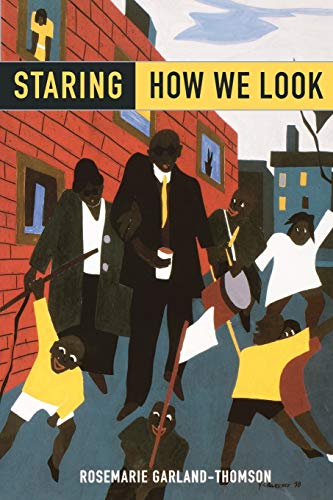

Staring how we look Rosemarie Garland-Thomson.
Detalles de publicación: Oxford New York Oxford University Press 2009.Descripción: x, 244 p. ill. 24 cmISBN:- 9780195326802 (pbk. : alk. paper)
- 0195326806 (pbk. : alk. paper)
- 302.54 T4821s 22
- B846 .T46 2009
| Imagen de cubierta | Tipo de ítem | Biblioteca actual | Biblioteca de origen | Colección | Ubicación en estantería | Signatura topográfica | Materiales especificados | Info Vol | URL | Copia número | Estado | Notas | Fecha de vencimiento | Código de barras | Reserva de ítems | Prioridad de la cola de reserva de ejemplar | Reservas para cursos | |
|---|---|---|---|---|---|---|---|---|---|---|---|---|---|---|---|---|---|---|
| Libro | Biblioteca Encarnación Valdés Colección General bev | 302.54 T4821s (Navegar estantería(Abre debajo)) | Disponible | 80000002397522 |
Descripciones mejoradas de Syndetics:
From a very young age we are told not to stare, and one hallmark of maturation is the ability to resist (or at least hide) our staring behavior. And yet, rarely do we master the impulse. Despite the complicated role it plays in our development, and its unique brand of visual enticement, staring has not been considered before as a suitable object for socio-cultural analysis. What is it about certain kinds of people that makes it impossible to take our eyes off them? Why are some visual stimuli irresistible? Why does staring produce so much anxiety? Drawing on examples from art, media, fashion, history and memoir, Garland-Thomson defines staring, explores the factors that motivate it, and considers the targets and the effects of the stare. A bodily inventory then enumerates how stares actually operate in daily life. A section on "Bodies" focuses on the question of size and scale as key indicators of normalcy, while certain body parts show themselves to be disproportionately arresting, as passages on "Faces" "Hands" and "Breasts" reveal. A concluding chapter on "Beholding" considers the frisson at play between starer and staree and offers an alternative way of understanding visual communication between people. Featuring over forty illustrations, Staring captures the stimulating combination of symbolic, material and emotional factors that make staring so irresistible while endeavoring to shift the usual response to staring, shame, into an engaged self-consideration. Elegant and provocative, this book advances new ways of thinking about visuality and the body that will appeal to readers who are interested in the overlap between the humanities and human behaviors.
Includes bibliographical references (p. 215-232) and index.
Tabla de contenidos provista por Syndetics
- Part 1 About Staring
- 1 Why Do We Stare?
- Part 2 What Is Staring?
- 2 Staring: A Physical Response
- 3 Staring: A Cultural History
- 4 Staring: A Social Relationship
- 5 Staring: Knowledge Gathering
- Part 3 Don't Stare
- 6 Staring: Getting into Trouble
- 7 Staring: Bad Manners
- 8 Staring: Rules and Rebellion
- Part 4 Starers and Starees
- 9 Looking Away, Staring Back
- Part 5 Scenes of Staring
- 10 Staring at Faces
- 11 Staring at Hands
- 12 Staring at Bodies
- 13 Staring at Breasts
- 14 Beholding