Contents :
Introduction : Anarchy and order xi --
One : The girl from Scranton 3 --
Two : The master builder 31 --
Three : The battle of Washington Square Park 61 --
Four : Urban renewal in Greenwich village 95 --
Five : The lower Manhattan expressway 137 --
Epilogue : separate ways 181 --
Acknowledgments 197 --
Notes 201 --
Index 215 --
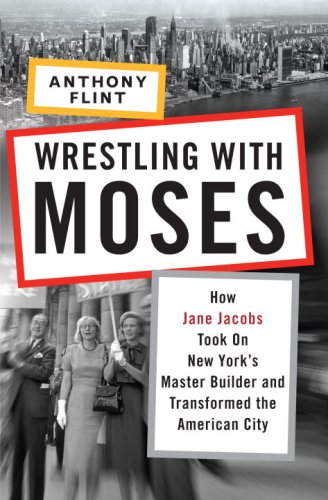
The David-and-Goliath story of legendary activist Jane Jacobs' clash with "power broker" Robert Moses, an urban planning battle that forever changed the way we look at cities. In 1968, journalist, activist, and writer Jane Jacobs ripped up a stenographer's notes during a public hearing and was charged with inciting a riot. The hearing concerned the proposed Lower Manhattan Expressway, a 350-foot wide, fifty-foot-high viaduct that would have linked the East and West sides of Manhattan. The expressway was the final puzzle piece in urban planning giant Robert Moses' vision of a New York City designed to accommodate traffic. But to Jacobs, it was a destructive force that would bruise vital neighborhoods and push out nearly 2,000 families and 800 businesses. The battle between Jacobs and Moses had begun years earlier when Jacobs successfully thwarted Moses' plan to direct traffic through Washington Square Park in the West Village. As a result of these battles, Moses would lose most of the power and influence he had wielded for so long. By successfully confronting Moses, Jacobs forever changed the way Americans viewed the city--as a living, breathing organism rather than a threat that needed to be controlled--and inspired citizens across the country to protest destructive urban "renewal" projects. Wrestling with Moses is a tale of a local battle with national significance, that reminds us of the power of the individual to confront and defy authority.
Includes bibliographical references and index.
Contents :
Introduction : Anarchy and order xi --
One : The girl from Scranton 3 --
Two : The master builder 31 --
Three : The battle of Washington Square Park 61 --
Four : Urban renewal in Greenwich village 95 --
Five : The lower Manhattan expressway 137 --
Epilogue : separate ways 181 --
Acknowledgments 197 --
Notes 201 --
Index 215 --
Extracto provisto por Syndetics
Chapter One The Girl from Scranton As the rattling subway train slowed to a stop, Jane Butzner looked up to see the name of the station, its colorful lettering standing out against the white-tile station walls as it flashed by again and again, finally readable: Christopher Street/Sheridan Square. As the doors opened, she watched as a crowd poured out, moving past pretty mosaics to the exit. She had moved to New York from her hometown of Scranton, Pennsylvania, and had joined her sister, Betty, in a small apartment in Brooklyn a few months before. She was hunting for a job, but the morning's interview had concluded swiftly, so she'd decided to explore her new city. She darted out before the doors slid shut and made her way through the turnstile and up a set of stairs to the street. Without knowing it, Jane had alighted in the heart of Greenwich Village, the place she would call home for decades to come. As she emerged, she immediately noticed that the streets ran off at odd angles in all directions. She saw storefronts with awnings shading cluttered sidewalks, kids chasing one another in front of a grocery, delivery trucks stopping and starting their way up the street. Walking north on Seventh Avenue, she saw the skyscrapers of midtown in the distance and, when she turned around, the cluster of tall buildings in the financial district to the south. But in this spot most buildings were two or three stories, and few were higher than five or six. They were simple: no grand entrances, no soaring edifices. She gazed at shopwindows full of leather handbags and watches and jewelry, strolled past barbershops and cafés, and ran her fingers over the daily newspapers stacked high in front of shelves inside filled with candy and cigars. Everywhere she looked she saw people-people talking to one another, it seemed, every few feet, among them longshoremen headed to taverns at the end of their shifts, casually dressed women window-shopping, old men with hands clasped on canes sitting on the benches in a triangular park. Mothers sat on stoops watching over it all. Everyone looked, she thought, the way she felt: unpretentious, genuine, living their lives. This was home. Arriving at her Brooklyn apartment that evening, Jane described the wonders of the neighborhood she had seen, concluding simply, "Betty, I found out where we have to live." "Where is it?" Betty asked. "I don't know, but you get in the subway and you get out at a place called Christopher Street." Jane had moved to New York City in 1934. Armed with a high-school diploma, a recently acquired knowledge of shorthand, and the wisdom of a few months working in the newsroom of a Scranton newspaper, she hoped to break into journalism. She knew it wasn't going to be easy to succeed in a business dominated by men; her assignments in Scranton had been limited to covering weddings, social events, and the meetings of women's civic organizations with names like the Women of the Moose and the Ladies' Nest of Owls No. 3. It was the thick of the Great Depression, and any job was difficult to come by. Her older sister, Betty, twenty-four, had warned her. Betty had come to New York a few years before with hopes of finding work as an interior designer, but was now grateful to have a job as a salesgirl in the home furnishings section of the Abraham & Straus department store. The headstrong Jane came to the big city anyway, joining her sister in the top floor of a six-floor walk-up in Brooklyn Heights, a neighborhood of Greek and Gothic Revival mansions and Italianate brownstones at the edge of the East River, overlooking Manhattan. Within weeks of arriving, Jane realized that breaking into journalism was going to take time and that, in the meantime, she'd need to support herself. She began poring over employment agency listings looking for any clerical position she could find, and s Excerpted from Wrestling with Moses: How Jane Jacobs Took on New York's Master Builder and Transformed the American City by Anthony Flint All rights reserved by the original copyright owners. Excerpts are provided for display purposes only and may not be reproduced, reprinted or distributed without the written permission of the publisher.
Reseñas proporcionadas por Syndetics
Library Journal Review
Flint (Lincoln Inst. of Land Policy; This Land: The Battle over Sprawl and the Future of America) writes about the battle between Robert Moses, New York's master urban planner of the 1920s-60s, and urban renewal activist Jane Jacobs. While covering the careers of both Moses and Jacobs, Flint focuses on two events: Moses's plans to extend Fifth Avenue through Washington Square Park (1950s) and to build a massive Manhattan highway, the Lower Manhattan Expressway (early 1960s). Jacobs (The Death and Life of Great American Cities) believed that neighborhood character-its people and buildings-must be preserved. She and other West Village activists used political smarts (e.g., strategic media coverage, having children canvass for petition signatures) to outmaneuver Moses, the powerful government official. The book concludes with current examples-such as how cities are now improving mass transit instead of building more highways-to show how Jacobs's legacy and ideas have held up over time. The jury is still out on Robert Moses's legacy, dealt a hard blow by Robert Caro's The Power Broker: Robert Moses and the Fall of New York. Verdict Recommended for readers interested in urban planning, preservation, or architectural history.-Leigh Mihlrad, Albany Medical Coll., NY (c) Copyright 2010. Library Journals LLC, a wholly owned subsidiary of Media Source, Inc. No redistribution permitted.
Publishers Weekly Review
Former Boston Globe reporter Flint recounts how activist and writer Jane Jacobs stopped the seemingly unstoppable master builder Robert Moses. Beginning in the 1930s, Moses consolidated his enormous power through the administrations of various mayors and governors, revamping the city parks network and constructing a mind-boggling array of projects including bridges, highways, Shea Stadium, Lincoln Center and 10 giant public swimming pools. Although highly skilled at crushing opponents, Moses was eventually outmaneuvered in the 1950s and '60s by Jacobs, whose landmark The Death and Life of Great American Cities was a war cry against urban renewal projects that destroyed existing neighborhoods. Jacobs derailed Moses's plans to run two highways through lower Manhattan (one in what would become trendy SoHo). But, says Flint (This Land: The Battle Over Sprawl and the Future of America), who is now at the Lincoln Institute of Land Policy, Moses's tarnished reputation has been undergoing rehabilitation recently as cities realize the value of reliable infrastructure. Lucid and articulate, Flint's account will appeal more to urban planners, policy wonks and community organizers than the general reader. Photos. (July 28) (c) Copyright PWxyz, LLC. All rights reserved
Booklist Review
In the 1950s, Jane Jacobs, lover of the dynamics of city neighborhoods, was a writer for Architectural Forum, challenging the conventions of architects and planners inspired by Le Corbusier and supported by federal urban-renewal programs. When the mercurial master builder Robert Moses planned a roadway through famous Washington Square Park, where Jacobs brought her children to play, she butted heads with the most powerful man in the city. Moses, who built the Lincoln Center and numerous bridges, was a man whose plans and visions had gone unchallenged by mayors, governors, and presidents. Sitting on numerous commissions, Moses wrote the regulations affecting urban planning in New York. But Jacobs fought plans by Moses and others that threatened vibrant Greenwich Village and other communities, forging coalitions and devising strategies that eventually lead to neighborhood-based nonprofit development corporations. She wrote The Death and Life of Great American Cities, which came to be a major resource for community activists. Reporter Flint offers a fascinating history of the two combatants as well as an architectural history of New York City.--Bush, Vanessa Copyright 2009 Booklist
Notas de autor provistas por Syndetics
Anthony Flint is the director of public affairs at the Lincoln Institute of Land Policy, a think-tank on land and development issues located in Cambridge, MA, and was a reporter at The Boston Globe for sixteen years. He is the author of This Land: The Battle Over Sprawl and the Future of America . He lives in Boston.
Wrestling with Moses :
APA
Flint A., . (2009). Wrestling with Moses: how Jane Jacobs took on New York's master builder and transformed the American city. United States: Random.
Chicago
Flint Anthony, . 2009. Wrestling with Moses: how Jane Jacobs took on New York's master builder and transformed the American city. United States: Random.
Harvard
Flint A., . (2009). Wrestling with Moses: how Jane Jacobs took on New York's master builder and transformed the American city. United States: Random.
MLA
Flint Anthony, . Wrestling with Moses: how Jane Jacobs took on New York's master builder and transformed the American city. United States: Random. 2009.