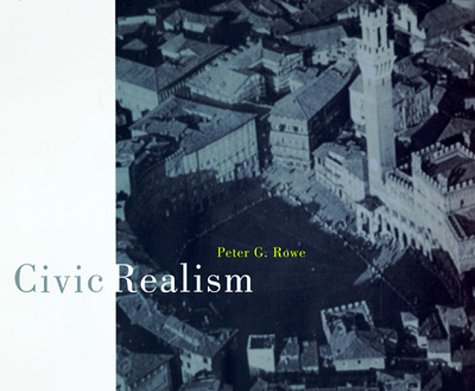

Civic realism / Peter G. Rowe. txt
Cambridge, Mass. : MIT Press, 1997Descripción: 255 p. ill. 23 cmTipo de contenido:- text
- unmediaded
- volume
- 0262181800
- 9780262681056
- 711/.4 21
- NA9053.S6 R69 1997
| Imagen de cubierta | Tipo de ítem | Biblioteca actual | Biblioteca de origen | Colección | Ubicación en estantería | Signatura topográfica | Materiales especificados | Info Vol | URL | Copia número | Estado | Notas | Fecha de vencimiento | Código de barras | Reserva de ítems | Prioridad de la cola de reserva de ejemplar | Reservas para cursos | |
|---|---|---|---|---|---|---|---|---|---|---|---|---|---|---|---|---|---|---|
| Libro | CARIBET Biblioteca Arquitectura Colección General CARIBET | General NA9053.S6 R69 1997 (Navegar estantería(Abre debajo)) | 1 | Disponible | 91000000002402 |
Descripciones mejoradas de Syndetics:
Examines the shape and appearance of civic places, and at the social, political, and cultural circumstances that bring them into existance. The book considers the role of the state and civil society in the construction of civil places and individual and collective uses of urban space.
Includes bibliographical references (p. 230-[242]) and index.
"A civic place belongs to everyone and yet to nobody in particular. In Civic Realism, Peter G. Rowe looks at the shape and appearance of civic places, and at the social, political, and cultural circumstances that bring them into existence. The book is as much about the making and reshaping of civic places as it is about urban architecture per se. According to Rowe, the best civic place-making occurs across the divide between the state and civil society." "Topics covered in the book include the role of the state and civil society in the construction of civic spaces, aesthetic and architectural dimensions of realism, individual and collective uses of urban space, and how civic places constitute as well as represent the civic aspects of our lives. The examples, mostly from the modern period, include recent public spaces in Barcelona, several of the Grand Projects in Paris, neorealist projects in postwar Rome, contemporary transformations of the Manhattan grid, and Plecnik's water axis in prewar Ljubljana."--Jacket.