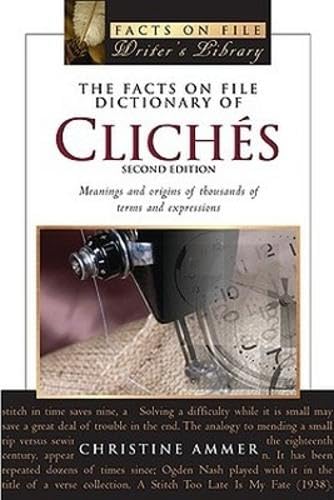
Imagen de portada de Amazon
Imagen de Amazon.com
Imagen de cubierta Syndetics
Portada de Syndetics
Imagen de OpenLibrary

The Facts on File dictionary of clichés Christine Ammer.

Por: Series Facts on File library of language and literatureDetalles de publicación: New York, NY Facts on File c2006.Edición: 2nd edDescripción: x, 534 p. 24 cmISBN:
  • 0816062803 (pbk. : acid-free paper)
  • 9780816062805 (pbk. : acid-free paper)
Otro título:
  • Dictionary of cliches
Tema(s): Clasificación CDD:
  • 423.1 A518f2 22
Clasificación LoC:
  • PE1689 .A48 2006
Valoración
    Valoración media: 0.0 (0 votos)
Existencias
Imagen de cubierta Tipo de ítem Biblioteca actual Biblioteca de origen Colección Ubicación en estantería Signatura topográfica Materiales especificados Info Vol URL Copia número Estado Notas Fecha de vencimiento Código de barras Reserva de ítems Prioridad de la cola de reserva de ejemplar Reservas para cursos
Referencia Biblioteca Encarnación Valdés Sala de Referencia bev 423.1 A518f2 (Navegar estantería(Abre debajo)) Disponible 80000002402652
Total de reservas: 0

Descripciones mejoradas de Syndetics:

This updated and expanded edition of a popular title explains the meanings and origins of almost 4,000 cliches and common expressions. Each entry in The Facts On File Dictionary of Cliches, Second Edition includes the meaning of the cliche or expression, its origin and early uses, the historical development of the phrase, and its present-day usage. For this second edition, the author has added hundreds of new cliches, including many from the business world, such as drum up, fork over, and go belly-up; from the military, such as the balloon goes up, body count, and mickey mouse; and from popular novels, especially mysteries and thrillers. Other new cliches include bells and whistles, yada yada yada, and whatever. The Facts On File Dictionary of Cliches, Second Edition is the largest, most comprehensive, and most entertaining reference of its kind. Fully indexed and cross-referenced, this essential resource will prove invaluable for students, writers, and general readers.

Includes index.

Extracto provisto por Syndetics

The definitive reference for clichés--now updated!Praise for the hardcover edition:...an excellent resource for word lovers...inherently fascinating...--Library JournalThis updated and expanded edition of a popular title explains the meanings and origins of almost 4,000 clichés and common expressions. Each entry in The Facts On File Dictionary of Clichés, Second Edition includes the meaning of the cliché or expression, its origin and early uses, the historical development of the phrase, and its present-day usage.For this second edition, the author has added hundreds of new clichés, including many from the business world, such as "drum up," "fork over," and "go belly-up; from the military, such as "the balloon goes up," "body count," and "mickey mouse" and from popular novels, especially mysteries and thrillers. Other new clichés include bells and whistles, yada yada yada, and whatever.The Facts On File Dictionary of Clichés, Second Edition is the largest, most comprehensive, and most entertaining reference of its kind. Fully indexed and cross-referenced, this essential resource will prove invaluable for students, writers, and general readers. Excerpted from The Facts on File Dictionary of Cliches: Meanings and Origins of Thousands of Terms and Expressions by Christine Ammer All rights reserved by the original copyright owners. Excerpts are provided for display purposes only and may not be reproduced, reprinted or distributed without the written permission of the publisher.

Reseñas proporcionadas por Syndetics

Library Journal Review

Clich?s often enliven our writing and speech and give us food for thought. So a dictionary of such phrases is an excellent resource for word lovers. Each of the approximately 4000 A-to-Z entries in this updated and expanded second edition by Ammer (The American Heritage Dictionary of Idioms) ranges from 30 to 200 words and contains a bit of etymology and information about usage. For example, readers learn that the true phrase behind the clich? "the proof is in the pudding" is actually "the proof of the pudding is in the eating," an expression particularly used in Britain, where "pudding is more of a basic dish than it is to Americans." Among the hundreds of new clich?s in this volume are "drum up," "body count," and "yada yada yada." The index and cross references help readers find phrases that may begin a bit differently than expected. Ideally, there would be a greater number of cross references, leading readers to synonymous turns of phrase, and the index entries would apply to individual words, not just phrases. What if, e.g., a reader were only able vaguely to recall something about something in the pudding? Bottom Line Despite the small imperfections, the book is inherently fascinating and an excellent place to look for old chestnuts galore. Of the few similar books this reviewer has seen, Ammer's is more up to date and authoritative, in part because of the Facts On File name. Public libraries wanting a book specifically on clich?s (not just proverbs or sayings) should purchase; those already owning the first edition might pass, especially where budgets are tight. Manya Chylinksi, Boston (c) Copyright 2010. Library Journals LLC, a wholly owned subsidiary of Media Source, Inc. No redistribution permitted.

Booklist Review

Christine Ammer acknowledges in the preface to this second edition of her dictionary of cliches that it may seem oxymoronic for her to speak of updating a dictionary of cliches by adding new cliches. But of course every cliche is new at some blurry point along a time line, just as others gradually fall out of favor. Thus, as a linguist whose concern is current usage, Ammer has not only added new ones (new in the sense of having recently become established as cliches) but she has culled and discarded many older cliches--such as alas and alack and blot one's copybook --that appeared in the first edition but that are rarely seen or heard nowadays. Taking the long view of the historian, Ammer regards a collection such as hers as giving form to the particularity of an era's attitude. A pointed example is drawn from the testimony of a young soldier pressed by her comrades to participate in harassment of prisoners at Abu Ghraib prison in Iraq. Her response, when agreeing to join in, was OK. Whatever. This example, along with several others, appears in the entry for whatever, which Ammer says is one of the most recent additions to clichedom, noting, too, that it is used very loosely. Her own definition--in any case; anything goes; as you wish --is certainly adequate, though it hardly accounts for the word being sometimes irksome, and even incendiary, as well as nonchalant. In this connection, she adduces the actor Russell Crowe's assault on a hotel clerk who uttered the word with a greater measure of disrespect than Crowe thought appropriate. (It's an absolute delight to find such matters brought up in discussing meaning and usage.) The thoroughness of this entry is typical of the whole, and the same thoroughness may be found in the indexing, which permits both phrasal and keyword searches. Recommended for all libraries wanting to keep their collection of English-language resources current. --Harold Cordry Copyright 2006 Booklist
Compartir
logopucpr-y-vive

Contáctanos

¡Queremos saber de ti!

Tel. 787.841.2000 Ext. 1801

bibliotecavaldes@pucpr.edu

⁣Búscanos en las redes

© 2026 Desarrollado por Ignite Online • All Rights Reserved • Powered by Koha.