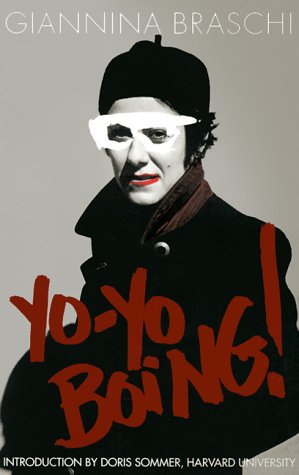
This iconic Spanglish novel by the leading Hispanic-American poet Giannina Braschi was heralded by the New York Daily News as "an in your face assertion of the vitality of Latino culture in the U.S." Jean Franco of Columbia University praised Braschi for her "extraordinary virtuosity, her command of many different registers, her dizzying ability to switch between English and Spanish. It is also a very funny novel, a novel of argumentative conversations that cover food, movies, literature, art, the academy, sex, memory, and every day life. It is a book that should be performed as well as read.
Reseñas proporcionadas por Syndetics
Library Journal Review
Though touted as a novel, this is more of a hybrid, both linguistically and structurally. It opens with a ten-page monolog in Spanish called "Close-Up," related by a woman assessing her physical, emotional, and intellectual features. The second section, "Blow-Up," centers on a conversationhalf Spanish, half Englishalso narcissistic but at times focused outward, in which the speakers make emotional, intellectual, and artistic judgments about themselves and others. In the final short section, "Black-Out," a woman named Giannina, presumably the author, returns to a Spanish monolog. Braschi writes beautiful, malleable Spanish, playing with word forms in a musical, rhythmic waysome passages are a tour de forcebut she is not as sure-footed in English. Though the long central dialog can be tiring, the book is often exciting, as much a performance piece as a novel, reflecting the way language is actually used. Purchase for literary, Latino, and feminist collections.Harold Augenbraum, Mercantile Lib., New York (c) Copyright 2010. Library Journals LLC, a wholly owned subsidiary of Media Source, Inc. No redistribution permitted.
Publishers Weekly Review
Writing in an elevated version of the "code-switching" half-Spanish, half English that is the daily language of many U.S.-born Latinos, Braschi's (Empire of Dreams) novel is at once a literary liberation and a frustrating challenge. Dispensing with a traditional story line, the work takes the form of an exuberant discussion involving an indeterminate number of speakers. Confusingly, these interlocutors are indicated only by a dash, not by name, while they yo-yo between languages and from subject to subject: writers, films, sex, childhood, family and, ultimately, Puerto Rican artistic expression in New York City. Allusions come helter-skelter, as Fellini, Pee-Wee Herman, Nabokov and even Columbia University Latin Americanist Jean Franco are invoked, celebrated and derided. The character who declares "Pero no me vas a tumbar al suelo [you're not going to knock me to the ground] after you've given me wings" expresses the conversation's conflicted mood and overarching defiant pride. Braschi's melange of prose and poetry, English and Spanish, is admirable for its energy, its experimental format and its insistence on Spanglish as a literary language, but those very qualities will render it of interest only to the most literary-minded of bilingualists. (Sept.) (c) Copyright PWxyz, LLC. All rights reserved
Notas de autor provistas por Syndetics
Widely considered one of the most innovative voices in Hispanic-American literature, Giannina Braschi's classic titles include the postmodern poetry trilogy Empire of Dreams, the violent and funny Spanglish classic novel Yo-Yo Boing!, and the politically charged humorous work of dramatic fiction United States of Banana. She writes in Spanish, Spanglish, and English to capture the American immigrant's cultural experience and to explore the political options of her native Puerto Rico: colony, state, or nation. During her teen years in San Juan, Giannina Braschi was Puerto Rico's women's tennis champion, a singer, and a fashion model. She later discovered poetry as her calling and acquired a Ph.D. in the Spanish Golden Age from the State University of New York-Stony Brook. She has taught Rutgers University, City University of New York, and Colgate University where she served as National Endowment Distinguished Chair and Writer-in-Residence. She has published a book on the Spanish Romantic poet B#65533;cquer and essays on classics by Cervantes, Garcilaso, Lorca, Machado, and Vallejo. She has won grants and awards from the National Endowment for the Arts, New York Foundation for the Arts, El Diario/La Prensa, PEN American Center, Ford Foundation, Danforth Scholarship, InterAmericas, Instituto de Cultura Puertorrique#65533;a, and Reed Foundation. She lives in New York.