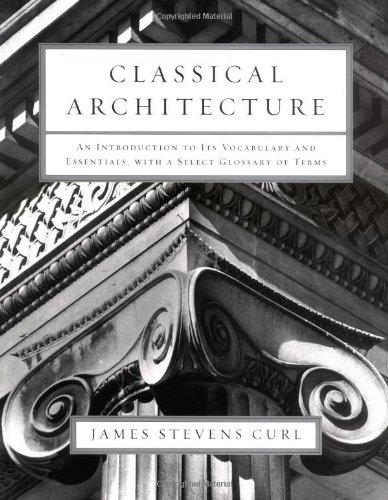

Classical architecture : an introduction to its vocabulary and essentials, with a select glossary of terms / James Stevens Curl. txt
New York ; London : W. W. Norton & Company , 2003Edición: 2nd edDescripción: 231 p. ill. 28 cmTipo de contenido:- text
- unmediaded
- volume
- 9780393731194
- 720/.9 21
- NA260 C87 2003
| Imagen de cubierta | Tipo de ítem | Biblioteca actual | Biblioteca de origen | Colección | Ubicación en estantería | Signatura topográfica | Materiales especificados | Info Vol | URL | Copia número | Estado | Notas | Fecha de vencimiento | Código de barras | Reserva de ítems | Prioridad de la cola de reserva de ejemplar | Reservas para cursos | |
|---|---|---|---|---|---|---|---|---|---|---|---|---|---|---|---|---|---|---|
| Libro | CARIBET Biblioteca Arquitectura Colección General CARIBET | General NA260 C87 2003 (Navegar estantería(Abre debajo)) | 1 | Disponible | 91000000000208 |
Descripciones mejoradas de Syndetics:
This well-illustrated book describes the fundamental principles and various aspects of classical architecture, including a detailed, illustrated glossary that is almost a dictionary of classical architecture in itself.
Professor James Stevens Curl discusses in clear, straightforward language the origins of classical architecture in Greek and Roman antiquity and outlines its continuous development, through its various manifestations during the Renaissance, its transformations in Baroque and Rococo phases, its reemergence in eighteenth-, nineteenth-, and twentieth-century Neoclassicism, and its survival into the modern era. The text and illustrations celebrate the richness of the classical architectural vocabulary, grammar, and language, and demonstrate the enormous range of themes and motifs found in the subject.
All those who wish to look at buildings old and new with an informed eye will find in this book a rich fund of material, and the basis for an understanding of a fecund source of architectural design that has been at the heart of western culture for over two and a half millennia.
"1st American pbk. ed."--T.p. verso.
First published in 1992; 2nd ed. originally published in London by B.T. Batsford.
Includes bibliographical references (p. 223-225) and index.
Tabla de contenidos provista por Syndetics
- Illustration Sources(p. 6)
- Preface to the Second Edition(p. 7)
- Preface to the First Edition(p. 9)
- I Introduction(p. 11)
- What is Classical Architecture?
- A few definitions
- II The Orders of Architecture and Their Application(p. 15)
- Introduction
- The Greek Orders
- The Greek Doric Order
- The Greek Ionic Order
- The Greek Corinthian Order
- The Roman Orders
- The Tuscan Order
- The Roman Doric Order
- The Roman Ionic Order
- The Roman Corinthian Order
- The Roman Composite Order
- Application of the Orders
- III The Graeco-Roman Roots of Classical Architecture(p. 55)
- The main sources of Classicism: Greek Architecture
- Roman Architecture
- Concluding comparative remarks
- IV The Renaissance Period(p. 65)
- Columns, pilasters, antae, and piers
- Key buildings of the Early Renaissance
- Later Palazzi
- Venetian Palazzi, Sansovino, and Alberti
- Centralized and circular plans
- Michelangelo
- Serlio and Vignola
- Palladio
- V Baroque, Rococo, and Palladianism(p. 105)
- Introduction
- Bernini, Borromini, ellipses, and western facades
- Some French examples
- Classical Architecture in England
- Some German buildings
- Palladianism
- VI Neoclassicism and After(p. 145)
- Neoclassicism and Rome
- Cordemoy and Laugier
- The rediscovery of Greece
- The Greek Revivai
- The move away from Neoclassicism
- VII Epilogue(p. 169)
- Glossary(p. 171)
- Select Bibliography(p. 223)
- Index(p. 226)